What it is
Cladrastis kentukea, the American yellowwood, a medium-sized deciduous tree of the southeastern United States, and a member of the legume family — kin to the black locust, laburnum, and the other pea-flowered trees.
It is one of the rarest trees in the eastern North American forest, found naturally only in scattered, isolated pockets, mostly on limestone bluffs and slopes — never common anywhere, and easily overlooked in the wild — yet it makes such a fine ornamental that it is planted far more widely in gardens and streets than it grows in nature.
Chains of fragrant flowers
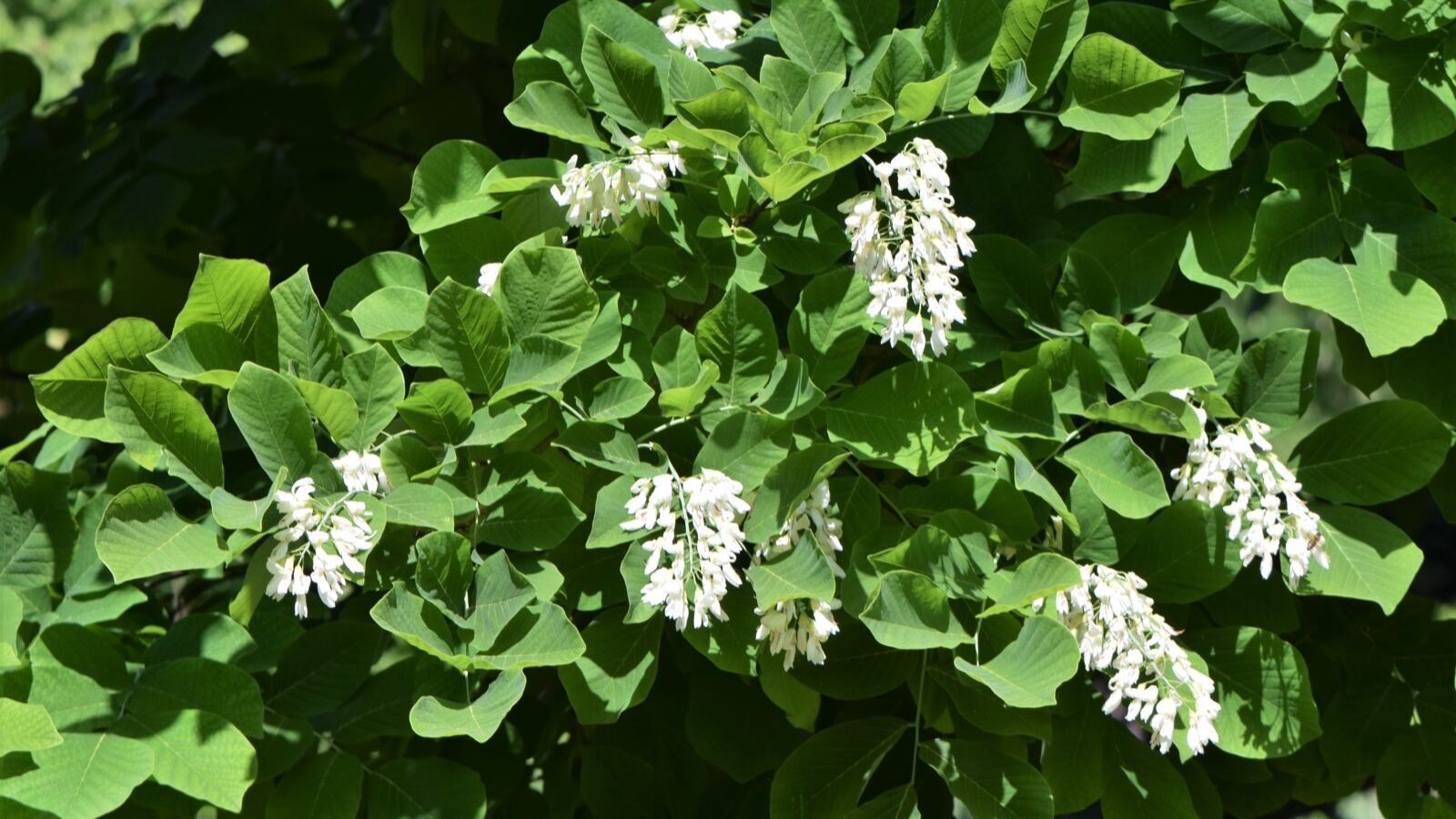
The yellowwood's glory is its flowering. In early summer it hangs out long, drooping, wisteria-like chains of pure white, fragrant, pea-shaped flowers — foot-long panicles that cover the tree in a soft white cascade and scent the air. It is one of the most beautiful of all flowering native trees when in full bloom.
The catch is that it flowers irregularly — heavily one year, sparsely or not at all for a year or two after, the alternate-bearing habit seen in many trees — so a yellowwood's great flowering years are events to be enjoyed when they come. Pink-flowered forms exist. The flowers are excellent for pollinators and native bees, and being a legume the tree may fix a little nitrogen, though it is not a strong fixer like the black locust.
Out of flower the tree is still handsome: bright green compound leaves that turn a clear golden-yellow in autumn, and — notably — smooth grey bark very like a beech's, unusual and attractive on a legume.
The yellow wood
The tree's name comes from its heartwood, which is a clear, bright yellow when freshly cut (ageing to brown). This yellow wood yielded a yellow dye used by early settlers, and the fine, hard, stable timber — though never available in quantity, given the tree's rarity — was prized for gunstocks and decorative turning. The dye and the colour are the tree's small economic footnote; its rarity meant it was never a timber of commerce, unlike its relatives.
The weak crotch
One practical feature every grower should know: yellowwood tends to branch into tight, narrow, upright forks low on the trunk, and these narrow crotches, with bark pinched between them, are structurally weak and prone to splitting in storms and under the weight of a heavy flowering year — the same included-bark weakness that troubles some maples and ornamental pears.
The remedy is early formative pruning: train the young tree to a strong framework with wide-angled branches, and prune it — importantly — in summer, not winter, because yellowwood (like birch and maple) "bleeds" sap heavily from winter cuts. Get the structure right when young and it makes a sound, long-lived tree; neglect it and it may split apart in middle age.
Growing it
Adaptable and tough despite its wild rarity. Yellowwood tolerates a range of soils including clay and — reflecting its limestone-bluff origins — alkaline ground, which many ornamental trees dislike, and it stands heat, drought once established, and urban conditions reasonably well, making it a good, distinctive street and garden tree. It wants full sun for best flowering and a well-drained site. See urban forestry.
It is slow to moderate, medium-sized (10 to 15 m), long-lived, and largely free of serious pests and diseases. Grown from seed (scarified, like other legumes) and from root cuttings. Prune in summer, train early, and enjoy the great flowering years when they come. See propagation.
See also
- Black Locust the fellow flowering legume tree
- Laburnum another tree hung with pea-flower chains
- Beech the tree its smooth grey bark resembles
- Pollinator Habitat the nectar its flower chains provide
- Pruning Basics training out the weak forks, and why to prune in summer
- Honey Locust another ornamental legume for tough sites