What it is
Terminalia catappa, the tropical almond, sea almond, or Indian almond — a large, spreading tree of tropical coasts and lowlands, probably originating around the Indian Ocean and now pantropical, planted and naturalised on warm shorelines around the world.
Despite the name it is not related to the true almond (a stone fruit); it belongs to a wholly different family, and the name comes only from the almond-like flavour of its edible kernel. It is one of the most recognisable trees of the tropical beach, valued for shade, for shoreline protection, and for a surprising range of uses.
The pagoda form
The tropical almond has one of the most distinctive shapes of any tree, and it is worth knowing because it makes the tree unmistakable. It grows in horizontal tiers — the branches radiate out in near-flat whorls at intervals up the trunk, one layer above another, like the storeys of a pagoda or the tiers of a wedding cake.
This tiered, layered architecture (a growth pattern known to botanists as "Aubréville's model") gives young trees an almost geometric, storied silhouette and makes them superb, broad, flat-topped shade trees — which is exactly why they are planted along tropical streets, parks, and beaches everywhere. Beneath one, the deep shade and the tiered canopy are instantly familiar to anyone who has spent time on a warm coast.
Red leaves in the tropics
The tropical almond does something unexpected for a tropical tree: it puts on autumn colour, even at the equator. Although it is broadly evergreen, it sheds its large, leathery, paddle-shaped leaves once or twice a year, and before they fall the leaves turn brilliant red, copper, and yellow — a flush of "autumn" colour in a climate that has no autumn, and a striking sight where most tropical foliage stays relentlessly green.
Those fallen leaves have a well-known second life: they are extremely high in tannins, and are famous in the aquarium world as "Indian almond leaves" or catappa leaves, dropped into fish tanks to release tannins that lower the pH, tint the water, and have genuine mild antibacterial and antifungal effects prized by keepers of bettas, shrimp, and blackwater fish. The bark, leaves, and fruit have long been used similarly in traditional medicine and for tanning and dyeing, all on the strength of that heavy tannin content.
The fruit and the kernel
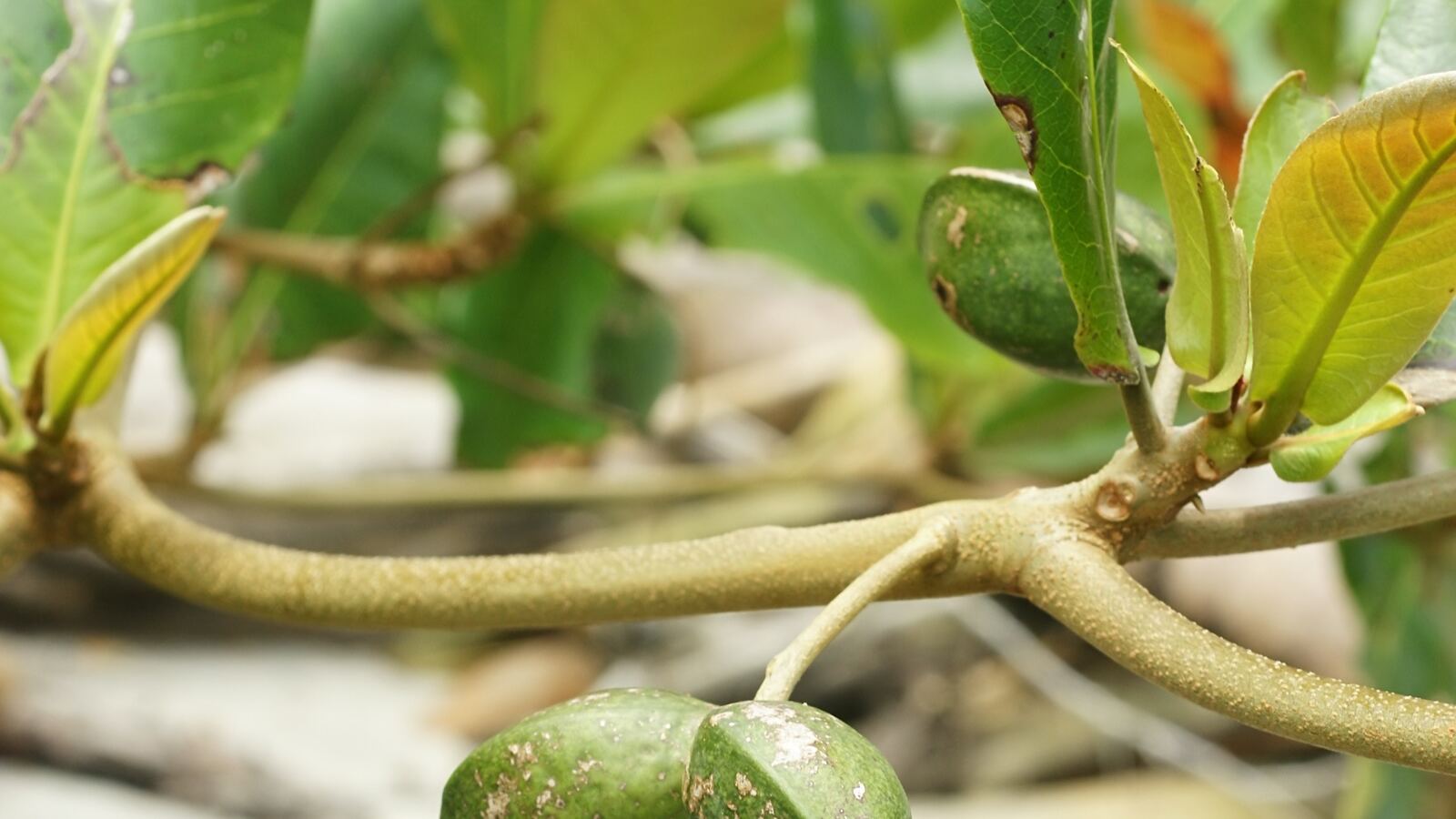
The fruit is a flattened, almond-shaped drupe that ripens red or yellow, with a thin fibrous flesh around a hard, corky, buoyant stone — buoyancy that lets the fruit float on ocean currents and colonise distant beaches, which is how the tree spread naturally across the tropics, the same sea-dispersal as the coconut. Inside the tough stone is a small, oily, edible kernel that tastes of almond — genuinely good, but fiddly to extract from the hard shell, so it is more a nibble and a wild snack than a crop. Fruit bats, birds, and other animals eat the flesh and help disperse the stones.
A coastal workhorse
Like the sea grape and casuarina, the tropical almond is a front-line coastal tree, tolerant of salt spray, salt-laden wind, sandy poor soil, and drought, with roots that help bind shorelines — so it is widely planted for beach shade and shoreline stabilisation, and it provides coastal habitat and food. Its toughness has also made it a mildly invasive tree on some shores outside its native range, the familiar caution for a salt-proof, sea-dispersed tree. See coastal dunes and erosion control.
Growing it
Tropical to warm-subtropical and frost-tender, wanting full sun and tolerant of almost any soil including pure sand, salt, and drought — an easy, fast, tough tree for a warm climate.
It becomes large and wide-spreading, so it needs room, and its heavy leaf-fall (though useful) and dropping fruit make it a slightly messy street tree. Grown very easily from the floating seeds and from cuttings. Beyond shade and shoreline use it yields a hard, reddish, water-resistant timber used for boats and construction, rounding out its long list of uses. See propagation.
See also
- Sea Grape the other classic tropical beach-stabilising tree
- Coconut the fellow sea-dispersed coastal tree
- Casuarina a front-line coastal shelter tree
- Almond the unrelated true almond it borrows its name from
- Coastal Dunes shoreline stabilisation in the tropics
- Erosion Control holding tropical shorelines
- Amla
- Myrobalan
- Screw-Pine
- Kakadu Plum