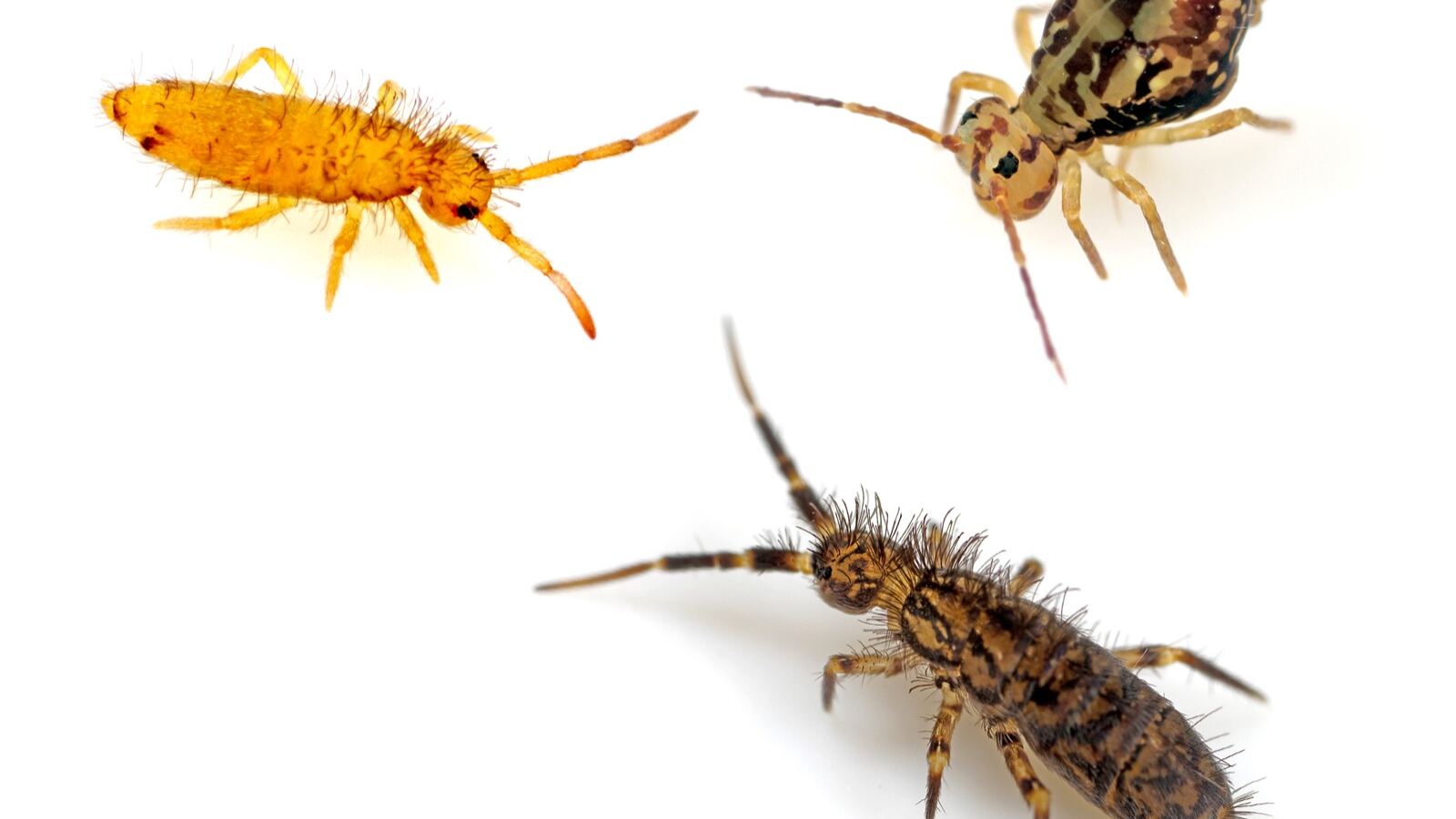
The animals you never see
A square metre of healthy woodland soil holds on the order of 100,000 mites, 100,000 springtails, and several million nematodes, along with protozoa in the tens of millions.
They are largely invisible, collectively they outnumber every other soil animal by orders of magnitude, and they do work that earthworms and decomposers cannot do alone.
This entry covers the middle layer of the soil food web: too small to see, too important to ignore.
Springtails
Collembola. Tiny hexapods, usually under 3 mm, and among the most abundant animals on earth.
Most have a furcula — a forked appendage held under tension beneath the abdomen. Released, it flicks the animal several centimetres into the air, which is the escape mechanism and the origin of the name.
They eat fungal hyphae, bacteria, algae, and decaying plant material, and their role is regulatory as much as decompositional. By grazing fungal networks they keep fungal populations turning over and release nutrients locked in microbial biomass. Grazing also stimulates fungal growth, in the same way that mowing stimulates grass.
They are also serious dispersers of fungal spores, including mycorrhizal spores, moving inoculum through the soil profile. See mycorrhizal fungi and soil inoculation.
Springtail populations are a decent indicator of soil condition — abundant and diverse in undisturbed, organic-rich soil, sharply reduced by tillage, compaction, drought, and pesticide.
Soil mites
Acari, and enormously diverse. Four broad groups matter:
Oribatid mites, the beetle mites, are the most numerous. Slow-moving, heavily armoured, long-lived by soil animal standards, and primarily fungal feeders and litter shredders. They are among the best indicators of soil maturity and stability, because they recolonise disturbed ground very slowly.
Mesostigmatid mites are fast predators, taking nematodes, springtails, and other mites — the top of the microarthropod food chain.
Prostigmatid mites are a mixed group of predators, fungal feeders, and some plant parasites, including the spider mites that damage crops.
Astigmatid mites are opportunists that boom in rich, disturbed, high-nitrogen conditions — including compost heaps and stored grain.
The ratio between these groups is used as a soil quality index: undisturbed soils are dominated by oribatids and predators, disturbed ones by fast-cycling opportunists.
Nematodes
Roundworms, the most numerous multicellular animals on earth. A single teaspoon of soil holds thousands.
They are classified by what they eat, and the composition of the community tells you a great deal about the soil:
Bacterial feeders — the most abundant group, grazing bacteria and excreting ammonium. This is the single largest route by which nitrogen becomes available to plants.
Fungal feeders, doing the same on fungal hyphae.
Predatory nematodes, eating other nematodes and protozoa.
Omnivores, which are sensitive to disturbance and characteristic of stable soils.
Plant parasites — the small minority that cause problems, including potato cyst eelworm and root knot nematode. See crop rotation and potatoes.
Because different feeding groups have different sensitivities to disturbance, the nematode community structure is one of the more informative biological indicators of soil health available, and it is used formally in soil assessment.
The microbial loop
This is the mechanism that makes the whole group matter to a grower, and it is worth stating plainly.
Bacteria and fungi are extremely efficient at taking up nutrients, and they immobilise them — nitrogen and phosphorus locked in microbial cells are not available to plants.
Microbial biomass is also nitrogen-rich relative to the animals that eat it. When a nematode or protozoan consumes bacteria, it takes the carbon it needs and excretes the surplus nitrogen as ammonium, directly into the soil solution, in the rhizosphere where roots are.
So plant-available nitrogen in an unfertilised soil comes very largely from predation on microbes, not from decomposition alone. Estimates commonly attribute a substantial share of nitrogen mineralisation to this grazing route.
That reframes what a fertile soil is: not a store of nutrients, but a functioning food web cycling them. It is the core argument in soil food web, long-term soil care, and no-dig.
Kill the grazers and you interrupt the supply, whatever the total nutrient content of the soil.
What harms them
Tillage. Physically destroys fungal hyphae and mite habitat, exposes animals to predation and desiccation, and collapses pore structure. Oribatid mites in particular take years to recover. See no-dig.
Bare soil. Drying, temperature extremes, and no food supply. See soil cover.
Compaction, which eliminates the pore spaces they live in. See decompaction.
Soluble fertiliser at high rates, which shifts communities toward fast bacterial-feeding opportunists and away from the fungal and predatory groups characteristic of stable soil.
Pesticides and fumigants, obviously, and some fungicides severely.
Drought and waterlogging.
What helps
Organic matter, continuously. Every form of it — compost, leaf mould, mulch, chop and drop. The food supply is the population limit.
Permanent cover and living roots, which feed the rhizosphere directly through root exudates. See cover cropping.
Minimal disturbance.
Diverse plant communities, which produce diverse root exudates and litter and support correspondingly diverse soil communities. See polyculture and structural diversity.
Recovery is slower than people expect. Bacterial and nematode populations rebound within a season; oribatid mites and fungal networks take years. That asymmetry is why soil built over a decade is not the same as soil amended last spring, and why long-term soil care is framed on a decade scale.
Useful nematodes
Not all are pests — several are sold as biological controls, and they work.
Phasmarhabditis hermaphrodita against slugs, Steinernema and Heterorhabditis against vine weevil, chafer grubs, leatherjackets, and codling moth larvae.
They are applied as a soil drench, need moist warm soil to move and infect, and are genuinely effective within those constraints. See slugs and snails and integrated pest management.
See also
- Soil Food Web the whole system these sit inside
- Earthworms the larger engineers
- Decomposers the shredders and rotters
- Mycorrhizal Fungi the networks springtails graze and disperse
- No-Dig Gardening why tillage sets them back years
- Long-Term Soil Care the decade-scale recovery
- Soil-Dwelling Pests