What they do for a grower
A single barn owl family takes something on the order of 3,000 to 5,000 small mammals in a breeding season. Kestrels, tawny owls, and buzzards take comparable quantities across their territories.
That matters practically because voles are a serious problem for young trees. They ring-bark saplings under snow and in long grass through winter, killing them outright, and it is one of the more common and under-diagnosed causes of establishment failure. See voles and gophers and tree planting.
Owls and raptors are the only control operating at the scale of a whole field.
Who hunts what
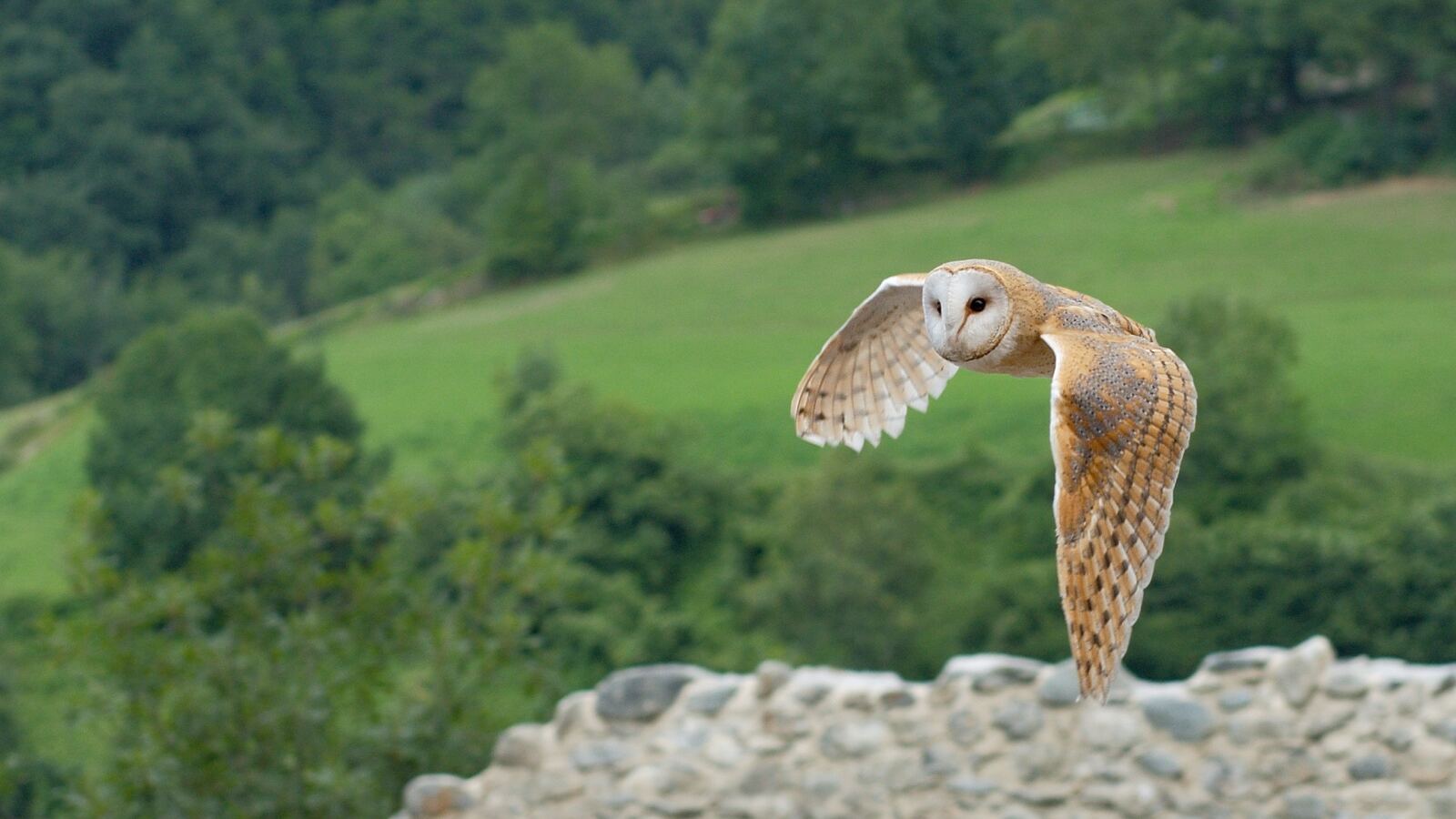
Barn owl. Rough tussocky grassland, hunting on the wing at low level, largely on field voles. Almost entirely dependent on that one habitat — mown or heavily grazed grass supports no voles and therefore no barn owls.
Tawny owl. Woodland and gardens, hunting from a perch. Broader diet: rodents, birds, amphibians, and large insects. The classic hooting owl.
Little owl. Partly diurnal, taking a lot of beetles and earthworms as well as small mammals — genuinely useful in an orchard.
Kestrel. Hovering over open ground, mainly voles. Can see ultraviolet, and vole urine trails fluoresce in UV, so a hovering kestrel is reading scent-marked runways from the air.
Buzzard. Generalist and substantially a scavenger, taking rabbits, voles, worms, and carrion.
Sparrowhawk. Bird-hunting specialist, ambushing along hedgerows and through gardens. The one that causes complaints at bird feeders, and its presence indicates a songbird population large enough to support it.
Rodenticides kill the predator too
This is the single most important thing in this entry.
Second-generation anticoagulant rodenticides — brodifacoum, bromadiolone, difenacoum, flocoumafen — are designed to persist in the body of the rodent so that a single feed is lethal over several days.
During those days the poisoned rodent is slow, disoriented, and easy to catch. Predators eat them preferentially.
The compounds then accumulate in the predator's liver. Monitoring programmes in Britain and elsewhere routinely find anticoagulant residues in the large majority of barn owls, kestrels, red kites, and buzzards tested — commonly 80 percent or more.
The effects range from sublethal impairment of clotting to outright death from haemorrhage, and they compound across a season.
So a rodenticide programme removes the animals that were providing free, continuous, self-scaling rodent control — and the rodents, which breed far faster, recover first. It is the same dynamic as slugs and snails and pellets, with a longer half-life.
If rodent control is genuinely necessary, use snap traps in protected boxes, exclude rodents physically, remove food sources, and if anticoagulants must be used, use first-generation compounds in secure bait stations, never in open trays, and never as a permanent baiting regime.
Nest boxes work
Raptor populations are frequently limited by nest sites rather than by food, because the cavities and ledges they need are in old trees and old buildings, both of which have become scarce.
Barn owls take large boxes readily, in barns or on poles, ideally 3 to 5 m up with a clear flight line, near rough grassland and away from major roads — road mortality is a leading cause of death, and a box beside a fast road is a trap.
Tawny owls use deep vertical boxes on woodland trees.
Kestrels use open-fronted boxes on poles and buildings.
Boxes work spectacularly well where the habitat is right and are pointless where it is not. The habitat comes first.
The habitat that actually matters
Rough tussocky grassland, uncut, is the single most important provision. Field voles need dense grass litter at the base of tussocks, and they are absent from short or heavily grazed swards.
That means margins, corners, beetle banks, and set-aside strips left uncut — the same provisions that support beneficial predators and the grassland invertebrates in grassland restoration.
A 3 to 6 m rough margin around a field is a genuine barn owl foraging habitat. A mown one is not.
Hunting perches. Kestrels, buzzards, and little owls hunt from posts, isolated trees, and hedgerow standards. Adding perch posts to open ground measurably increases raptor activity, and it is used deliberately in some rodent management.
Old trees and standing deadwood for cavity nesters. See dead wood habitat.
Hedgerows as flight lines and cover. See hedgerow care.
Owl pellets
Owls swallow prey whole and regurgitate the indigestible fur and bone as compact pellets, usually at roost sites.
Dissecting them gives a precise record of what has been eaten, since the skulls and jaws are identifiable to species. It is the standard method for surveying small mammal populations, requires no equipment, and is among the more accessible pieces of field ecology anyone can do.
A roost with accumulating pellets is also confirmation that the territory is occupied, which is useful monitoring.
The wider picture
Raptors are top predators, which makes them both indicators and casualties.
They accumulate whatever is in the food chain — the DDT and organochlorine era, which caused eggshell thinning and near-collapse of peregrine and sparrowhawk populations, is the historical case, and the anticoagulant situation above is the current one.
Their recovery following the DDT ban is one of the clearest demonstrations that regulating a persistent pollutant works, and it is worth setting alongside the lichen recovery described in lichens and mosses.
Illegal persecution remains a significant limiting factor for several species, particularly hen harriers and red kites in some regions.
Where they are present and unpoisoned, they provide rodent control that no purchased product matches, at no cost, indefinitely. See predator-prey balance.
See also
- Voles and Gophers the prey, and the damage they do
- Hedgehogs and Small Mammals the wider small mammal picture
- Insectivorous Birds the other half of bird pest control
- Grassland Restoration rough grass as vole habitat
- Dead Wood Habitat cavity nest sites
- Predator-Prey Balance why poisoning backfires
- Owls