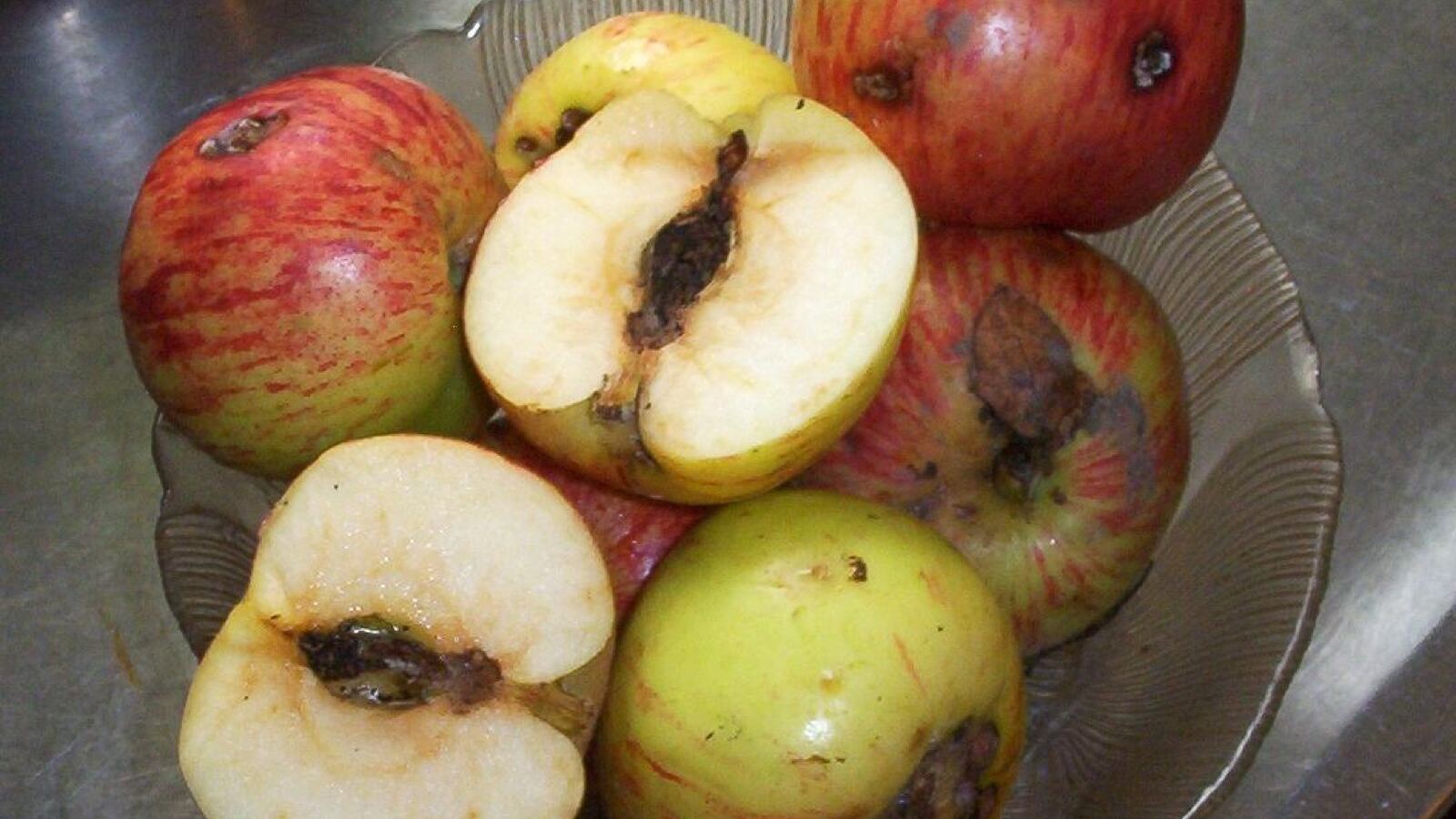
The competition for the crop
An orchard is a concentrated feast, and a specific set of insects has evolved to get to the apples, pears, and stone fruit before you do. Knowing the main culprits — and, crucially, when each is vulnerable — is the whole of orchard pest management, because almost every one of them has a narrow window when a simple, low-toxicity intervention works and outside which nothing does.
The main offenders
Codling moth — the classic "maggot in the apple." A small moth lays eggs on developing apples and pears in early summer; the caterpillar bores into the fruit, tunnels to the core, feeds, and exits, leaving the frass-filled tunnel everyone has bitten into. It is the number-one apple pest worldwide. The key tool is the pheromone trap — a lure baited with the female moth's scent that catches the males — used both to monitor the flight (so any spray or treatment is timed to the moment of egg-hatch) and, in enough numbers, to disrupt mating. Grease bands, sticky traps, and encouraging predators all help.
Apple sawfly — a look-alike of codling moth damage earlier in the season; its larva tunnels just under the skin and then into the core of young fruit, causing early "June drop" of ribboned, scarred fruitlets. Removing and destroying infested dropped fruitlets breaks the cycle.
Winter moth and other caterpillars — the wingless female winter moth crawls up the trunk in late autumn to lay her eggs in the canopy, and the spring caterpillars then defoliate the tree and damage blossom and fruitlets. Because she cannot fly, a grease band (a sticky barrier around the trunk in autumn) physically stops her climbing — one of the neatest, most low-tech controls there is.
Plum moth (and the related pests of stone fruit) — the maggot in the plum, controlled again by pheromone traps and timing.
Pear midge — a tiny fly whose larvae cause young pears to blacken, swell, and drop; sanitation (removing affected fruitlets) is the main control.
Sap-suckers — aphids, scale, and pear/apple suckers — and mites round out the cast, but these are largely handled by the natural enemies below.
The strategy: timing, barriers, and allies
The lesson running through the whole list is that orchard pests are beaten not by spraying on a calendar but by three things:
- Timing and monitoring. Pheromone traps tell you exactly when a pest is flying, so any intervention hits its one vulnerable moment; blanket spraying at the wrong time is useless and harmful.
- Barriers and sanitation. Grease bands stop the crawling moths; picking up and destroying dropped, infested fruit removes the next generation; and this sanitation — clearing fallen fruit and mummies — is one of the most effective and underused controls.
- Encouraging natural enemies. The single biggest control on orchard caterpillars is birds: a family of insectivorous birds in a nest box strips thousands of caterpillars from the trees, and studies show netting birds out sharply increases damage. Add the parasitoid wasps, lacewings, ladybirds, spiders, earwigs, and bats that patrol a diverse orchard, and most of the sap-suckers and many of the caterpillars are dealt with for free. An orchard managed for its predators — nest boxes, a flowering understorey, no broad-spectrum sprays — needs far less intervention than a sterile one.
Put together — a few pheromone traps, grease bands in autumn, diligent removal of dropped fruit, and a orchard full of birds and predators — and the maggot in the apple becomes the rare exception rather than the rule. See tree diseases for the fungal and bacterial problems of fruit, which are managed alongside.
See also
- Apples and Pears and Stone Fruit the crops these pests attack
- Insectivorous Birds the orchard's most effective caterpillar control
- Parasitoid Wasps and Lacewings the natural enemies of the sap-suckers
- Integrated Pest Management monitoring, timing, and traps
- Garden Pests Overview the wider approach to pests
- Tree Diseases the diseases managed alongside the pests