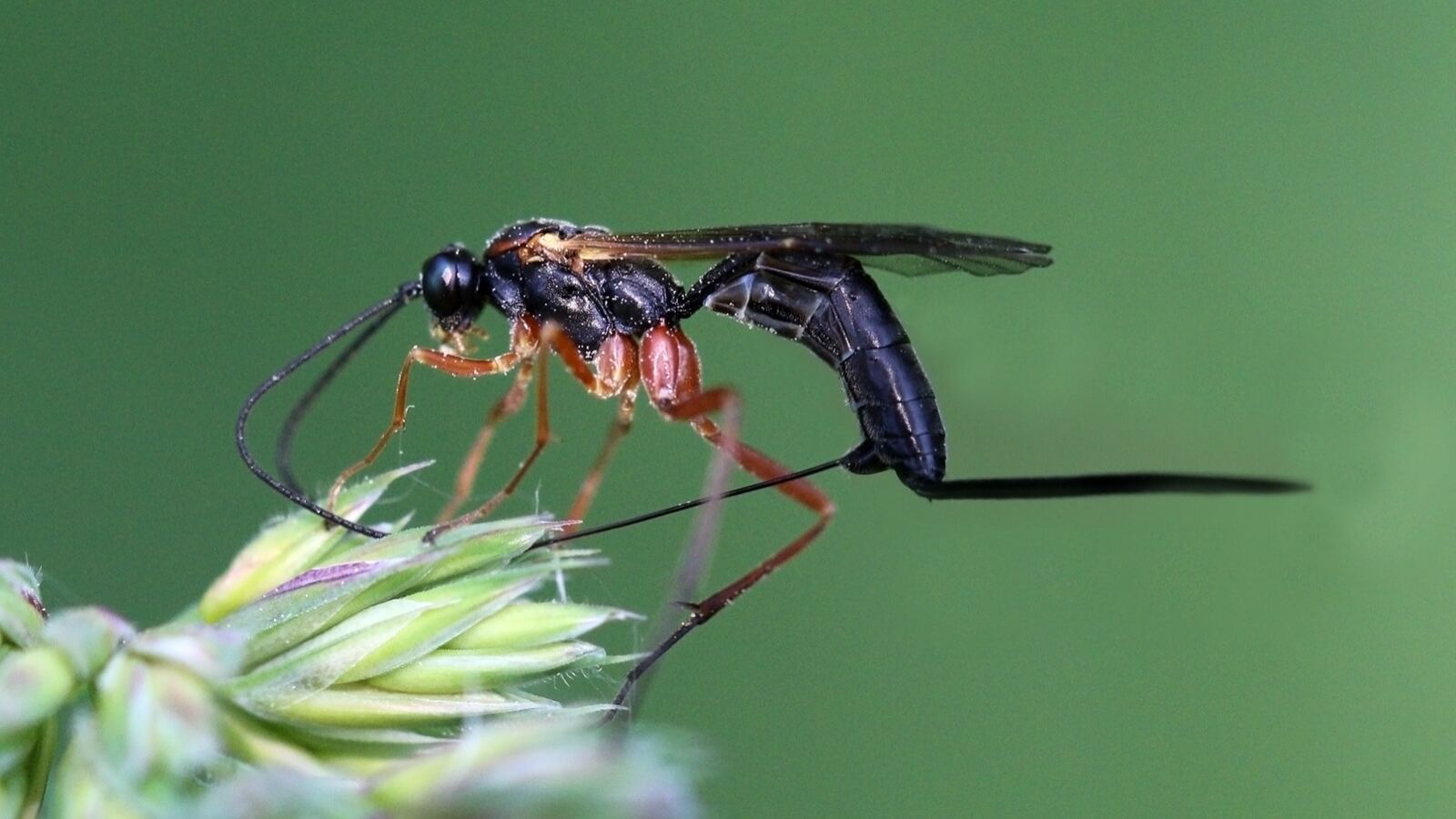
What they are
Parasitoid wasps are a vast group of mostly tiny, harmless (to us), non-stinging wasps whose way of life is one of the most remarkable — and grisly — in nature. Unlike a true parasite, which lives off its host without killing it, a parasitoid lays its eggs in or on another insect, and its larvae devour that host alive from the inside, eventually killing it. They are, in effect, the insect world's guided missiles, and they are everywhere.
There are enormous numbers of them — the ichneumon wasps, braconid wasps, chalcid wasps, and their relatives may be among the most species-rich groups of animals on Earth — and between them they attack almost every kind of insect. Most are so small they go entirely unnoticed, yet they exert one of the strongest controls on pest numbers in any ecosystem. (The strangeness of their life cycle famously troubled Darwin, who could not reconcile a benevolent creator with wasps that eat caterpillars alive.)
How they work
A female parasitoid hunts down a host — an aphid, a caterpillar, a fly larva, a beetle grub, an egg — and, with a needle-like egg-laying tube (the ovipositor, not a sting), injects one or more eggs. The larvae hatch inside and eat the host from within, carefully keeping it alive until the last, before pupating.
The signs are visible once you know them:
- the "mummified" aphid — a swollen, bronzed, papery aphid husk glued to a leaf, from which a single parasitoid wasp will emerge through a neat round hole. A colony of these mummies means the parasitoids are winning;
- the little cocoons clustered on a dying caterpillar's back (the braconid wasps of the "wasp-covered hornworm");
- the sudden collapse of a pest outbreak as the parasitoids catch up.
Different parasitoids specialise on different pests and different stages — some attack eggs (the tiny Trichogramma wasps, killing pests before they ever hatch), some the larvae, some the adults — and together they form a layered natural defence. The tachinid flies do the same job as parasitoids from the fly side.
Using and keeping them
Parasitoid wasps are the backbone of much biological control. Some of the great successes in pest management have come from importing a pest's specific parasitoid — controlling invasive scale insects, whiteflies, and others — and Trichogramma, Aphidius, Encarsia, and other parasitoids are reared and sold by the million for release in greenhouses and crops.
But most of the work is done for free by the wild parasitoids already present, and the way to support them is, once again, simple:
- Grow nectar flowers, especially the small, open, accessible flowers of the umbellifers (carrot, fennel, dill, cow parsley) and daisies — the adult wasps are tiny and need nectar and pollen to fuel their egg-laying, so a flowering pollinator habitat directly powers the parasitoids;
- Tolerate a few pests — parasitoids need hosts to lay in, so a garden scoured clean of every aphid starves its own biocontrol;
- Avoid broad-spectrum insecticides, which kill the delicate wasps far more thoroughly than the pests, and which — by removing the parasitoids — regularly cause pest outbreaks worse than the one being sprayed.
Parasitoid wasps are perhaps the clearest argument for the whole integrated-pest-management philosophy: an invisible army is already at work on your pests, and the job is mostly to feed it and not to poison it. See beneficial predators and coevolution.
See also
- Aphids and Caterpillars the parasitoids' main hosts
- Beneficial Predators the wider natural-enemy workforce
- Ants and Wasps their stinging, social relatives
- Pollinator Habitat the nectar flowers that fuel the adult wasps
- Integrated Pest Management parasitoids as biological control
- Coevolution the arms race between parasitoid and host