The workforce you already have
Almost every pest in a garden has predators and parasites already present or capable of arriving. The question is whether the site supports them well enough to keep a resident population rather than an occasional visitor.
That distinction is the whole game. Predators that must recolonise each year always arrive after the pest has built up. Predators that overwinter on site are there when the first aphids appear.
Everything below is about which species do what, and what they need to stay.
Lacewings
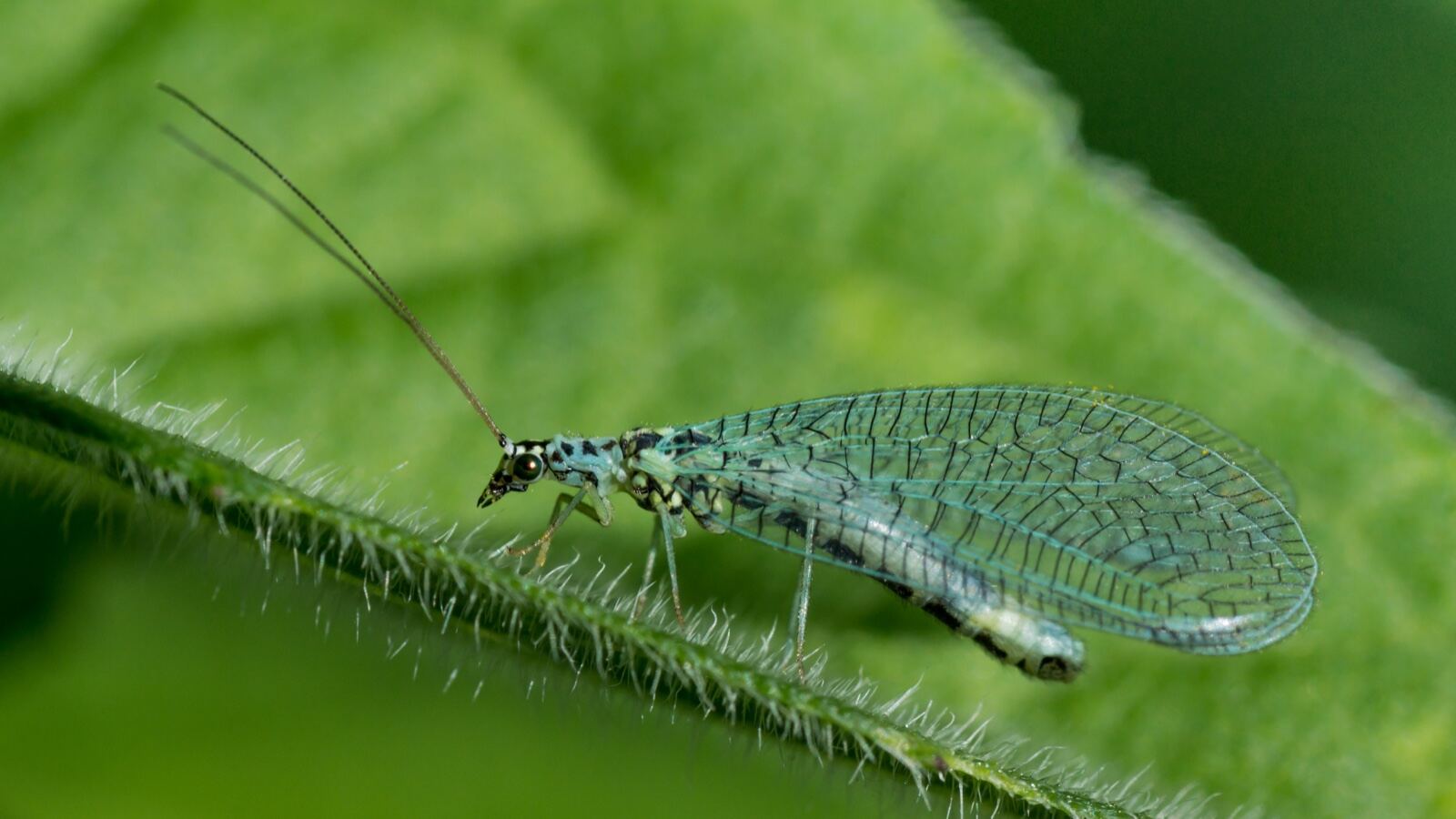
Green and brown lacewings, Chrysopidae and Hemerobiidae. Delicate adults with lace-veined wings; larvae that are small, flattened, and startlingly aggressive.
The larva is sometimes called an aphid lion, and it earns it — hundreds of aphids over its development, plus thrips, mites, small caterpillars, and insect eggs. Some species camouflage themselves with the drained husks of their victims.
Eggs are unmistakable: laid singly on the end of a fine stalk about a centimetre long, which keeps them out of reach of their own siblings, since the larvae are cannibalistic.
Adults of most species eat pollen and nectar, so flowering plants keep them on site.
They overwinter as adults or pupae in leaf litter, hollow stems, bark, and outbuildings.
Ground and rove beetles
Carabids and staphylinids, working the soil surface at night, and the most under-appreciated predators in the whole system.
They take slug eggs and small slugs, cutworms, root fly eggs and larvae, wireworms, and aphids that fall to the ground. Some are specialist snail hunters with narrow heads for reaching into shells.
They are ground-dwelling and flightless or reluctant fliers, which means they cannot recolonise quickly and depend entirely on undisturbed refuge within walking distance.
The classic provision is a beetle bank: a raised strip of tussocky grass through or alongside a field, left uncut, which stays dry and provides overwintering density of hundreds per square metre. From there they disperse into the crop each spring.
At garden scale the equivalent is any undisturbed rough margin, mulch, or log pile. Tillage and bare soil are the enemy. See no-dig, soil cover, and rock and log piles.
They are a significant part of the answer to slugs and snails.
Parasitoid wasps
Mostly tiny, mostly unnoticed, and collectively the most important group in biological control.
A parasitoid lays inside or on a host, and the larva consumes it from within — fatal by definition, unlike a true parasite.
The visible signatures are worth learning:
Aphid mummies — bronzed, swollen, papery aphids glued to a leaf, each with a neat round exit hole. Every mummy is an aphid that was killed and a wasp that emerged. A colony full of mummies needs no intervention.
Caterpillar cocoons — clusters of small white or yellow silk cocoons on or beside a dying caterpillar, most familiar on cabbage white larvae. See caterpillars.
Whitefly scales turning black, which is Encarsia formosa at work — the parasitoid sold commercially for greenhouse whitefly and a genuine success. See whiteflies and spider mites.
Adults feed on nectar and need small, shallow, accessible flowers, since their mouthparts are short. Umbellifers are the standard provision.
Spiders and harvestmen
Generalist predators, present in very large numbers, and taking an enormous total quantity of insects.
Web-builders intercept flying insects; hunting spiders work foliage and ground. Harvestmen, which are not spiders, scavenge and take small soft-bodied prey including aphids and mites.
They need structure — vegetation of varied height, undisturbed litter, standing stems — rather than any specific plant.
Earwigs
Genuinely useful, and widely disliked.
In orchards earwigs are significant predators of woolly aphid, psyllids, pear sucker, and codling moth eggs, and their presence measurably reduces damage. European orchardists deliberately encourage them with straw-filled flowerpots inverted on canes as daytime refuges.
They do also damage soft fruit and flower petals, which is where the reputation comes from. On balance, in a tree fruit system, they are on your side.
Predatory mites and midges
Phytoseiid mites hunt spider mites and thrips, and are the standard biological control in protected cropping.
Aphidoletes midge larvae are small orange maggots that kill aphids in numbers, and are commonly used under glass.
Both work particularly well in enclosed environments where they cannot disperse away. See integrated pest management.
Vertebrates
Birds take caterpillars, aphids, and larvae in quantity, and the numbers are set out in insectivorous birds.
Amphibians and reptiles work the ground layer at night, and slow-worms in particular are serious slug predators. See amphibians and reptiles.
Bats take large numbers of night-flying moths, including several orchard and crop pests. See bats.
Hedgehogs, shrews, and small mammals take slugs, snails, and larvae.
Owls and kestrels take voles, which matters for young trees. See voles and gophers.
What they all need
The provisions overlap almost entirely, which is convenient — one set of habitat decisions serves the whole guild.
Flowers across the whole season, especially small shallow ones for short-tongued adults. Umbellifers, yarrow, buckwheat, alyssum, and any herb allowed to flower. See culinary herbs and pollinator habitat.
Undisturbed overwintering refuge: standing dead stems, tussocky grass, leaf litter, log and stone piles, rough margins. Cut in spring, not autumn.
Permanent ground cover rather than bare tilled soil, which is fatal to ground-dwelling predators. See soil cover and no-dig.
Structural variety — ground layer, herb layer, shrubs, trees. See structural diversity and edge effects.
Tolerance of some pest presence, because a predator with no prey leaves or starves.
No broad-spectrum insecticides, including organic-approved ones. Pyrethrum and soaps are non-selective and hit predators harder than pests. See organic sprays.
Water, and shelter from wind.
That list is essentially the design brief in rewilding edges and pollinator habitat, which is not a coincidence — the habitat that supports pollinators supports predators, because most predatory adults eat nectar and pollen.
See also
- Ladybirds the best-known member of the guild
- Hoverflies pollinator and predator in one
- Predator-Prey Balance the underlying principle
- Integrated Pest Management fitting them into a strategy
- Rock and Log Piles overwintering habitat
- Slugs and Snails what the ground beetles are for
- Soil-Dwelling Pests
- Buckwheat, Quinoa and Amaranth
- Spiders
- Lacewings
- Ground Beetles
- Parasitoid Wasps