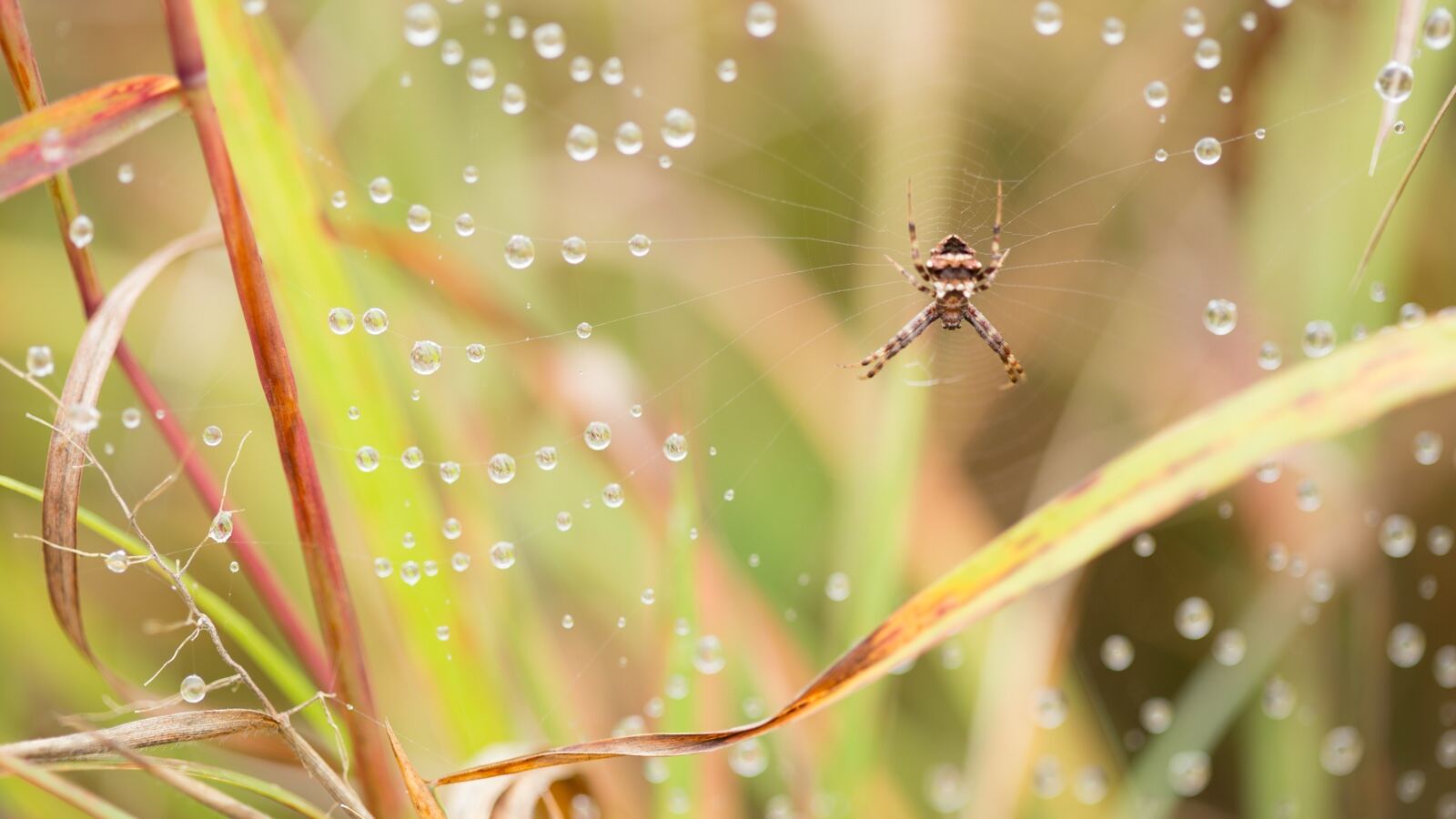
Not insects
Spiders are arachnids, not insects — eight legs, not six; two body parts, not three; no wings and no antennae. That distinction matters because it places them in a different guild of predators from the ladybirds, lacewings, and beetles: spiders are generalist hunters that eat almost any small animal they can catch, and they are present in numbers that dwarf almost every other predator.
The figures are startling. Spiders are among the most abundant predators on land, and estimates of the total weight of prey the world's spiders eat each year run to hundreds of millions of tonnes — comparable to the total weight of meat and fish eaten by all humanity. In any garden, meadow, or field, spiders are quietly doing an enormous share of the pest control, and a healthy population is one of the best signs of a functioning food web.
How they hunt
Spiders catch prey in two broad ways, and a good garden has both:
Web-builders spin silk to trap flying and jumping insects. The orb-weavers make the classic wheel-shaped webs that catch aphids' winged forms, moths, flies, and much else; sheet-web and tangle-web spiders fill the gaps of hedges and low vegetation. A garden full of webs is a garden full of insect traps working for free, day and night.
Hunters chase or ambush prey without a web. Wolf spiders run down prey across the ground and are important predators of pests at soil level; jumping spiders, with their large forward eyes, stalk and pounce like tiny cats; and crab spiders sit camouflaged on flowers, ambushing the insects that come to feed (they can even change colour to match the bloom). Between the trappers and the hunters, spiders cover the air, the foliage, and the ground.
Keeping them
Spiders are almost entirely harmless to people — the handful of medically-significant species are rare and localised, and the vast majority cannot even pierce human skin — and they are pure benefit in the garden. The way to have plenty of them is to give them what they need: undisturbed structure and cover.
- Permanent vegetation and layers — spiders need places to anchor webs and to hide, so structural diversity, unclipped corners, tall grass, and dense planting all support them.
- Overwintering shelter — leaf litter, log and rock piles, mulch, hollow stems, and undisturbed ground let spiders survive the winter on site, so they are present when pests first appear (the whole point made in beneficial predators).
- No broad-spectrum sprays — insecticides kill spiders along with pests, and because predators recover more slowly than the pests they eat, spraying often makes pest problems worse.
The single most spider-friendly thing a gardener can do is to stop tidying so much — to leave the leaf litter, the log pile, the messy hedge bottom, and the winter stems standing — and to put the spray can away. Do that, and one of the largest pest-control workforces on Earth moves in for free. See garden pests overview.
See also
- Beneficial Predators the wider guild spiders lead
- Ground Beetles and Lacewings other resident predators
- Rock and Log Piles the overwintering shelter spiders need
- Structural Diversity the cover that supports web-builders and hunters
- Food Webs the predator role spiders fill
- Integrated Pest Management why not to spray your predators