What they are
Lacewings are delicate, soft-bodied insects with large, transparent, finely-veined ("lacy") wings, most familiar as the pale green lacewings that drift to lighted windows on summer nights, and the smaller brown lacewings. The fragile, dreamy adult gives no hint of what its offspring do — because the lacewing larva is one of the fiercest small predators in the garden.
The aphid lion
The lacewing larva is a squat, mobile, alligator-shaped creature armed with a pair of large, curved, hollow jaws like ice-tongs, and it is nicknamed the "aphid lion" for good reason: it hunts down soft-bodied pests, seizes them, and sucks them dry through those hollow jaws, moving on to the next.
A single lacewing larva will eat hundreds of aphids over the two or three weeks before it pupates — along with mealybugs and scale insects, thrips, mites, whitefly, small caterpillars, and the eggs of many pests. Lacewing larvae rival and often exceed ladybird larvae as aphid predators, and they are one of the mainstays of natural pest control. Some species even camouflage themselves by piling the drained husks of their prey, and bits of debris, onto their own backs — a walking heap of rubbish that hides them from ants and their own predators.
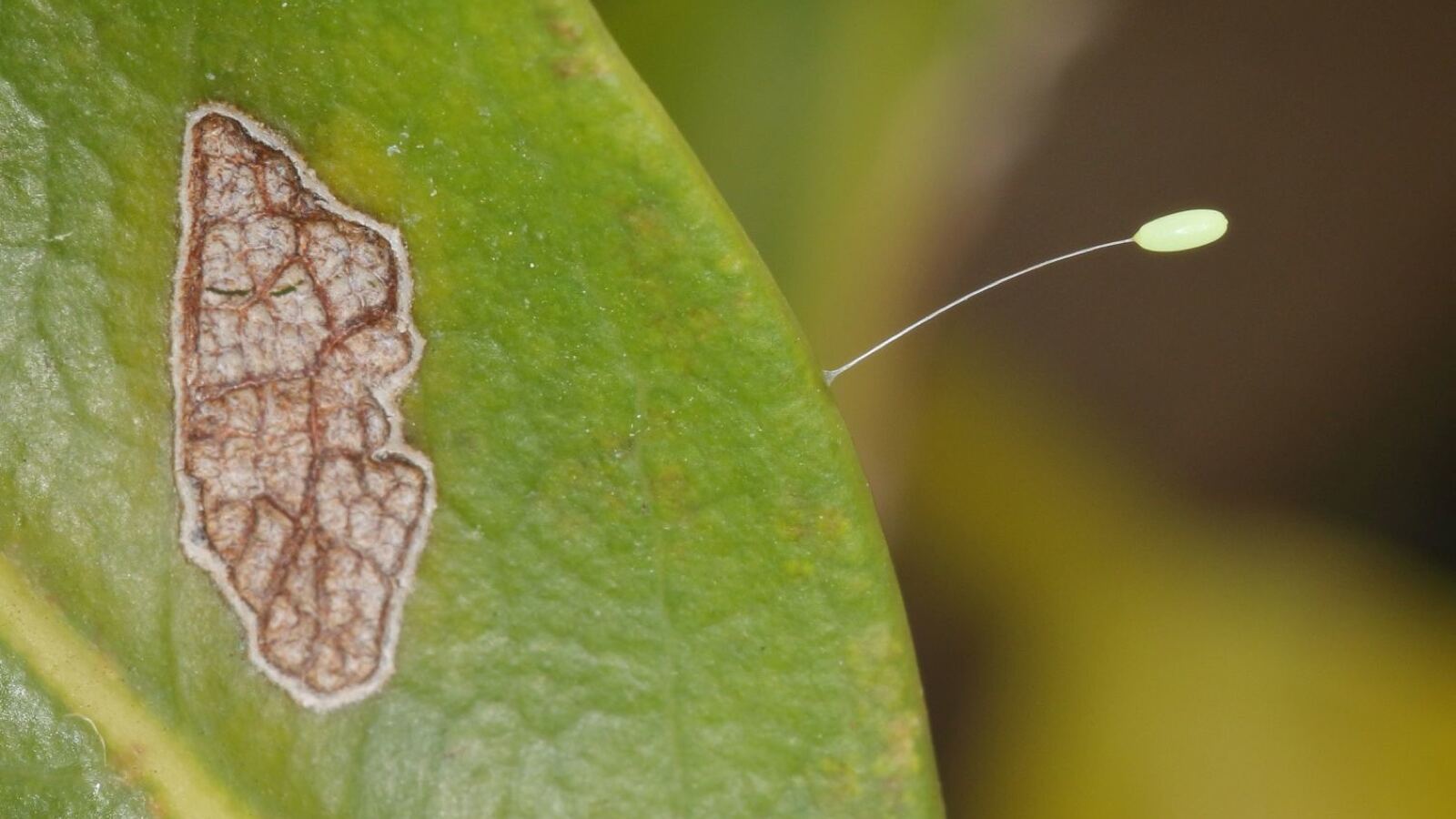
The eggs are a curiosity in themselves: the female lays each egg on the tip of a fine stalk, a slender thread holding the egg up off the leaf, which protects it from being eaten by ants and by the first-hatched larvae, who would otherwise turn on their siblings.
The adults, and keeping them
The adults are gentler. Many green lacewings feed only on nectar, pollen, and honeydew — so, like the hoverflies, the adult needs flowers even though the larva is a predator, and providing pollinator habitat with plenty of open flowers feeds the adults that lay the next generation of aphid lions. (Some brown lacewings hunt as adults too.)
To have lacewings working in the garden:
- Grow flowers — especially open, accessible ones (umbellifers, daisies, yarrow) that feed the nectar-feeding adults through the season;
- Provide overwintering shelter — adults hibernate in sheltered, dry places (evergreens, leaf litter, sheds, and the "insect hotels" whose lacewing chambers are packed with straw), so undisturbed cover lets them survive to breed early, the resident-predator principle again;
- Avoid broad-spectrum insecticides, which kill the delicate lacewings readily.
Lacewing eggs and larvae are also sold commercially for release in greenhouses and gardens, one of the standard biological controls — but a garden with flowers and shelter grows its own. Few allies give more pest control for so little effort. See beneficial predators.
See also
- Aphids the aphid lion's main prey
- Ladybirds the other great aphid predator, with the same needs
- Hoverflies another beneficial with a predatory larva and a nectar-feeding adult
- Beneficial Predators the guild lacewings belong to
- Pollinator Habitat the flowers that feed the adults
- Integrated Pest Management lacewings as biological control