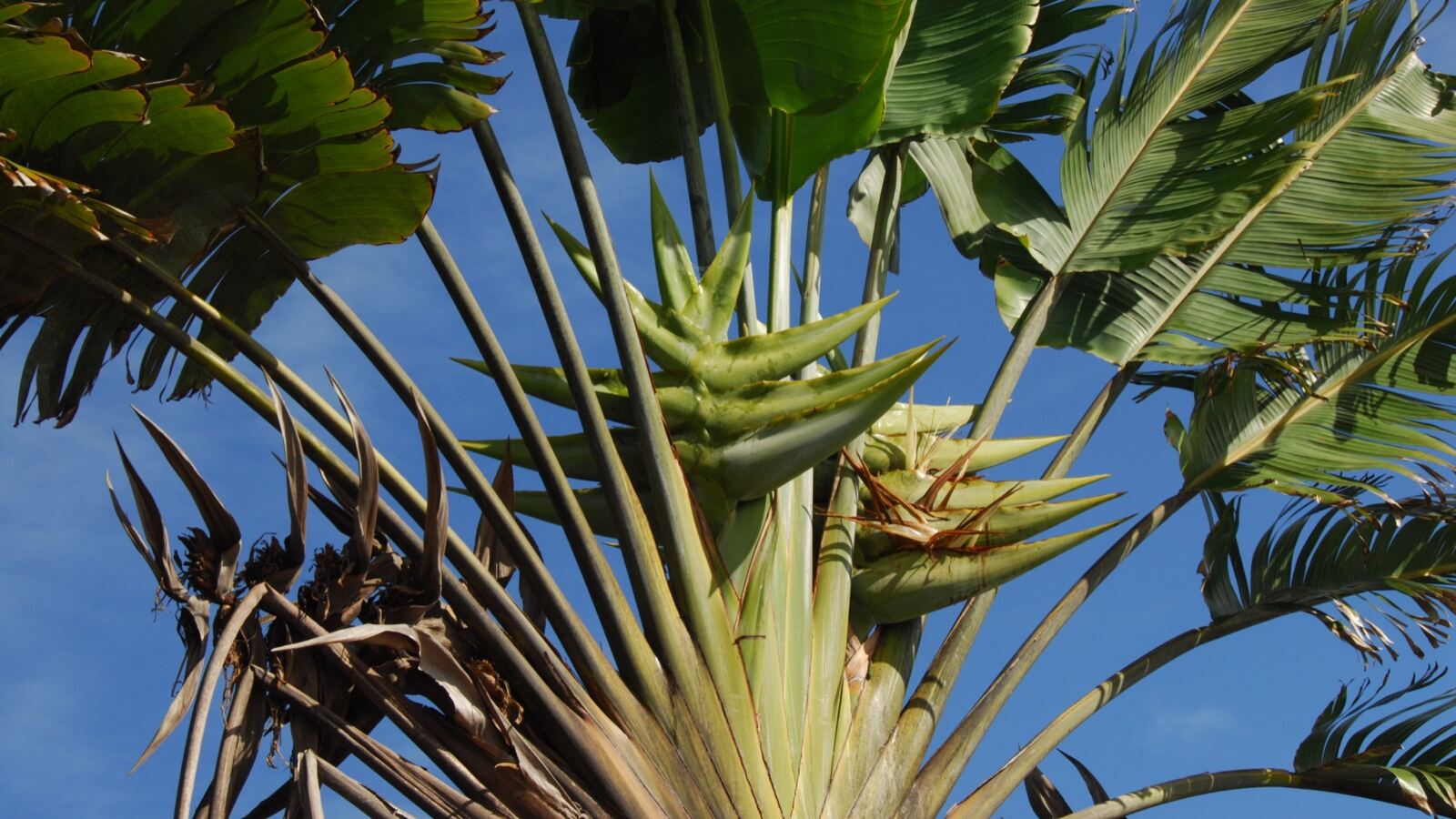
What it is
Ravenala madagascariensis, the traveller's palm or traveller's tree — a spectacular large plant of Madagascar, and one of the most instantly recognisable "trees" in the world, with a stout trunk topped by an enormous, flat, symmetrical fan of huge banana-like leaves, arranged in a single plane like a giant green peacock's tail or an open hand.
Despite the name, it is not a palm. It belongs to the bird-of-paradise family, Strelitziaceae, and is a giant relative of the banana and the bird-of-paradise flower (both in the order Zingiberales), with which it shares its big paddle-shaped leaves and its non-woody, herb-like structure. It is the national emblem of Madagascar and a ubiquitous ornamental across the frost-free tropics, planted for its dramatic architectural form.
The "traveller's" name
The tree's evocative name comes from two abilities that were said to aid a traveller — one probably a myth, one quite real.
A compass? The great flat fan of leaves is often said to align on an east–west axis, so that a lost traveller could use it to find direction, like a living compass. This is the romantic story behind the name — though in practice the orientation is unreliable and varies, so it is more folklore than fact, an appealing "traveller's" tale rather than a dependable compass.
A drink. The more genuine claim is water. The overlapping bases of the great leaf-stalks form cup-like reservoirs that collect and hold rainwater — sometimes a litre or more in each — and a thirsty traveller could, in principle, cut into a leaf base and release a drink of (not always clean) stored water. This water-storing habit is real and is part of the plant's ecology, a modest version of the water-catching seen in the dragon tree and the tank bromeliads. See drought-tolerant species. Between the supposed compass and the real water, the plant became the "traveller's" tree.
In Madagascar, the traveller's palm is also a keystone of a remarkable partnership: its flowers are pollinated by lemurs — the ruffed lemur pushes its snout into the tough flowers to drink the nectar and carries pollen between trees, one of the very few plants known to be pollinated by a primate, a uniquely Madagascan relationship. See pollinator habitat.
Growing it
Tropical to warm-subtropical and frost-tender, the traveller's palm wants heat, high humidity, ample moisture, and rich, moist, well-drained soil in full sun; it dislikes drought, cold, and dry wind (which tatters the great leaves). It is fast-growing and clumping, suckering from the base, and it needs plenty of room and shelter for its huge fan.
It is grown from seed (which has a striking, brilliant electric-blue seed coat — one of the very few truly blue colours in the plant world) and from suckers, and it is planted throughout the frost-free tropics and in warm conservatories as one of the most dramatic of all architectural foliage plants. As a giant, water-storing, lemur-pollinated relative of the banana masquerading as a palm, the traveller's palm is one of the botanical wonders of Madagascar. See propagation and palms for the true palms it is often mistaken for.
See also
- Banana and Plantain its true relative in the ginger-and-banana order
- Palms the family it resembles but does not belong to
- Dragon Tree another dramatic, water-related island tree
- Pollinator Habitat its rare lemur pollination
- Drought-Tolerant Species the rainwater-storing leaf bases
- Screw-Pine another dramatic, palm-like non-palm of the tropics