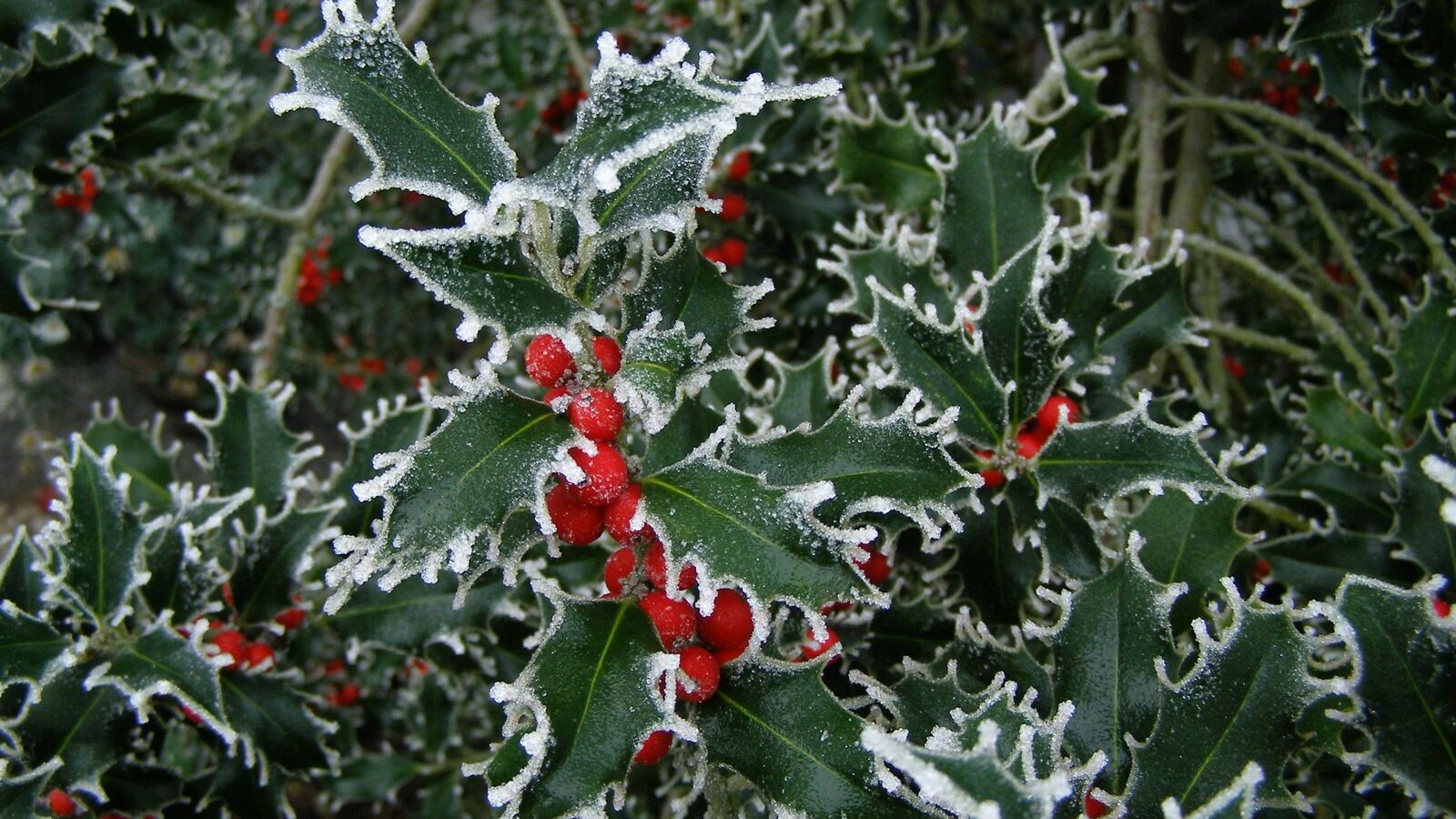
What it is
Ilex aquifolium in Europe, I. opaca in eastern North America, and around 500 species worldwide including the South American I. paraguariensis, which is yerba maté.
An evergreen small tree or large shrub, slow, shade-tolerant, and long-lived — several centuries is normal.
Dioecious: male and female flowers on separate plants, so only female trees carry berries, and only if a male is within pollinating range. A berryless holly is usually a male, and the cultivar names are no help at all — Golden King is female and Silver Queen is male.
The leaves change shape as the tree grows
The detail that makes holly worth a close look.
Lower leaves are heavily spined. Higher up the same tree, above roughly 2 to 3 m, the leaves are often smooth-edged ovals with a single point.
That is the browse line. Holly produces spines where herbivores can reach and stops bothering above it.
It is not merely developmental. The response is inducible: browsed trees produce spinier leaves, and the change is driven by epigenetic modification rather than by any change to the DNA sequence. A tree that has been grazed remembers, and it arms the parts that were attacked.
This makes holly one of the most legible examples of a plant defence you can read directly off the plant, and a good field illustration of the browsing pressure discussed in deer and rabbits.
Winter food when nothing else is left
Holly berries are not a first choice for birds. They are relatively low in fat and contain saponins that make them mildly unpalatable, so they hang on the tree long after other fruit has gone.
That is exactly what makes them valuable. By late winter, when hawthorn, rowan, and elderberry have all been stripped, holly is still loaded.
Mistle thrushes are known to guard individual holly trees aggressively through winter, driving off other birds to keep the crop for themselves — one of the clearest cases of resource defence in a garden bird.
Repeated frosts break the berries down and make them more palatable, which is why they are eaten in quantity late.
The dense evergreen structure is also first-rate nesting and roosting cover, and the deep leaf litter beneath an old holly shelters hedgehogs and invertebrates. See insectivorous birds and wildlife shrubs.
The berries are toxic to people — unpleasant rather than lethal, but genuinely so for children.
In the wood and the hedge
Holly is a shade-tolerant understorey tree, one of the few evergreens in temperate broadleaf woodland, and it forms a distinctive dark layer beneath oak and beech.
Under heavy deer pressure it is one of the last things left standing, since browsers avoid the spined lower growth — a holly-dominated understorey with nothing else beneath it is usually a sign of too many deer. It is a useful indicator in that respect.
In hedgerows it was traditionally left as a standard, and it makes an excellent stock-proof and windproof hedge component, holding its structure through winter when the deciduous species are bare. See hedgerow care.
Holly was also managed as winter fodder across upland Britain — cut and fed to sheep and cattle in hard weather, with dedicated hollins or holly hags maintained for the purpose. Many upland holly stands are relics of that practice.
Wood and use
White, fine-grained, and among the whitest timbers available. Used for inlay and marquetry, chess pieces, plane stocks, and traditionally stained black as a substitute for ebony.
Very hard and dense, burns hot even when green, and takes a fine finish. Rarely available in size.
Growing it
Tolerant of shade, exposure, salt wind, pollution, and clipping. Prefers moist well-drained soil and dislikes waterlogging.
Slow. 20 to 40 cm a year is typical, and a hedge is a long project.
Transplants badly once established, so plant small and young — container stock or small bare-root plants. Larger specimens sulk for years.
Plant a male within about 30 m of any female you want berries from, or accept a berryless tree.
Clip in late summer if hedging. Holly resprouts from old wood, so a neglected hedge can be cut back hard and will recover, though slowly.
Holly leaf miner produces pale blotches in the leaves and is almost universal; it is cosmetic and not worth treating, and it supports its own parasitoid wasps.
See tree planting and nursery stock.
The other hollies
Yerba maté, I. paraguariensis, is a South American holly whose leaves are dried and infused as the caffeinated drink of Argentina, Paraguay, Uruguay, and southern Brazil — grown in agroforestry systems under shade, much as cacao and coffee are.
American holly, I. opaca, fills the same understorey niche in eastern North America.
Winterberry, I. verticillata, is a deciduous holly grown for spectacular bare-stemmed berry displays.
See also
- Hawthorn the other great hedgerow berry tree
- Wildlife Shrubs feeding birds through winter
- Deer and Rabbits the browsing that shapes its leaves
- Hedgerow Care holly in a hedge
- Indicator Species reading browse pressure
- Native Oaks the canopy it grows beneath
- Cypresses and Thujas
- Box and Privet
- Yerba Maté
- Yaupon and Guayusa