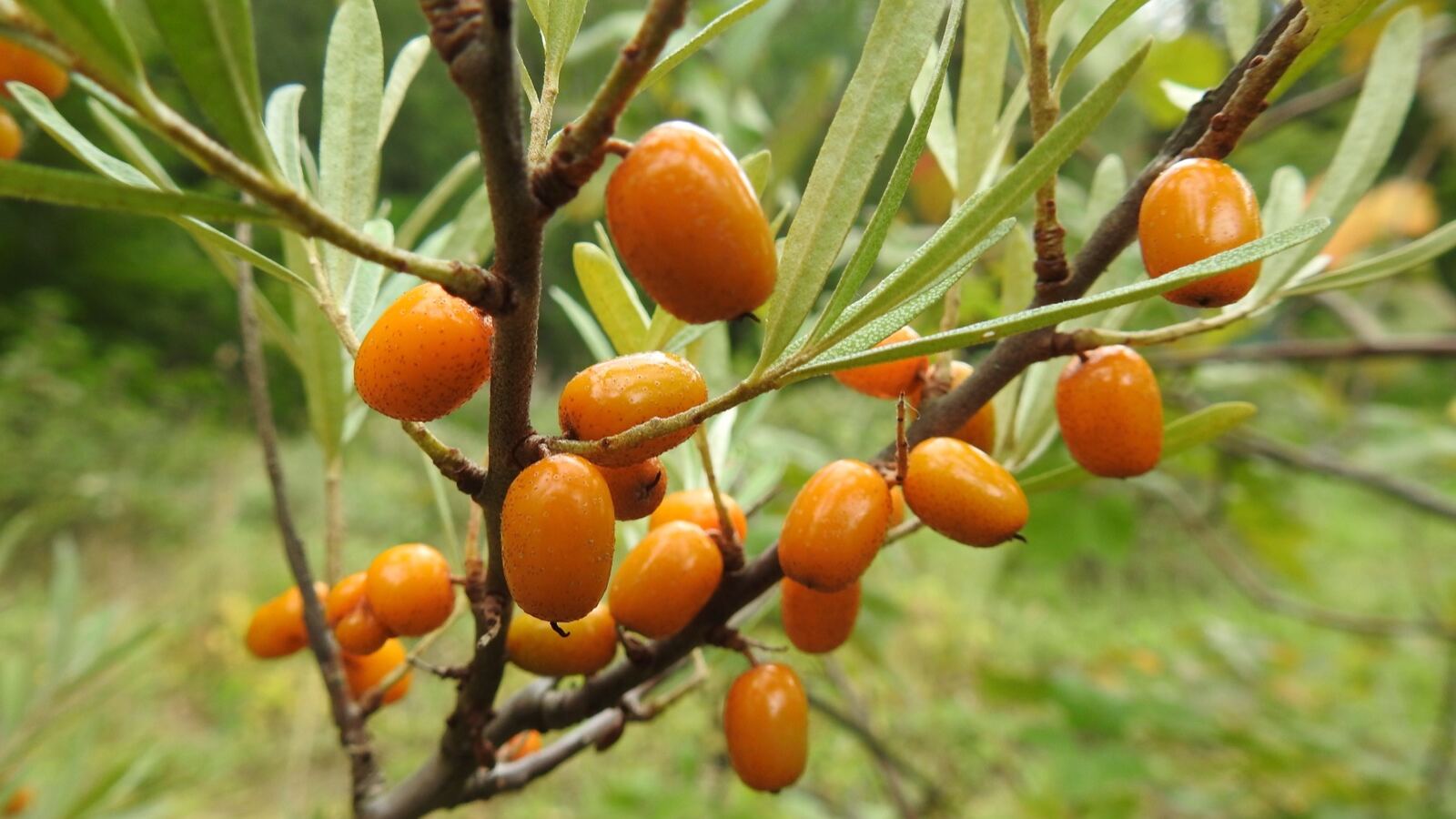
What it is
Hippophae rhamnoides, a thorny deciduous shrub of coasts, riverbanks, and mountain slopes across Europe and Asia, from the Atlantic to the Himalaya.
Narrow silver-grey leaves, vicious thorns, and dense clusters of orange berries packed tight along the stems.
Not a true buckthorn — the name is a coincidence of appearance. It sits in the Elaeagnaceae alongside autumn olive and oleaster.
It fixes nitrogen, and not with rhizobia
Sea buckthorn is a nitrogen fixer, and it uses a different partner from the legumes.
Where peas and beans and black locust work with Rhizobium bacteria, sea buckthorn hosts Frankia, a filamentous actinobacterium. The same partnership appears in alder and in the shrubs covered in nitrogen-fixing shrubs.
Frankia associations are what allow woody pioneers to colonise raw mineral substrates — dunes, glacial moraine, river gravels, mine spoil — where no nitrogen exists yet. See nitrogen-fixing bacteria and pioneer species.
That single capability explains almost everything sea buckthorn is used for.
Dune and slope stabilisation
Sea buckthorn tolerates conditions that eliminate nearly everything else: salt spray, sand blast, drought, poor mineral soil, and hard frost.
It suckers strongly and forms dense thickets, binding shifting sand with an extensive root system while simultaneously enriching it with fixed nitrogen — so it both holds the ground and prepares it for successors.
It has been planted at very large scale for exactly this, particularly across northern China, where it is a major species in erosion control and land rehabilitation programmes on the Loess Plateau and in dryland afforestation. See erosion control and dryland restoration.
The same properties make it valuable on mine spoil, road cuttings, and river embankments.
And they make it a problem. On established dune systems and species-rich coastal grassland in Britain and the Netherlands, sea buckthorn — much of it planted deliberately — has spread into a dense scrub that shades out rare dune flora and, by adding nitrogen, permanently changes the soil so the original low-fertility community cannot return.
That is the same mechanism described in black locust and in grassland restoration: a nitrogen fixer in a nutrient-poor habitat does not simply compete, it rewrites the conditions. Control on dunes is now a routine and expensive conservation task.
Native in some of these places and still damaging. It is a good reminder that the question is function in this habitat, not origin — the argument made in invasive species and native species.
The berries
Sea buckthorn fruit has an exceptional nutritional profile, and it is the reason the plant has become a commercial crop.
Vitamin C is very high, typically several times that of citrus by weight and among the highest of any temperate fruit.
It also carries substantial vitamin E, carotenoids, and — unusually for a fruit — significant omega-7 fatty acids, concentrated in the seed and pulp oils, which is the basis of the cosmetic and supplement industry built around it.
The taste is sharp, oily, and astringent, somewhere between passionfruit and vinegar. Almost nobody eats it raw. It goes into juices, cordials, jams, sauces, and oils, and is a staple in Russia, the Baltics, Scandinavia, and China.
Harvesting is genuinely difficult. The berries are soft, packed tightly against thorny stems, and burst if you pull them. The practical methods are cutting whole fruiting branches and freezing them, after which the berries knock off cleanly, or shaking frozen branches in winter. Commercial harvest usually means sacrificing the branch, which then regrows.
Dioecious, so plant both
Sea buckthorn has separate male and female plants, and only females fruit.
You need at least one male per six to eight females, positioned upwind, since pollination is by wind rather than insects.
Sexing is impossible until flowering, so buy named sexed plants from a nursery rather than seedlings if fruit is the aim. This catches out a great many people who plant a hedge of seedlings and get no berries at all. See nursery stock.
Wildlife
The berry crop is heavy, persists into winter, and is taken enthusiastically by thrushes, fieldfares, redwings, and waxwings — one of the more significant winter bird food sources on the coast. See seed-dispersing birds and wildlife shrubs.
The dense thorny thickets are excellent nesting cover.
Against that, on dune systems the same thickets replace open habitat that specialist invertebrates and plants require — which is the conservation tension above in miniature.
Growing it
Full sun, and it will not tolerate shade at all.
Free-draining soil, ideally sandy or gravelly. It dislikes heavy wet clay and rich ground.
Do not feed it. Nitrogen fertiliser suppresses its own fixation and produces soft growth.
Extremely hardy, extremely wind- and salt-tolerant, and drought-tolerant once established.
It suckers. Plant it where that is acceptable, or contain it. In a small garden it will spread further than expected.
Propagate from suckers, hardwood cuttings, or seed, which needs cold stratification. See propagation.
In productive systems it works well as a windbreak, a shelterbelt component, and a nitrogen-fixing element in a food forest — provided the suckering is planned for. See windbreaks and nitrogen fixers.
See also
- Alder the other Frankia-fixing pioneer
- Nitrogen-Fixing Shrubs the wider group
- Erosion Control dune and slope stabilisation
- Invasive Species when a native becomes a problem
- Wildlife Shrubs winter berries for birds
- Windbreaks coastal shelter planting
- Coastal Dunes
- Leucaena and Gliricidia
- Tree of Heaven
- Gorse and Broom
- Casuarina
- Elaeagnus