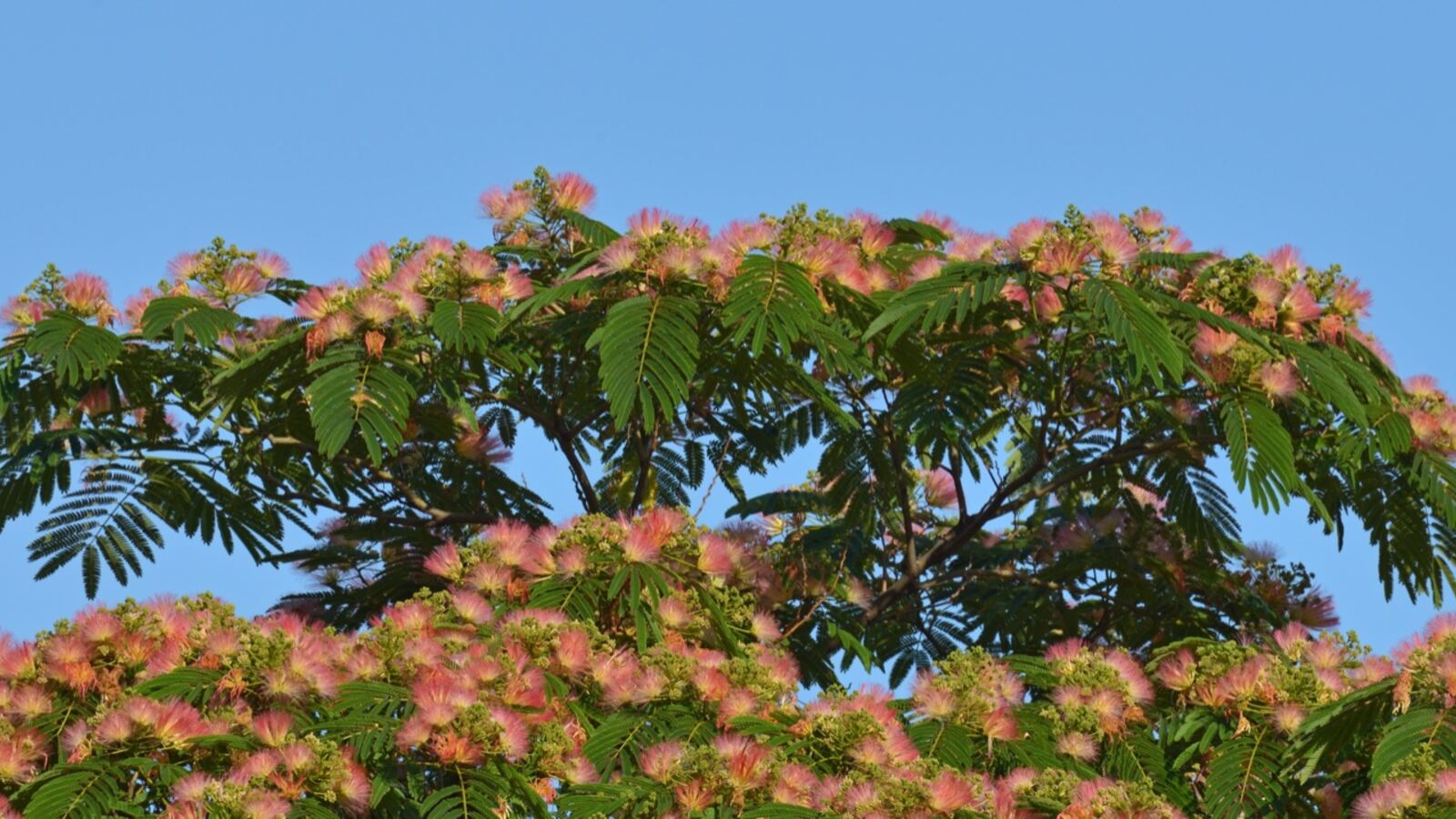
What it is
Albizia julibrissin, from Asia — Iran to Japan — and widely planted worldwide as an ornamental. Called silk tree, Persian silk tree, or mimosa, though it is not a true Mimosa, and the confusion of names is longstanding.
A small, spreading, flat-topped tree with delicate, doubly-compound, fern-like leaves and, in mid to late summer, showy flowers that look like pink silky powderpuffs — the colour coming entirely from a haze of long stamens rather than petals. It is a legume, in the same broad group as acacia and the nitrogen-fixing food trees.
The folding leaves
The silk tree's most charming feature is that its leaves move.
The fine leaflets fold shut at night and reopen in the morning — a daily rhythm called nyctinasty — and they also fold in response to touch, heat, and rain, though far more slowly and less dramatically than the true sensitive plant, Mimosa pudica, to which it is related.
The movement is driven by changes in water pressure in special cells at the base of each leaflet, the pulvini, pumping the leaflets open and closed. Why the tree does it is debated — reducing water loss, shedding rain, deterring night-feeding insects, and regulating temperature have all been proposed. Whatever the reason, a silk tree closing its leaves at dusk is one of the more visible pieces of plant behaviour a gardener can watch. It connects to the same pulvinus mechanism that lets the Mimosa and legume foliage respond to stimulus.
Nitrogen fixation, and invasiveness
As a legume, the silk tree fixes nitrogen through root nodules, improving the soil it grows in — see nitrogen fixers and nitrogen-fixing bacteria — and it is fast, tough, drought-tolerant, and undemanding.
Which is, as ever, exactly the profile of an invader. In the warm southeastern United States and elsewhere, silk tree has escaped cultivation and become invasive: it seeds prolifically, resprouts vigorously when cut, colonises roadsides and disturbed ground, and forms thickets. It is listed as invasive across much of the southern US and in other warm regions. See invasive species and the recurring fast-tough-legume pattern in black locust and leucaena.
In cooler climates, where it is less vigorous and seeds less freely, it is better behaved and remains a valued ornamental — the invasiveness is climate-dependent, as it is for so many species.
The flowers are genuinely good for pollinators and hummingbirds, producing abundant nectar over a long summer season. See pollinator habitat and native bees.
Growing it
Full sun, free drainage, heat. The silk tree is drought- and heat-tolerant once established and dislikes waterlogging and deep shade. Cold-hardiness varies by provenance — some strains survive to about minus 15 C, but hard winters kill or top-kill it, and it is marginal in cool temperate climates.
Fast-growing and short-lived — 20 to 30 years is typical — with weak wood prone to storm breakage, and it is often multi-stemmed and spreading, giving welcome dappled shade.
Mimosa wilt, a Fusarium vascular disease, kills silk trees across much of their planted range and has removed many street plantings; wilt-resistant cultivars exist. See tree diseases.
Grows very easily from seed — which is part of the invasiveness problem — and self-sows freely.
Where it is not invasive and the climate suits, the silk tree is a lovely small ornamental for its ferny foliage, summer powderpuff flowers, folding leaves, and light shade. Where it is invasive, it should not be planted, and the same beauty-versus-behaviour judgement applies as with so many introduced trees. See climate adaptation.
See also
- Leucaena and Gliricidia the related fast legume trees and the leaf-folding mechanism
- Acacia the broader legume-tree group
- Nitrogen Fixers the wider fixing-tree group
- Invasive Species the climate-dependent invasiveness
- Black Locust the same fast-tough-legume-invader pattern
- Pollinator Habitat the summer nectar
- Kentucky Coffeetree
- Jacaranda and Flame Tree
- Bauhinia
- Flame of the Forest
- Falcataria
- Judas Tree