What it is
Ailanthus altissima, from China, and one of the most successful invasive trees in the temperate world.
The name — tree of heaven, from an Indonesian name meaning reaching for the sky — is generous. It is fast, tough, and pervasive, and it is the tree of Betty Smith's novel A Tree Grows in Brooklyn, chosen precisely because it grows from cracks in pavement in the poorest, most neglected ground and keeps growing when everything else fails.
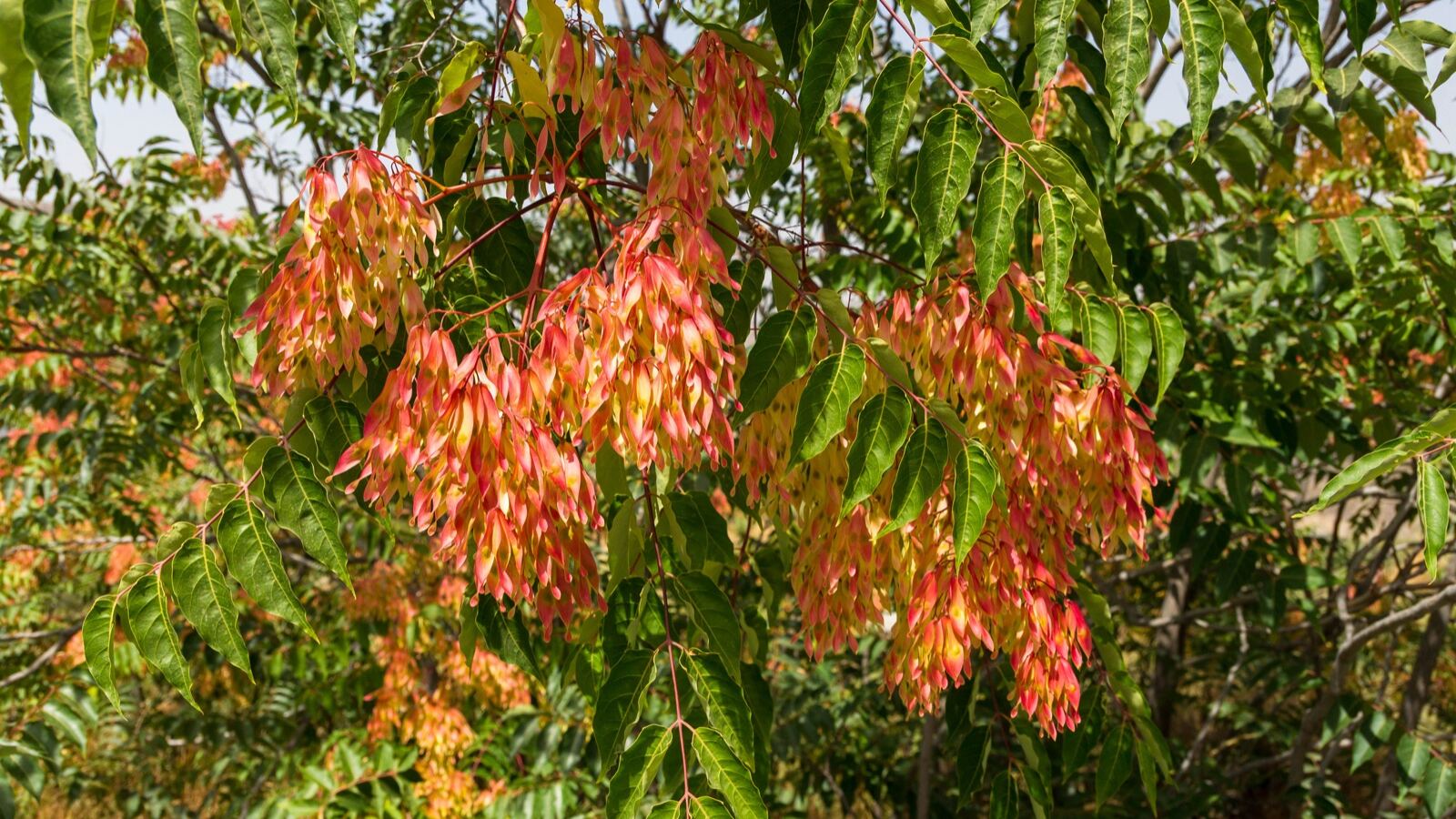
Large pinnate leaves with many leaflets, each with a distinctive small tooth and gland at the base, and a strong, unpleasant smell — often compared to rancid peanuts or cat urine — released when the leaves or twigs are crushed, which is a reliable identification feature.
Why it succeeds
Tree of heaven has close to the full toolkit of a successful invader, and it is worth cataloguing because it explains the difficulty of control.
Speed. Among the fastest-growing of all trees, up to 1 to 2 m a year, quickly overtopping competitors.
Seed. A single female produces enormous quantities of winged seed, dispersed on the wind over long distances.
Suckering. It suckers aggressively from a spreading root system, forming dense clonal thickets, and — crucially — cutting or damaging it triggers vigorous suckering and resprouting. A cut tree of heaven responds with dozens of new stems, so mechanical control alone multiplies it. This is the same trap as black locust and leucaena.
Allelopathy. It releases ailanthone and related compounds from its roots and bark that suppress the germination and growth of neighbouring plants — a chemical warfare that helps it clear ground and hold it. See invasive species.
Toughness. It tolerates drought, pollution, poor and compacted soil, salt, and the harshest urban conditions, growing from foundations, railway ballast, and pavement cracks where nothing else will.
Control
Tree of heaven is genuinely difficult to remove, and the method matters.
Cutting alone fails — it stimulates suckering and the plant returns denser. Repeated cutting over many years can eventually exhaust the root reserves, but it is a long campaign.
The effective approach is cut-and-treat or basal-bark herbicide applied to the standing tree so the chemical reaches the root system before the plant is killed, followed by monitoring and treatment of the inevitable suckers. Pulling seedlings while small, before the taproot develops, is worthwhile.
This is the standard difficult-invasive-tree management set out in invasive species, and tree of heaven is one of the hardest cases.
The spotted lanternfly connection
Tree of heaven has become a more urgent problem for a reason beyond its own invasiveness: it is the preferred host of the spotted lanternfly, Lycorma delicatula.
The spotted lanternfly is an invasive planthopper, itself from China, now spreading through North America and a serious threat to grapes, apples, stone fruit, hops, and hardwood timber, which it damages by feeding and by fouling plants with honeydew and sooty mould.
Its spread is closely tied to tree of heaven, which it strongly prefers, and controlling the tree is now part of controlling the pest — some management programmes retain a few treated tree of heaven as "trap trees" to concentrate and kill the lanternflies. It is a case where two invasions compound each other, in the manner of the harlequin ladybird and its effects. See tree diseases for the wider plant-trade-vector pattern.
Any redeeming features
Honestly, few in its introduced range.
It has been used for silk production — it is the host of the ailanthus silkmoth — for charcoal and cheap timber, and for erosion control and pioneer greening of degraded land, which is how it came to be planted so widely in the first place. Its very toughness makes it useful for stabilising the worst ground. See erosion control and pioneer species.
But in almost every temperate region outside China it is now regarded overwhelmingly as a weed tree to be controlled, and it is a listed invasive across Europe, North America, and Australia.
It is included here not as a tree to plant but as one to recognise and manage — the smell, the glandular leaf teeth, the suckering thickets, and the ability to grow from any crack are all diagnostic — and as a case study in what makes a tree invasive: the same fast, tough, resprouting, seed-heavy profile that recurs in sea buckthorn, black locust, and leucaena.
See also
- Invasive Species control methods for suckering invasive trees
- Black Locust the same resprouting-when-cut trap
- Leucaena and Gliricidia another useful-then-invasive fast tree
- Tree Diseases the plant-trade vector pattern
- Ladybirds another compounding invasion
- Pioneer Species the ground-colonising role it was planted for
- Gorse and Broom
- Chinaberry
- Amur Cork Tree