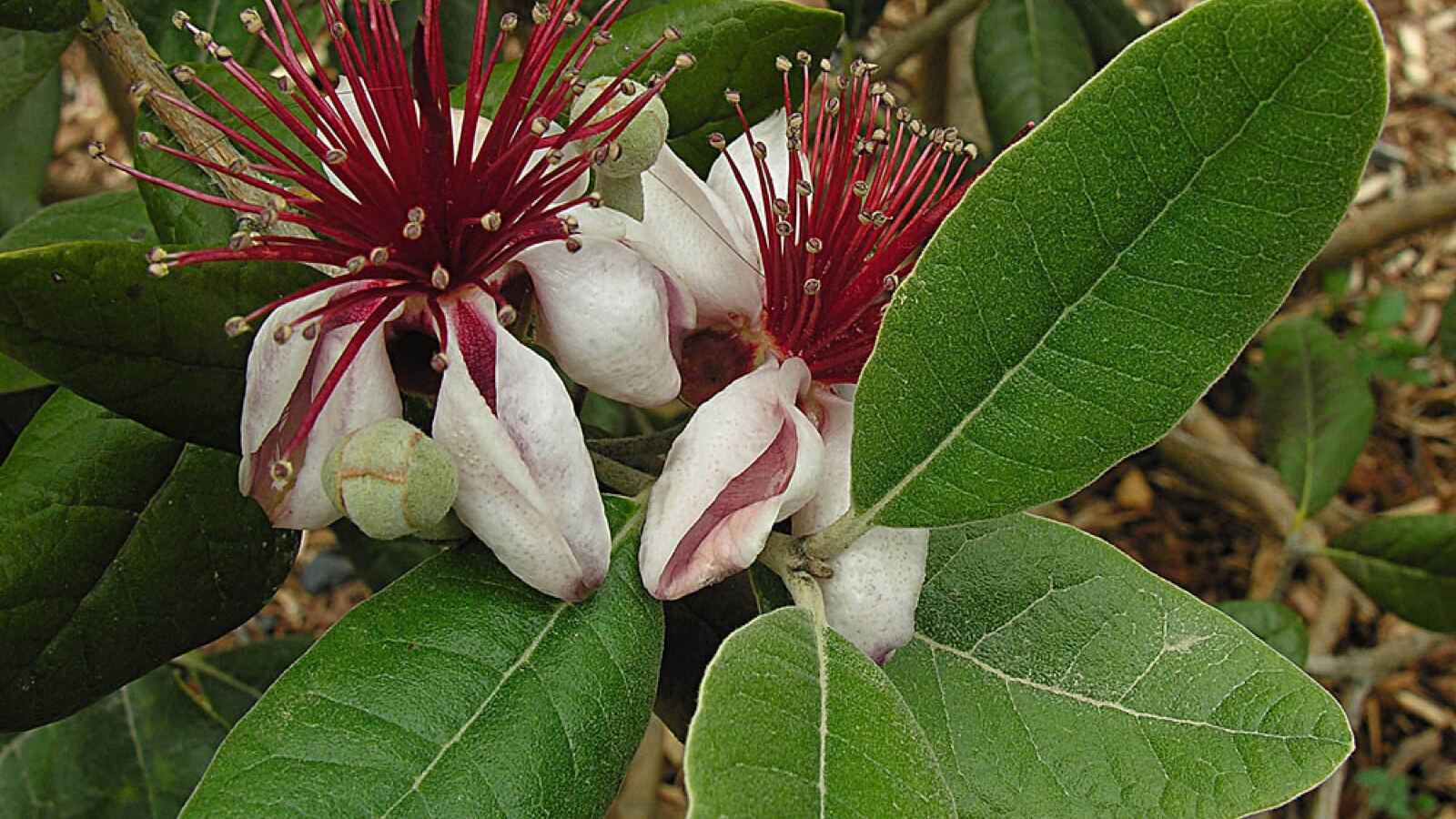
What it is
Acca sellowiana (long known as Feijoa sellowiana), the feijoa or pineapple guava, an evergreen shrub or small tree of the highlands of southern Brazil, Uruguay, and northern Argentina — and a member of the myrtle family, Myrtaceae, kin to the guava, eucalyptus, and clove.
It bears egg-shaped green fruit with a fragrant, granular, sweet-tart flesh tasting of a blend of pineapple, guava, and mint, scooped from the skin with a spoon. It is a much-loved fruit in New Zealand (where it is almost a national obsession), and grown across the subtropics and mild-temperate world — but it remains a garden and local fruit rather than a supermarket one, because it bruises and does not travel or keep well.
Eat the flowers too
The feijoa has a delightful and unusual feature: its flower petals are edible and delicious.
The flowers are showy — fleshy, cupped petals that are white outside and deep pinkish-red within, surrounding a brush of long crimson stamens — and the petals themselves are sweet, mild, and marshmallow-like, eaten straight off the bush or scattered on salads and desserts. Crucially, you can pick and eat the petals without sacrificing the fruit, because the tree does not need all its petals to set a crop. This makes the feijoa a rare two-harvest plant — flowers in one season, fruit in the next — and one of the prettiest edible flowers of any fruit tree.
The colourful, sweet-petalled flowers are built to attract birds, which eat the fleshy petals and, in doing so, pollinate the flower — a bird-pollination strategy (and a bird-reward of petals rather than nectar) that is unusual and charming. Where the right birds are absent, though, fruit set can be poor, and some growers hand-pollinate or plant more than one seedling for cross-pollination. See pollinator habitat.
It tells you when it's ripe
The feijoa solves the perennial "is it ripe?" problem in the simplest possible way: it drops the fruit when ready.
Feijoas do not ripen well if picked early and are hard to judge on the bush, so the standard method is to let the fruit fall to the ground of its own accord and collect it daily — a windfall harvest, gathered from a soft mulch or netting laid beneath the tree. Fallen fruit is at perfect ripeness and is simply picked up, which makes harvesting a feijoa about as easy as fruit-growing gets, though it means eating or processing the crop quickly before it spoils. See harvest and storage.
Tough and hardy
For the grower in a cool climate, the feijoa's great virtue is hardiness. Unlike most of its subtropical myrtle relatives — the frost-tender guava especially — the feijoa tolerates real winter cold, surviving to around −10°C once established, so it fruits in mild-temperate gardens and coastal regions well outside the subtropics, one of the hardiest of all "exotic" fruits.
It is also tough in other ways: wind-firm and salt-tolerant (a good coastal and hedge plant), drought-tolerant once established, and largely free of serious pests and diseases, though it needs a certain amount of winter chill and a long enough warm season to ripen its fruit, which is the main limit at the cool edge of its range. Its density and toughness make it a useful evergreen hedge as well as a fruit plant — an edible, flowering, wildlife-friendly screen.
Growing it
Mild-temperate to subtropical, hardy to moderate frost; full sun for best fruiting (it grows in part shade but crops less), and almost any well-drained soil, tolerant of poor ground, wind, salt, and drought.
Pollination. Many feijoas are partly self-fertile but crop far better with two different plants (seedlings or different cultivars) for cross-pollination, so plant more than one where you can.
Propagation. Seedlings are easy but variable, so named fruiting cultivars are grown from cuttings, layering, or grafting. See propagation and grafting. Prune lightly to shape or as a hedge; little else is needed. See pruning basics.
The feijoa is one of the best fruit trees for a cool-but-mild garden: hardy, tough, evergreen, with edible flowers, self-harvesting fruit, and almost no trouble — a natural component of a temperate-edge food forest.
See also
- Guavas the tenderer myrtle-family relative
- Clove, Nutmeg, and Allspice the myrtle-family spice trees
- Eucalyptus another Myrtaceae relative
- Pollinator Habitat the bird pollination of feijoa flowers
- Hedgerow Care feijoa as an edible evergreen hedge
- Food Forest Design a hardy exotic for cool-climate systems
- Rose Apple and Jambolan
- Jaboticaba
- Lilly-Pilly