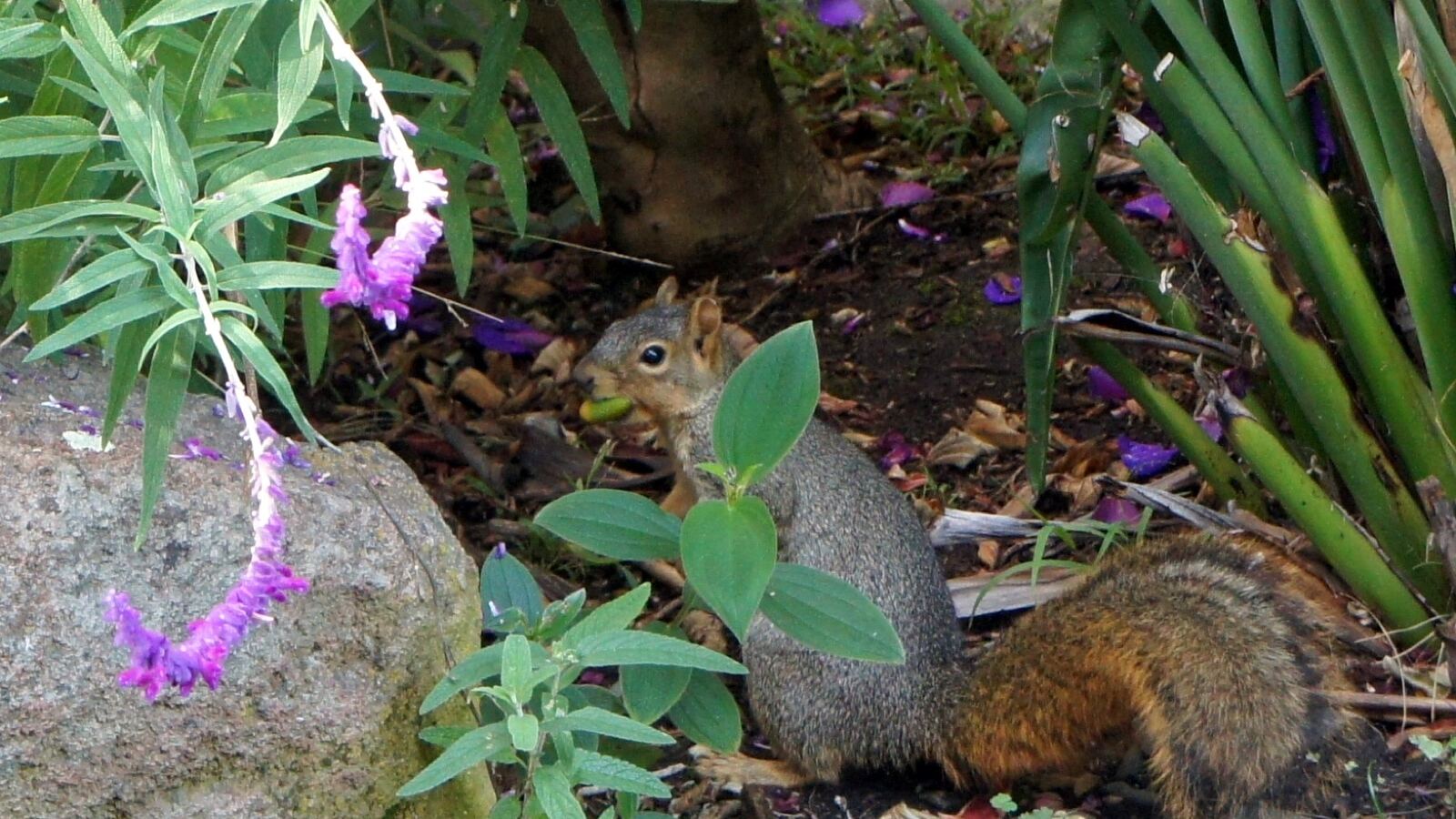
The tree-planting rodent
The squirrel's most important role in the world is one it performs entirely by accident: it plants trees. Squirrels are scatter-hoarders — in autumn they gather far more acorns, hickory nuts, walnuts, pine seeds, and beechmast than they can eat, and they bury them one by one in thousands of small caches across the ground as a winter food store.
Crucially, they forget, or never return to, a large fraction of these buried nuts — and every forgotten cache is a nut planted at the perfect depth, in bare soil, spread out away from the parent tree. So the squirrel is one of the great seed dispersers and planters of the forest: much of the natural regeneration of oaks, hickories, and many nut trees depends on squirrels (and their bird counterparts, the jays and nutcrackers) burying and forgetting the seed. The oaks and the squirrels are locked in an old coevolutionary bargain — the tree feeds the squirrel and, in the forgetting, gets itself planted. In this the squirrel is a genuine keystone of forest renewal.
The other side: the pest
For all that, the squirrel is also, in many places, a serious pest — the same appetite and abundance that plant forests also damage them and the garden:
- Bark-stripping. Squirrels (grey squirrels especially) strip bark from young trees to reach the sappy tissue beneath, which can girdle and kill or deform them — a major problem in commercial and amenity woodland, damaging exactly the young trees a forester is trying to grow.
- Raiding the harvest. They take nuts, fruit, and seed from orchards and gardens, dig up bulbs and newly-sown seed, and raid bird feeders and (occasionally) nests.
So the squirrel is genuinely two-faced: forest-planter and forest-damager, disperser and pest, depending on the setting and the numbers.
The grey-and-red problem
In Britain and parts of Europe, the squirrel carries an extra, invasive dimension. The North American grey squirrel, introduced in the nineteenth century, has largely displaced the native red squirrel across Britain and Ireland — partly by out-competing it (greys are larger, more adaptable, and can digest unripe acorns reds cannot), and, decisively, by carrying squirrelpox virus, which the greys tolerate but which is lethal to reds. The red squirrel now survives mainly in refuges (islands, the far north, conifer forests where it has an edge) and behind active grey-control programmes. It is a textbook invasive-species story — a robust, disease-carrying introduced competitor replacing a native — and it makes grey-squirrel management a conservation priority in a way it is not in the greys' native range.
In the garden and the wood
For the grower, the squirrel is usually a matter of protecting specific things rather than waging war — netting or caging vulnerable seed and fruit, tree guards on young trees where bark-stripping is a risk, and squirrel-resistant bird feeders — while accepting that in a garden with trees, squirrels come with the territory. In the wider landscape, valuing the squirrel's forest-planting role while managing its damage and (where it is invasive) its impact on natives is the balanced view: a rodent that is, all at once, a pest, a nuisance, and one of the most important planters of trees on Earth. See woodland management.
See also
- Seed Dispersal the scatter-hoarding that plants forests
- Native Oaks, Hickory and Pecan, and Nut Pines the trees squirrels bury and plant
- Seed-Dispersing Birds the jays that do the same job
- Coevolution the oak-and-squirrel bargain
- Invasive Species the grey squirrel and the red
- Woodland Management managing squirrel bark damage