What it is
Catalpa, a small genus split, like so many, between eastern North America and East Asia — the northern catalpa, C. speciosa, and southern catalpa, C. bignonioides, of the United States, and Chinese species, plus a hybrid, C. × erubescens.
Called the Indian bean tree in Britain, though it has nothing to do with India or beans — the name refers to the long pods and to the Native American peoples in whose range it grew.
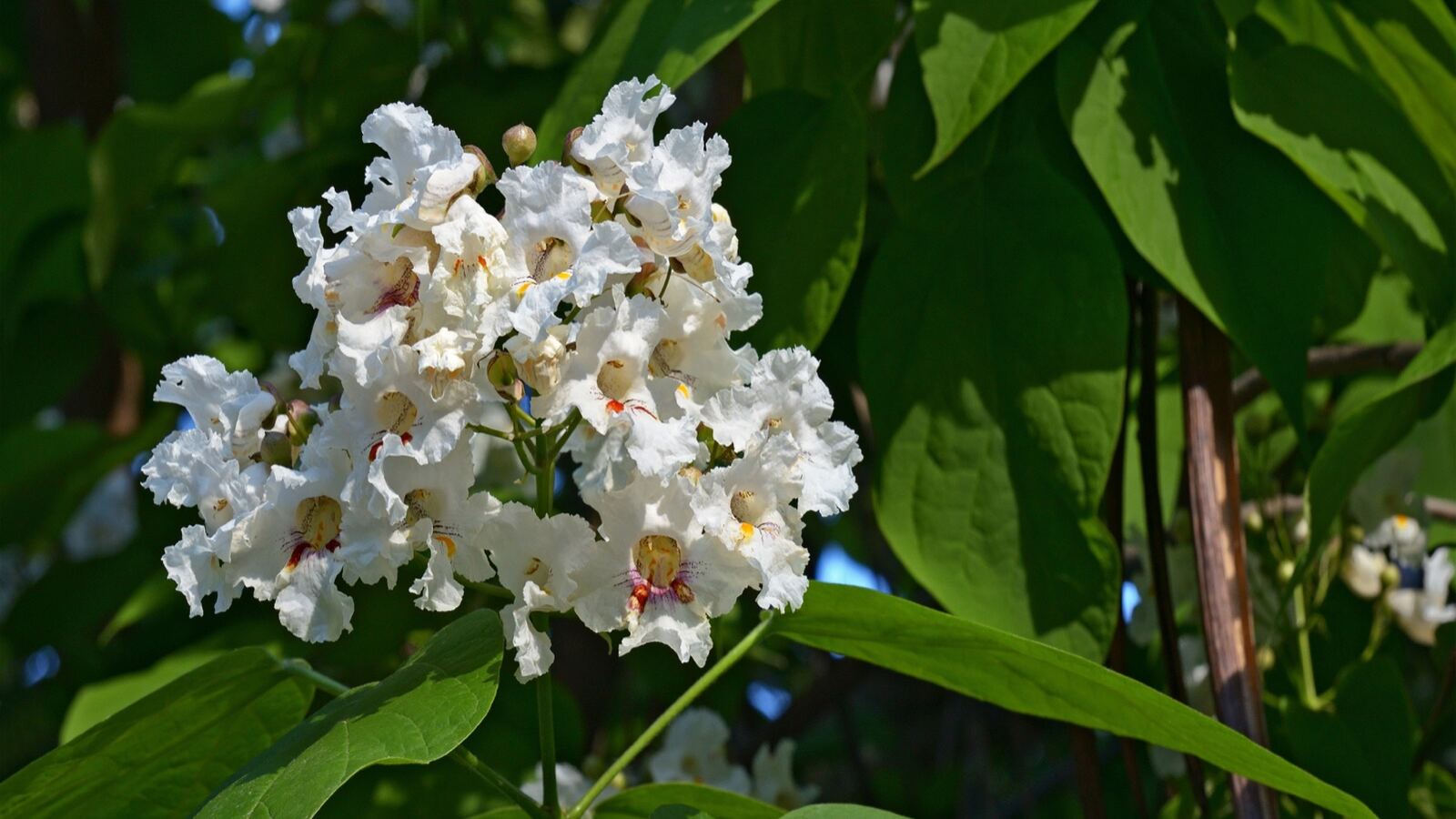
It has a distinctly tropical look that is unusual in a hardy tree: enormous heart-shaped leaves up to 30 cm, upright panicles of frilled, orchid-like white flowers marked with yellow and purple, and long, slender, dangling seed pods.
The flowers and the pods
Flowers. In midsummer, later than most trees, catalpa produces showy upright clusters of trumpet-shaped white flowers with ruffled edges and purple-and-gold throats — genuinely spectacular, and a good late nectar source when much tree blossom is finished. The throat markings are nectar guides steering bees to the flower. See native bees and pollinator habitat.
Pods. The flowers give way to long, thin, bean-like capsules, 20 to 40 cm or more, that hang in bunches through winter and split to release winged seeds — the source of the bean-tree name and, for some, a litter nuisance.
The huge leaves give dense shade and make a bold subtropical effect, which is why catalpa is planted as an ornamental well beyond its native range; a golden-leaved form, Aurea, is popular.
Catalpa worms
The southern catalpa has an unusual claim on the affections of American anglers.
It is the sole larval foodplant of the catalpa sphinx moth, whose large caterpillars — catalpa worms or catawba worms — can defoliate a tree, and which are prized above almost any other bait for freshwater fishing. Southern fishing families have traditionally kept a catalpa or two specifically as a bait source, and the caterpillars are collected, and even frozen, for the purpose.
The trees usually refoliate and recover from defoliation, and the relationship is a good small example of a specialist insect tied to a single tree, in the manner of the pawpaw and its swallowtail. See caterpillars.
Growing it
Undemanding and fast.
Full sun, and tolerant of a wide range of soils, heat, drought once established, and urban conditions — another tough ornamental in the hackberry mould, though the large soft leaves are easily tattered by wind and hail, so it does best with some shelter.
Fast-growing, reaching 10 to 20 m, with a broad spreading crown. The wood is soft, light, and weak, so old catalpas shed limbs and are relatively short-lived — but the northern catalpa's timber is unexpectedly durable in ground contact, and it was valued for fence posts and railway sleepers for exactly that rot resistance, an odd virtue in an otherwise weak wood.
It can be pollarded or coppiced hard to produce a mass of even larger leaves on a compact plant, a technique used to grow it for foliage effect in small gardens — the same manipulation applied to paulownia and eucalyptus. See coppice rotation.
Grows readily from seed and from cuttings. Few serious diseases, though verticillium wilt and leaf spot occur, and the soft wood makes it prone to storm damage.
Catalpa is grown almost entirely for its bold ornamental effect — the vast leaves, the summer flowers, the dangling pods — and as a late nectar tree and a curiosity, rather than for any product.
See also
- Paulownia the other big-leaved, fast, pollardable ornamental
- Native Bees the late nectar the flowers provide
- Caterpillars the catalpa worm and its fishing use
- Hackberry another tough urban tree
- Coppice Rotation pollarding for giant foliage
- Pawpaw and Persimmon another tree with a single specialist insect
- Osage Orange
- Jacaranda and Flame Tree
- Sausage Tree
- Ipê and Pau d'Arco
- African Tulip Tree