What it is
Butea monosperma, the flame of the forest — also called palash, dhak, or the "bastard teak" — a medium-sized, often crooked and gnarled deciduous legume of the Indian subcontinent and Southeast Asia, kin to the silk tree, coral tree, and the other pea-flowered trees.
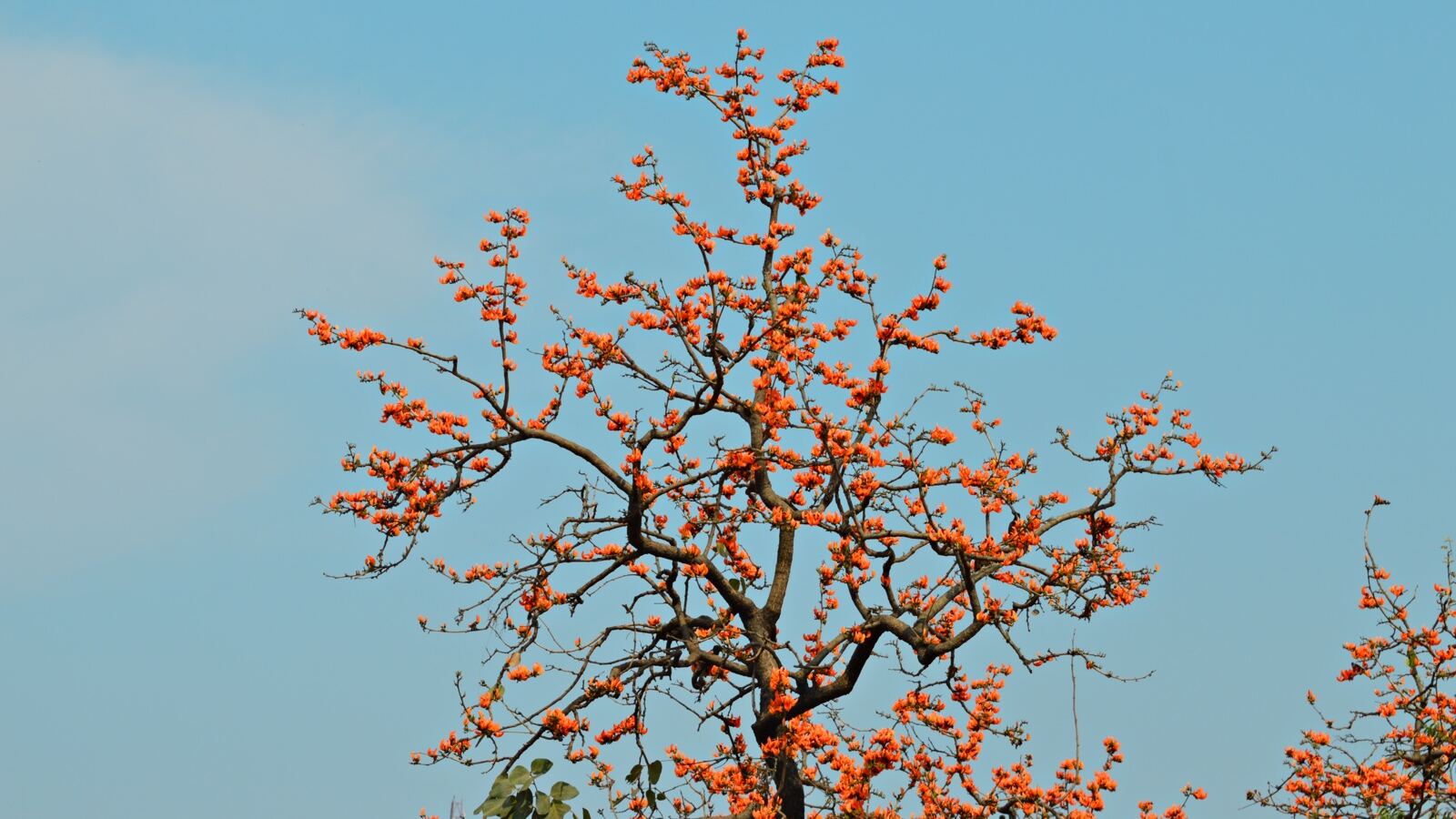
For most of the year it is an unremarkable, twisted, grey-branched tree — but in the dry spring it transforms utterly, dropping its leaves and blazing into a mass of brilliant flower, which is why it is called the flame of the forest.
A tree on fire
When the flame of the forest blooms, on the bare, leafless branches, it covers itself in dense clusters of large, curved, beak-shaped flowers in vivid scarlet, orange, and flame-red, so that whole trees, and whole dry hillsides of them, seem to catch fire — one of the great sights of the Indian spring, and the counterpart of the flame tree, jacaranda, and golden shower tree in its own dry-country way.
The flowers are shaped and coloured for bird pollination: rich in nectar and a strong red that birds see well, they are worked by sunbirds, mynas, and other birds (as well as bees), which pollinate the tree as they drink — the same bird-flower strategy as the coral tree. See pollinator habitat. The tree is deeply woven into Indian culture and religion: it is sacred, associated with several deities and with the god of fire, its trifoliate leaves used in ritual and (like the bael) as leaf-plates, and it appears throughout Indian poetry and painting as the very image of spring and of flame.
The colours of Holi, and the lac insect
The flame of the forest has two classic uses that make it far more than an ornament.
Holi colours. The brilliant flowers are the traditional source of the natural colours of the Holi festival — the spring festival of colour — and of the tesu dye: the flowers are boiled to make a bright yellow-orange dye that was the original, natural Holi colour and a traditional textile dye, before synthetic powders replaced much of it. So the tree's flame literally coloured one of India's great festivals.
Lac and shellac. The flame of the forest is one of the important host trees of the lac insect (Kerria lacca), the scale insect whose secreted resin is harvested as lac — the raw material of shellac (the varnish and wood finish, and the coating once used for gramophone records) and of the crimson lac dye. Sticklac is scraped from the twigs of lac-host trees like the palash, so the tree supports a traditional resin-and-dye industry, in the way other lac-host trees and insect-and-tree partnerships do. The tree also yields a gum (Bengal kino), fodder, fibre, timber, and a long list of Ayurvedic medicines from its bark, seeds, and flowers — a thoroughly useful tree.
Growing it
Tropical to subtropical, frost-tender, and notably tough and drought-hardy: the flame of the forest thrives on poor, dry, degraded, and even saline and waterlogged soils where little else grows, and as a legume it fixes nitrogen and improves the ground, which — with its toughness — makes it valuable for dryland restoration, reclaiming degraded and saline land, and erosion control. See nitrogen fixers.
It wants full sun and a distinct dry season (which triggers the spectacular flowering), is slow-to-moderate growing and long-lived, and is grown easily from seed. As a sacred, spectacular, nitrogen-fixing, dye-and-resin-yielding, land-reclaiming tree, the palash is one of the most valuable and beloved trees of the Indian countryside. See propagation.
See also
- Coral Tree the fellow bird-pollinated, scarlet-flowered legume
- Silk Tree and Golden Shower Tree legume-tree relatives
- Jacaranda and Flame Tree other blazing flowering trees
- Nitrogen Fixers the palash's soil-improving role
- Dryland Restoration reclaiming degraded and saline land
- Bael another sacred Indian tree with ritual leaves
- Bombax