What they are
A group of spiny or wiry yellow-flowered leguminous shrubs of European heath, moor, and poor ground.
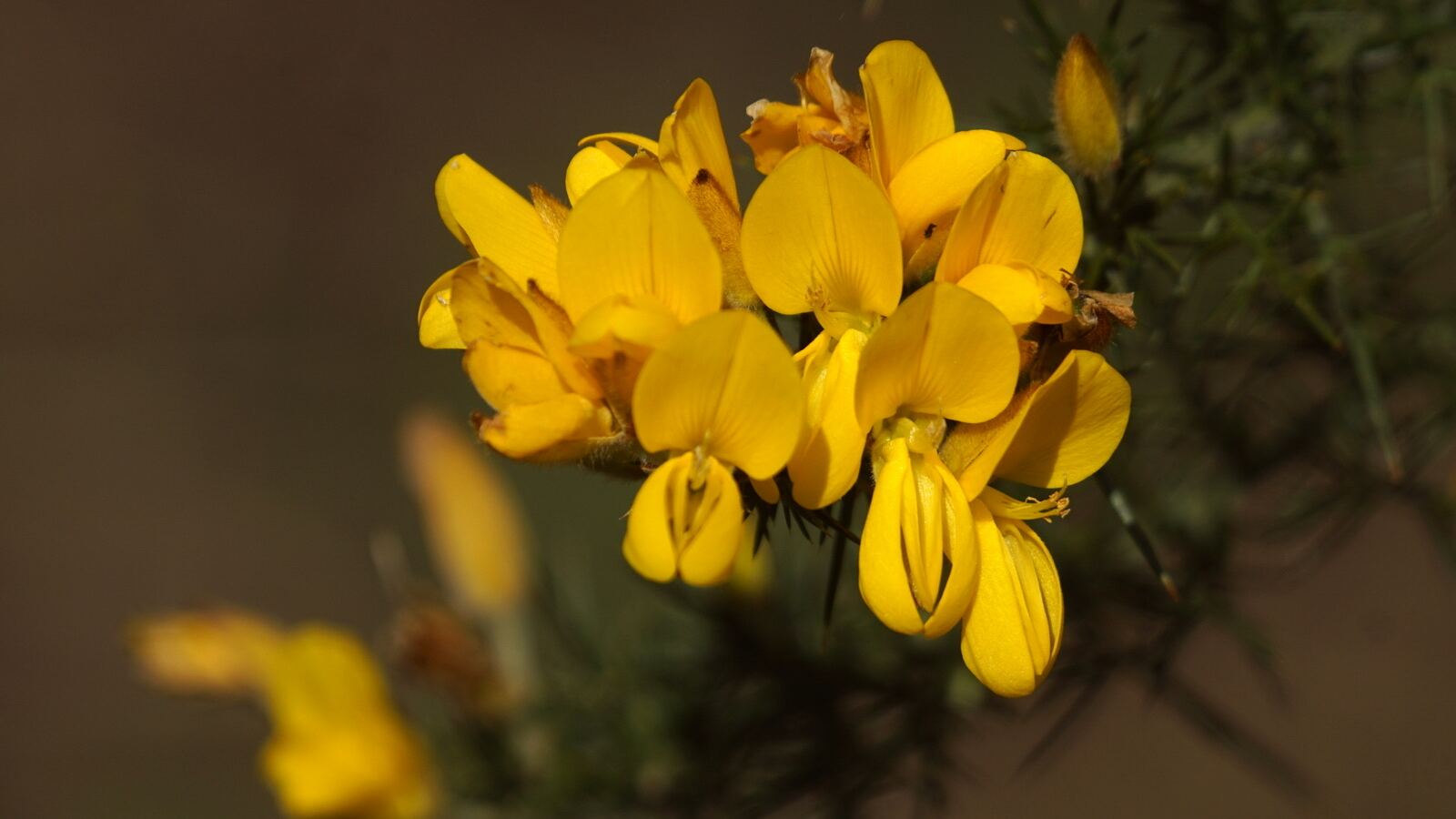
Gorse, Ulex europaeus, is dense, viciously spiny, and evergreen, its leaves reduced to spines.
Broom, Cytisus scoparius, is spineless with green whippy stems and small leaves.
Spanish broom, Spartium junceum, and the various Genista brooms fill similar roles around the Mediterranean.
All are legumes, all flower in masses of yellow pea-flowers, and all are nitrogen-fixing pioneers of the poorest, most acid, most infertile ground — the shrub-scale equivalent of the pioneer trees, doing on heath and dune what alder and sea buckthorn do elsewhere. See nitrogen fixers and pioneer species.
Flowering and coconut scent
Gorse is famous for flowering almost year-round — "when gorse is out of bloom, kissing is out of season," the old saying goes, meaning never, because there is always a little gorse in flower. The main flush is spring, when a gorse-covered slope turns solid gold and the flowers give off a strong scent of coconut or vanilla on a warm day, one of the characteristic smells of European heathland.
The flowers are an important early nectar and pollen source, and the dense spiny bushes are prime nesting habitat for heathland birds — Dartford warbler, linnet, stonechat, yellowhammer — and cover for reptiles and invertebrates. Gorse and broom are keystone structure of a healthy heath. See pollinator habitat and rewilding edges.
Exploding pods and fire
Both fire their seeds explosively: the ripe pods dry, twist, and split with an audible crack on a hot day, flinging the seeds a metre or more — the same ballistic dispersal as witch hazel. On a still, hot summer afternoon a gorse bank crackles continuously with popping pods.
Gorse is also intensely flammable — high in oils, and it burns fiercely — which makes it a serious wildfire fuel and, historically, a valued fuel in its own right: gorse was cut and burned in bread ovens and lime kilns, and grown deliberately for fuel and for fodder (bruised gorse fed to livestock in winter). It regenerates readily after fire, resprouting and germinating from the seed bank, so it is part of a fire-adapted heath cycle. See fire management.
Managing heathland
On European heath and moor, gorse and broom are native and valuable, but they need management — left unchecked they spread and, by fixing nitrogen, enrich the poor soil that the specialised heathland flora depends on, tipping the balance toward coarse grasses and scrub, exactly the fertility-driven succession described in grassland restoration and coastal dunes.
So heathland management involves controlling gorse — cutting, burning, and grazing on rotation — to keep a mosaic of open heather and gorse patches rather than a solid gorse thicket. It is a balance, since some gorse is essential habitat and too much smothers everything. See meadow management for the analogous cutting-and-grazing balance.
Fierce invaders abroad
Outside their native range, gorse and Scotch broom are among the world's worst invasive shrubs — the recurring fate of tough, fast, nitrogen-fixing, seed-heavy, fire-adapted plants.
In New Zealand, Australia, the Pacific coast of North America, Chile, and elsewhere, gorse and broom have invaded pasture, forest margins, and open ground on a huge scale, forming dense impenetrable flammable thickets, enriching soils, increasing fire risk, and costing enormous sums to control. Gorse is a particular scourge in New Zealand. Their seed banks persist for decades, so control is a long campaign of cutting, burning, grazing (goats), and follow-up. See invasive species, and the identical pattern in black locust, leucaena, and tree of heaven.
Ironically, gorse's nitrogen fixation and quick cover mean it is sometimes tolerated as a nurse for regenerating native forest in New Zealand — native trees seed into the gorse, grow up through it, and eventually shade it out, so a gorse thicket can be a stage toward forest rather than a permanent state. It is the nurse tree principle applied to an invasive shrub, and a rare case of an invasion being harnessed.
Growing them
Rarely planted deliberately in their native range, but broom in particular is grown as an ornamental for its flowers, and dwarf and coloured-flowered Cytisus and Genista cultivars are common garden shrubs.
They want full sun and poor, free-draining, acid soil — rich ground makes them soft and short-lived — and they resent transplanting and root disturbance, so are planted small from pots. Both are short-lived, 10 to 15 years, and become leggy with age. See propagation.
Do not plant gorse or Scotch broom where they are invasive.
See also
- Nitrogen Fixers the fixing-shrub role
- Pioneer Species colonising the poorest ground
- Invasive Species gorse and broom abroad
- Fire Management gorse as fuel and fire-adapted plant
- Laburnum the related pea-flowered legume tree
- Nurse Trees gorse nursing native forest in New Zealand
- Tagasaste
- Sandbox Tree