What they are
Elaeagnus, a genus of tough, often silvery-leaved shrubs and small trees of the northern hemisphere — including autumn olive (E. umbellata), Russian olive (E. angustifolia), goumi (E. multiflora), and the evergreen silverberries and oleasters.
They are not olives (the resemblance is only in the narrow, silvery, scaly leaves), but they belong to the family Elaeagnaceae, which makes them close relatives of the sea buckthorn — and, like sea buckthorn, they share that family's two defining traits: they fix nitrogen without being legumes, and they bear tart, nutritious, edible berries.
Nitrogen without legumes
Like the sea buckthorn, alder, and casuarina, the elaeagnus fix atmospheric nitrogen through an actinorhizal partnership — forming root nodules not with the Rhizobium bacteria of the legumes, but with the filamentous soil bacterium Frankia. This is one of the several independent evolutionary routes to nitrogen fixation among trees and shrubs, and it lets the elaeagnus thrive on the poorest, rawest ground — mine spoil, road cuttings, dry banks, pure sand — where they enrich the soil as they grow. See nitrogen fixers and nitrogen-fixing bacteria.
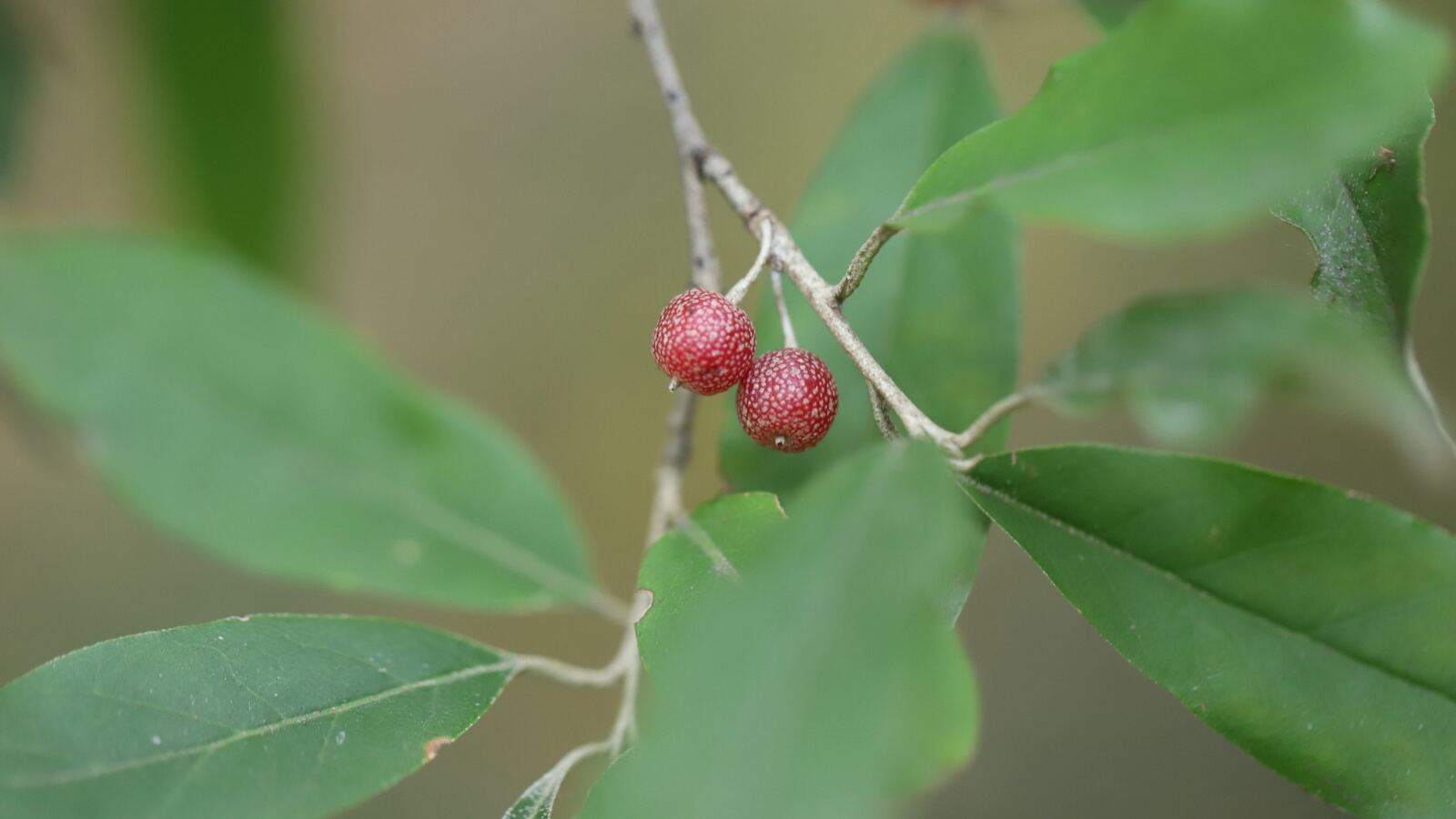
Their berries, too, are worth knowing: goumi and autumn olive bear tart-sweet, speckled red fruit that is genuinely good to eat (and unusually rich in lycopene, the antioxidant of tomatoes), used for jams, sauces, and fresh eating, and they are heavily eaten by birds. These virtues — nitrogen fixation, tough pioneering, edible berries, wildlife value — are exactly why the elaeagnus were once so enthusiastically planted.
Planted for good, escaped for ill
And there is the catch. Autumn olive and Russian olive were deliberately and widely planted across North America through much of the twentieth century — for wildlife food and cover, for windbreaks and erosion control, and for reclaiming poor and disturbed land, promoted and distributed by conservation agencies precisely because they were tough, fast, nitrogen-fixing, and good for birds.
The birds were the problem. They ate the abundant berries and spread the seed everywhere, and the same qualities that made these shrubs useful — toughness, fast growth, nitrogen fixation, heavy fruiting, tolerance of poor ground — made them, once loose, aggressive invasive species. Autumn olive and Russian olive now invade old fields, prairies, riverbanks, and open woodland across large parts of the United States, forming dense thickets, out-competing native plants, and — insidiously — changing the soil by adding nitrogen, which tips the balance against the native flora adapted to lean ground (the same fertility-driven damage done by gorse and other nitrogen-fixing invaders). They are now widely listed as noxious weeds in the very regions that once distributed them — a textbook cautionary tale of a well-intentioned planting programme creating the invasion it never foresaw, and of why nitrogen-fixing pioneers must be handled with special care. See pioneer species.
Growing them
The elaeagnus are, for better and worse, among the toughest and easiest of all woody plants: they tolerate drought, wind, salt, poor and dry and disturbed soil, and cold, and they grow fast and fruit young.
The evergreen ornamental elaeagnus (E. × ebbingei and relatives) are well-behaved, useful, tough evergreen hedge and screen plants, valued for their salt- and wind-tolerance and their tiny, powerfully-fragrant autumn flowers; goumi is grown as a hardy, nitrogen-fixing, edible-fruited shrub in permaculture and food forest plantings. But autumn olive and Russian olive should not be planted where they are invasive — which is much of North America — and the responsible course is to choose the non-invasive kinds or native alternatives. Grown from seed and cuttings. See propagation and wildlife shrubs.
See also
- Sea Buckthorn the close relative — same family, same nitrogen fixing, same edible berries
- Nitrogen Fixers and Nitrogen-Fixing Bacteria the actinorhizal partnership
- Casuarina and Alder other Frankia-nodulating fixers
- Invasive Species autumn olive and Russian olive in North America
- Gorse and Broom another nitrogen-fixing invader that enriches soil to the natives' cost
- Wildlife Shrubs the berries and cover the elaeagnus provide