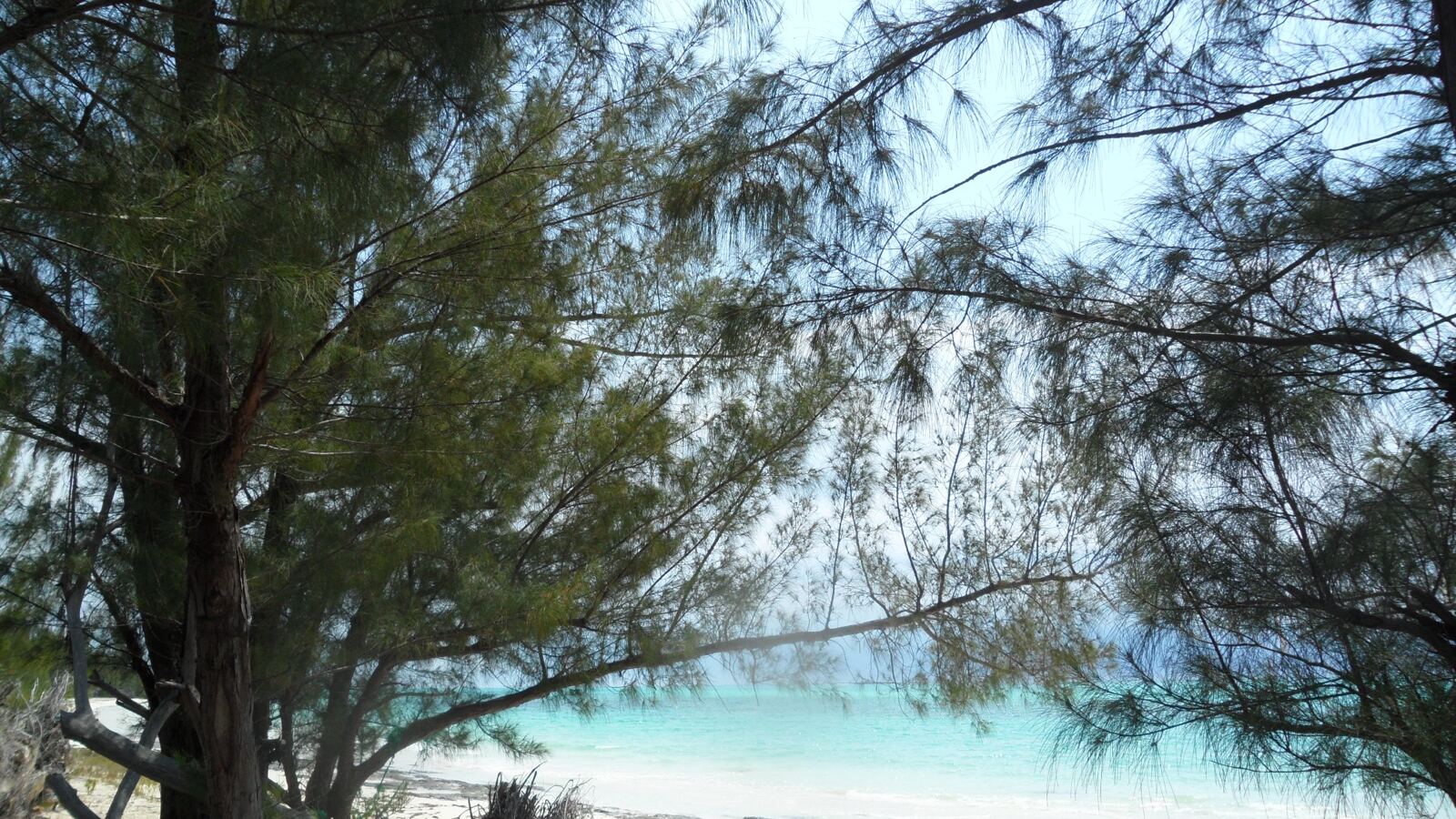
What it is
Casuarina and its relatives (Allocasuarina), the she-oaks or Australian pines — evergreen trees of Australia, Southeast Asia, and the Pacific that look, at a glance, exactly like conifers but are nothing of the kind.
The "needles" are not leaves but fine, jointed, drooping green branchlets that do the tree's photosynthesis; the true leaves are reduced to tiny scales in rings at the joints, and the seed is carried in small woody cone-like structures. It is a striking case of a flowering plant converging on the form of a pine to suit dry, exposed conditions — the same problem solving producing the same shape in unrelated lineages. The name "she-oak" comes from a fancied resemblance of the timber's grain to oak, the "she" implying inferior; "Australian pine" is the American name for the introduced tree.
Nitrogen fixing without being a legume
Casuarina's most important quality is hidden underground: it is a nitrogen fixer, but not a legume.
Instead of the Rhizobium bacteria that nodulate acacia and mesquite, casuarina forms root nodules with a filamentous soil bacterium called Frankia, an "actinorhizal" partnership. This is the very same nitrogen-fixing relationship used by the alder and the sea buckthorn — a completely separate evolutionary route to fixing nitrogen from the legumes, and evidence that this most valuable of tree tricks arose more than once. See nitrogen fixers and nitrogen-fixing bacteria.
Because it fixes its own nitrogen, casuarina thrives on the poorest, rawest, most infertile ground — pure coastal sand, mine spoil, eroded slopes — where it acts as a tough pioneer, enriching the soil and stabilising it, which is why it has been planted so widely for reclamation, shelter, and fuelwood across the dry and coastal tropics.
Coastal defender and wind-singer
In its native and appropriate range, casuarina is a superb coastal and windbreak tree.
It withstands salt spray, wind, drought, sand blast, and poor soil, and its deep and spreading roots bind loose sand, so it is a front-line tree for stabilising coastal dunes and sheltering land behind the shore — a classic windbreak species in exposed places. The fine drooping foliage gives casuarina groves their other famous quality: they "sing" in the wind, the breeze through the needle-like branchlets producing a soft continuous sighing or whistling that is one of the characteristic sounds of an Australian or tropical shore. The wood is dense and hard and among the best of all firewoods, burning hot and long.
The Florida problem
The very toughness that makes casuarina useful makes it, elsewhere, a serious invasive species — and Florida is the cautionary tale.
Planted there for windbreaks and shade, Australian pine escaped and has invaded beaches, dunes, and disturbed ground across the state and the Caribbean. It forms dense stands that shade out native dune plants, its thick mat of shed needles and its allelopathy suppress everything beneath, its shallow surface roots make it prone to toppling in storms (a hazard, not the protection a native dune community gives), and — most seriously — its dense growth on nesting beaches blocks sea turtles and the American crocodile from nesting. It is now a prohibited, actively-removed invader in Florida. The pattern is the familiar one of a hardy, salt- and drought-proof, prolific tree becoming a menace far from home, exactly as tamarisk and melaleuca have in the same region. See erosion control for the shoreline-stabilising role it is wanted, and not wanted, to play.
Growing it
Full sun, heat, and poor, sandy, or saline soil; extremely tough and fast, tolerant of drought, salt, wind, and infertility, and intolerant only of hard frost and deep shade.
Grows fast from seed and coppices readily, which is part of its value for fuelwood and its persistence as a weed. Plant it for coastal shelter, dune stabilisation, land reclamation, and fuel only where it is native or non-invasive — and never in places like Florida where it is prohibited. See propagation and windbreaks.
See also
- Alder the other actinorhizal, Frankia-nodulating nitrogen fixer
- Nitrogen Fixers the non-legume route to fixing nitrogen
- Coastal Dunes casuarina stabilising and invading shores
- Windbreaks a front-line coastal shelter tree
- Invasive Species Australian pine in Florida
- Sea Buckthorn another actinorhizal coastal pioneer
- Sea Grape
- Tropical Almond
- Elaeagnus
- Pepper Tree