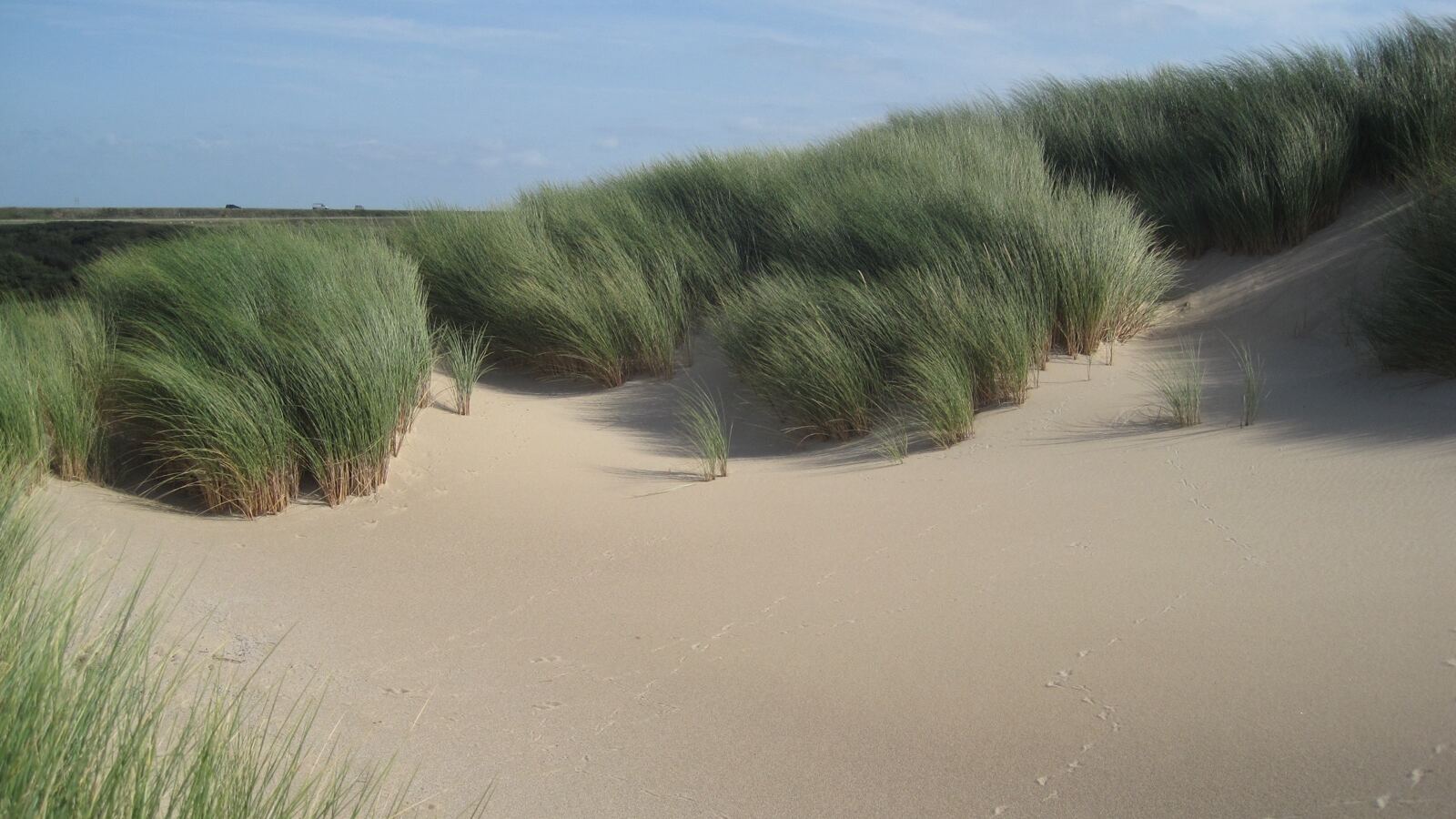
Sand held by a grass
A dune system exists because a few plants can do something unusual: grow upward through accumulating sand.
Marram grass, Ammophila arenaria, is the key species in Europe, with A. breviligulata on the American Atlantic coast and Spinifex in Australasia.
Marram tolerates burial. Sand accumulating around it stimulates vertical rhizome growth, so it grows up through the deposit and keeps its leaves in the light. Each new layer of sand produces more growth, which traps more sand.
That positive feedback is what builds a dune. Remove the marram and the dune moves.
Marram also requires burial — it declines and is replaced when sand stops accumulating, which is why it dominates the mobile foredune and disappears further inland. It is a genuine pioneer that engineers itself out of its own habitat. See pioneer species.
The dune succession
A dune system read from the sea inland is a successional sequence laid out in space, which makes it one of the best places to see succession directly.
Strandline — annuals on tideline debris.
Embryo dunes — sand couch, low hummocks, salt-tolerant.
Mobile yellow dunes — marram, actively accumulating sand, mostly bare ground between plants.
Fixed grey dunes — sand stabilised, a crust of lichens and mosses forming, marram declining, and a species-rich low sward developing. Grey dune is among the most botanically rich habitats in Europe and is a priority for conservation. See lichens and mosses.
Dune slacks — damp hollows where the surface reaches the water table. Distinct flora including orchids, and important amphibian habitat. See amphibians and reptiles.
Dune heath and scrub — the later stage, acidifying, with heather and eventually sea buckthorn, birch, and pine.
Each stage supports a different community, and a functioning system needs all of them present simultaneously — which requires ongoing sand movement.
The over-stabilisation problem
The counterintuitive part, and the reason modern dune management often looks like vandalism.
Twentieth-century dune management aimed to stop the sand moving: planting marram, fencing, laying brushwood, and in many places planting conifers or sea buckthorn.
It worked. Across northwest Europe dune systems became largely fixed and vegetated — and the specialist species collapsed.
Grey dune and bare sand species need open, disturbed, nutrient-poor, mobile conditions. A stabilised dune develops a closed sward, accumulates organic matter and nitrogen, and is invaded by coarse grasses and scrub. The rare invertebrates, lichens, and annuals that need bare sand disappear.
Atmospheric nitrogen deposition accelerates it independently, fertilising a habitat whose diversity depends on infertility — the same mechanism described in grassland restoration.
The loss of rabbit grazing to myxomatosis removed another source of disturbance. See deer and rabbits.
So restoration now frequently means remobilising sand: cutting notches through foredunes to let wind and sand move inland, stripping vegetation and turf, removing scrub and planted conifers, and reintroducing grazing.
It is deliberately undoing a century of stabilisation work, and it is well supported by the ecology.
Where stabilisation is still right
The distinction is between coastal defence and habitat, and they can conflict.
Where a dune protects property or infrastructure, maintaining its volume and integrity is legitimate, and marram planting, brushwood, and fencing all work.
Sand fencing — porous barriers that slow wind and drop its sediment load — accumulates sand effectively and is used to rebuild eroded foredunes. The mechanism is the same as a windbreak, applied to sediment rather than to crops.
Boardwalks and access control matter enormously. Trampling is a major cause of blowouts, because a footpath through marram destroys the vegetation, wind exploits the gap, and a small breach becomes a large one. Directing feet is cheap and effective.
The reasonable synthesis: maintain the seaward defence dune where assets require it, and allow dynamism inland.
Invasive species
Dunes are unusually vulnerable, because low fertility is the habitat's defining feature and anything that adds nitrogen changes it fundamentally.
Sea buckthorn, a nitrogen fixer, is native to some dune systems and severely damaging on others, forming dense thickets that shade out dune flora and enrich the soil permanently. Control is a routine and expensive task. See sea buckthorn and invasive species.
Marram itself is invasive in North America and Australasia, where it builds steeper, more continuous foredunes than the native species and displaces them — with knock-on effects on nesting shorebirds that need open low dunes.
Pines and other planted trees, established for stabilisation and now being removed.
Restoring a dune
Diagnose first. Is the problem erosion, over-stabilisation, trampling, nutrient enrichment, or invasion? They need opposite treatments, and getting it wrong is common. See site reading.
Control access before anything else, since trampling undoes other work.
Remove scrub and planted trees where grey dune is the target.
Consider turf stripping to expose bare sand and remove accumulated nutrients — drastic-looking and effective.
Reintroduce grazing. Rabbits, or conservation grazing with hardy stock, maintains the open sward. See rotational grazing.
Allow blowouts rather than repairing every one.
Plant marram only where accumulation is the goal, and use local material.
Monitor over years, since dune vegetation responds slowly and weather dominates short-term change. See monitoring.
The general principle is the one running through this section: identify the process that maintained the habitat, and restore the process rather than the appearance. In mangroves it is tidal exchange; in dunes it is sand movement. See mangrove restoration.
See also
- Sea Buckthorn the nitrogen fixer that transforms dunes
- Grassland Restoration the same fertility problem
- Pioneer Species marram as a self-eliminating pioneer
- Erosion Control stabilisation where it is warranted
- Mangrove Restoration restoring process rather than appearance
- Invasive Species marram outside its range
- Wild Roses
- Casuarina
- Sea Grape
- Tropical Almond
- Norfolk and Bunya Pines
- Nipa Palm
- Screw-Pine