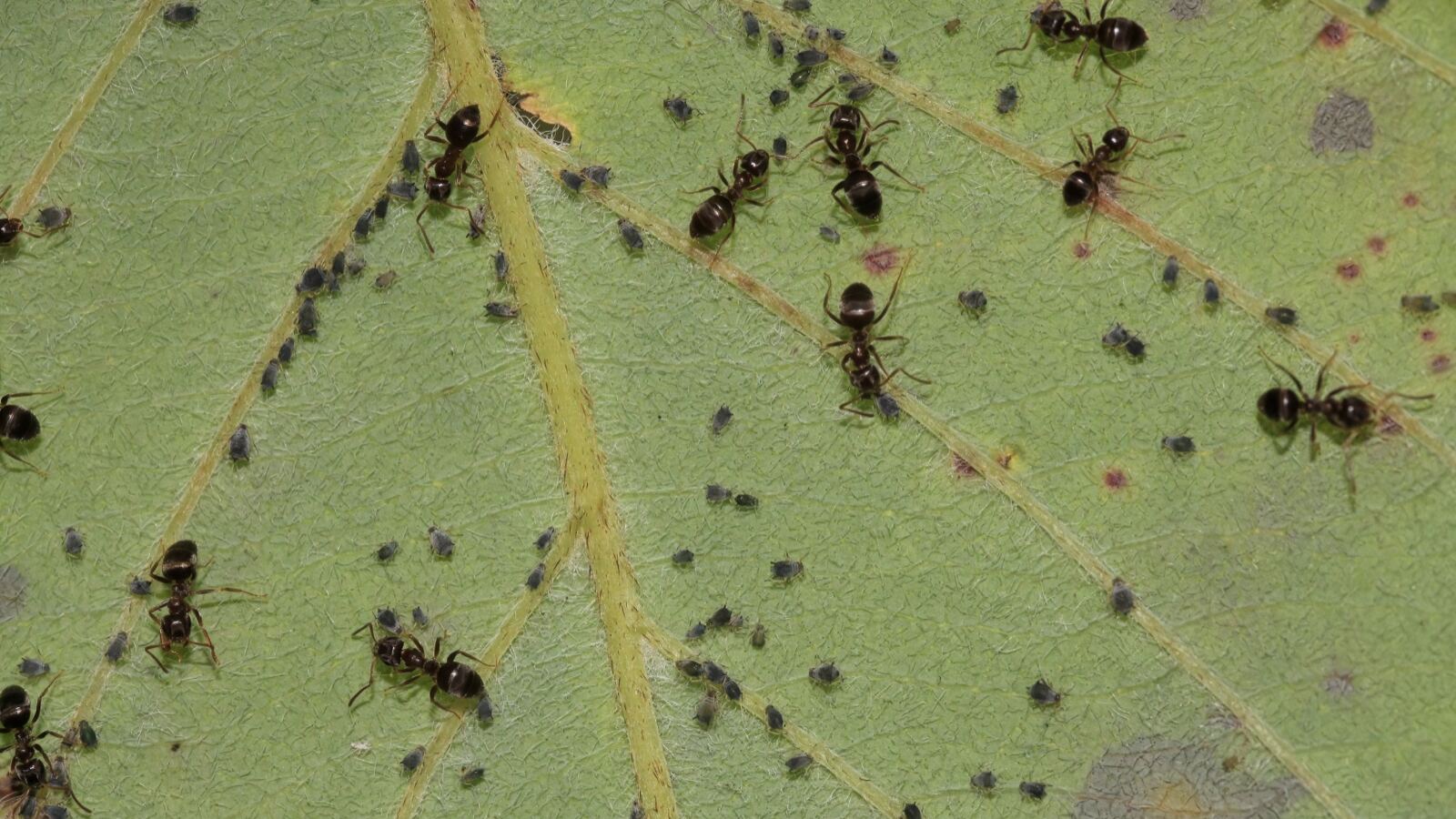
Ants farm your aphids
The single most useful thing to understand about ants in a garden.
Many ant species tend aphids for honeydew, the sugary excretion aphids produce from plant sap. The relationship is genuine husbandry:
They defend them. Ants actively attack and remove ladybird larvae, hoverfly larvae, lacewings, and parasitoid wasps from the colonies they tend.
They move them to better feeding sites on the plant.
They overwinter aphid eggs in their nests and carry the hatchlings out to host plants in spring.
They stroke them with antennae to stimulate honeydew release.
The consequence is direct: an aphid colony attended by ants persists far longer than one that is not, because the predators are being physically evicted. If aphid numbers are not falling despite obvious predator presence, look for ants.
The fix is a barrier, not an insecticide. A greased band or horticultural glue band around a fruit tree trunk stops ants reaching the canopy, and the predators then work uninterrupted. Cheap, targeted, and effective. See aphids and predator-prey balance.
What ants do that is useful
They are not simply a problem, and the balance is genuinely mixed.
Soil engineering. Ant nests move large quantities of soil, create macropores, improve drainage and aeration, and redistribute nutrients. In some systems their earth-moving rivals earthworms.
Predation. Many species are significant generalist predators of caterpillars, larvae, and other insects.
Seed dispersal. Myrmecochory — seed dispersal by ants — is widespread and under-appreciated. Many woodland plants produce seeds with an elaiosome, a fatty appendage that ants carry back to the nest, eat, and discard the seed intact in a nutrient-rich, predator-free chamber.
Violets, wood anemone, celandine, primrose, bloodroot, and trilliums all depend on it. A substantial share of temperate woodland ground flora is ant-dispersed, which is one reason ancient woodland ground flora spreads so slowly — the dispersal agent moves seeds metres per year, not kilometres. See historical ecology and indicator species.
Wood ants in conifer forest are keystone species, taking enormous numbers of insects and building mounds that are habitats in themselves. See scots pine.
Social wasps
Common wasps and hornets have the worst reputation of any garden insect, and it is largely undeserved for most of the year.
For most of the season they are predators. A wasp colony provisions its larvae with animal protein — caterpillars, aphids, flies, and other insects — and a single nest takes an estimated several thousand insects over a season, many of them pests.
Through spring and midsummer, wasps are doing free pest control on your behalf and are almost entirely uninterested in you.
Then the colony stops rearing brood. In late summer the queen ceases laying, the larvae the workers were feeding disappear, and with them the sugary secretion the larvae gave the adults in exchange for protein.
The workers, now with no job and no sugar source, go looking for it — which is when they arrive at fallen fruit, jam, and beer gardens. The nuisance phase is the last few weeks of a colony that has spent months being useful.
Hornets are larger, considerably less aggressive than common wasps, and significant predators. They are protected in some countries and are worth leaving alone.
Asian hornet, Vespa velutina, is a different matter — an invasive predator of honeybees spreading across Europe, and sightings should be reported to the relevant authority. See invasive species.
Solitary wasps and parasitoids
The great majority of wasp species are solitary, sting-free as far as people are concerned, and enormously beneficial.
Solitary hunting wasps provision individual cells with paralysed prey — caterpillars, aphids, spiders, weevils — one species often specialising narrowly.
Parasitoid wasps lay in or on hosts, and collectively they are the most important group in biological control. Their signatures are covered in beneficial predators: bronzed aphid mummies, white cocoons beside a dying caterpillar, blackened whitefly scales.
Gall wasps induce the plant to grow a structure that houses the larva — oak apples, marble galls, robin's pincushion. Mostly harmless to the tree, and each gall supports its own community of inquilines and parasitoids.
Fig wasps are the obligate pollinators of figs, in one of the tightest mutualisms known. See fig species.
Most solitary wasps nest in hollow stems, beetle holes in dead wood, or bare soil — the same provisions as solitary bees. See native bees and rock and log piles.
Living with both
Leave wasp nests alone unless they are somewhere genuinely hazardous. The colony dies in autumn, the nest is never reused, and it will have removed thousands of pest insects first.
Band fruit trees against ants rather than spraying aphids.
Provide nesting habitat — hollow stems, dead wood, bare sunny soil — for solitary wasps and bees.
Flowering plants support adult wasps of all kinds, which take nectar. Umbellifers again, plus ivy in autumn — an ivy in flower in September is covered in wasps, hoverflies, and late bees. See pollinator habitat.
Deal with ants in the house by exclusion rather than treating the garden. Ants outdoors are mostly doing useful work, aphid farming aside.
See also
- Aphids the crop the ants are farming
- Ladybirds the predators ants evict
- Beneficial Predators parasitoid wasps in the guild
- Native Bees the same nesting requirements
- Leafcutter Ants the tropical fungus-farming relatives
- Predator-Prey Balance why banding beats spraying
- Parasitoid Wasps