What it is
Anacardium occidentale, the cashew, a spreading evergreen tree native to northeastern Brazil, spread by Portuguese traders to Africa and India in the sixteenth century, and now grown across the seasonally-dry tropics — with India, Vietnam, and West Africa the major producers.
It belongs to the cashew family, Anacardiaceae, alongside the mango, pistachio, and sumac, and it carries the family's hallmark: a caustic, urushiol-related oil that makes handling the raw nut genuinely hazardous.
The upside-down fruit
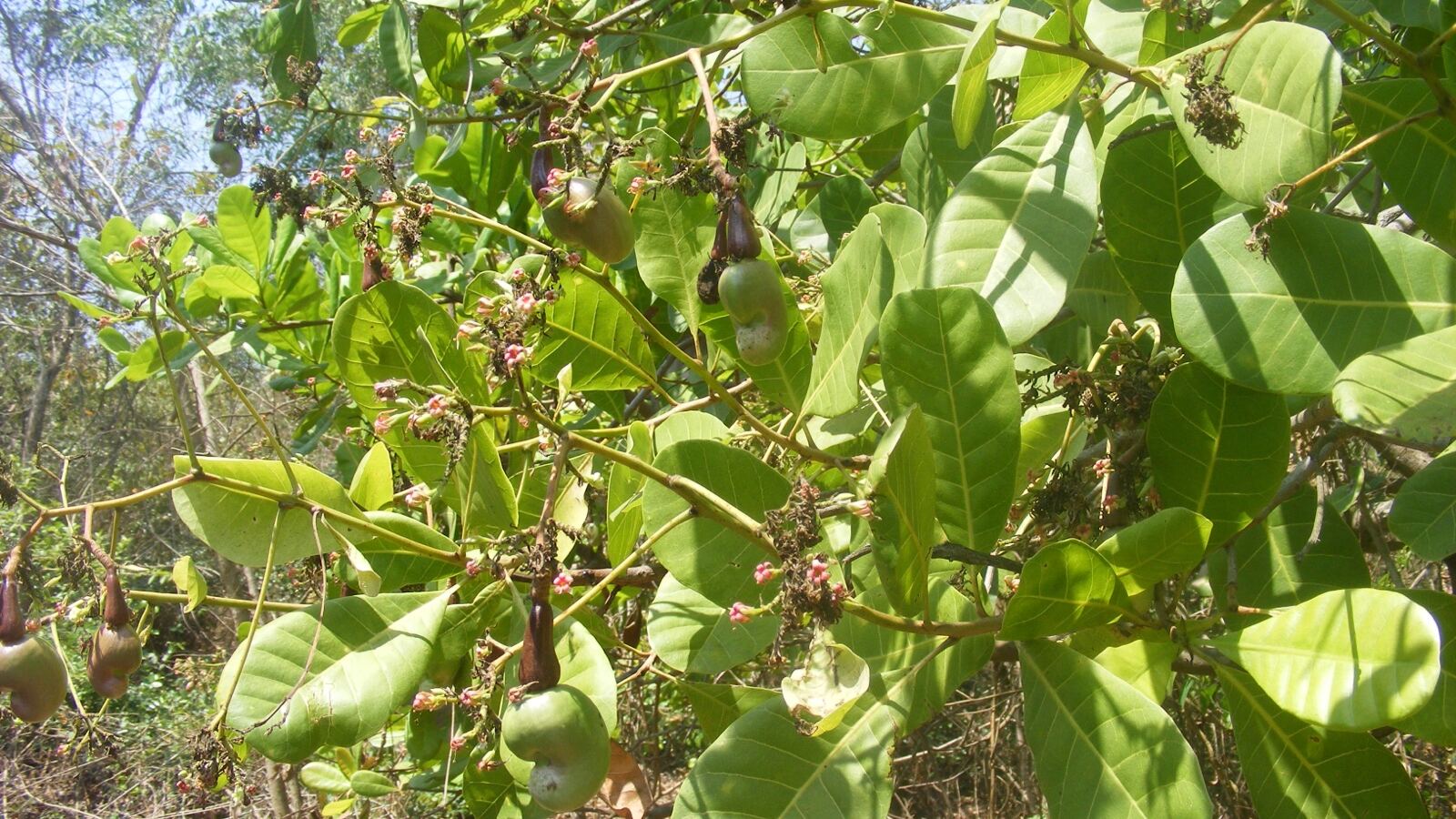
The cashew is one of the strangest-looking of all food plants because the fruit and the nut are two separate structures, arranged the wrong way round.
What looks like the fruit — the swollen, glossy, red or yellow, pear-shaped "cashew apple" — is not the fruit at all but a swollen flower stalk (an accessory fruit). The true fruit, the familiar kidney-shaped grey nut, hangs on the outside, beneath the apple, dangling like an afterthought. This is the reverse of the normal arrangement, where the seed sits inside the fruit.
The cashew apple is juicy, sweet-tart, astringent, and highly perishable — too delicate to ship, so it is little known outside growing regions, where it is eaten fresh and made into juice, jams, and fermented into liquor (the Goan feni and Brazilian cajuína). Vast quantities are simply wasted because only the nut travels well, a real loss of food.
The dangerous shell
The reason cashews are never sold in their shells, and always cost more than other nuts, lies in that shell.
Between the hard outer shell and the edible kernel is a layer of cashew nut shell liquid (CNSL), rich in anacardic acid and cardol — caustic, blistering compounds chemically kin to the urushiol of poison ivy and sumac. Raw cashew shell will burn and blister skin, and the fumes from careless roasting are hazardous, so processing the nut — roasting to destroy the oil, then shelling and cleaning — is skilled, labour-intensive, and historically hard on the workers who do it by hand. This is why the "raw" cashews sold in shops are in fact steamed or roasted; a truly raw, in-shell cashew is not safe to handle casually. The caustic CNSL is itself a valuable industrial product, used in brake linings, resins, and coatings.
An easy, tough tree
For all the hazard in the nut, the tree itself is easy and tough.
Cashew thrives in hot, seasonally-dry lowland tropics on poor, sandy soils where little else fruits, tolerates drought well once established, and asks very little — which is why it became an important smallholder cash crop and a tree for stabilising and using degraded, sandy, coastal ground. It has been widely planted for erosion control on poor tropical soils as well as for its nut. Its toughness on poor dry ground puts it alongside the other resilient dryland-tropical trees, and it fits naturally into a low-input tropical food forest.
Growing it
Hot lowland tropics, frost-free, with a distinct dry season for flowering and fruiting; it dislikes cool, wet, and high-altitude conditions.
Soil. Undemanding — it prefers deep sandy well-drained soil and tolerates poor and sandy ground, but resents waterlogging and heavy clay. Drought-hardy once established.
Form. A low, spreading, wide tree, reaching 10 to 12 m but often broader than tall, so it needs room.
Propagation. Seedlings are variable, so improved high-yielding types are grafted; it also grows readily from the nut. See grafting and propagation.
Cashew is a rewarding, low-input tree for a hot dry-tropical garden — for the apple as much as the nut, since the fresh apple is a treat that never reaches the market. Just respect the shell.
See also
- Mango the close relative, and the same family chemistry
- Pistachio another edible-nut member of the cashew family
- Sumac and Smoke Tree the urushiol relatives
- Tropical Fruit Trees cashew in the wider tropical orchard
- Erosion Control cashew on poor, sandy tropical soils
- Grafting propagating improved cashew varieties
- Marula
- Mombin and Ambarella
- Quebracho