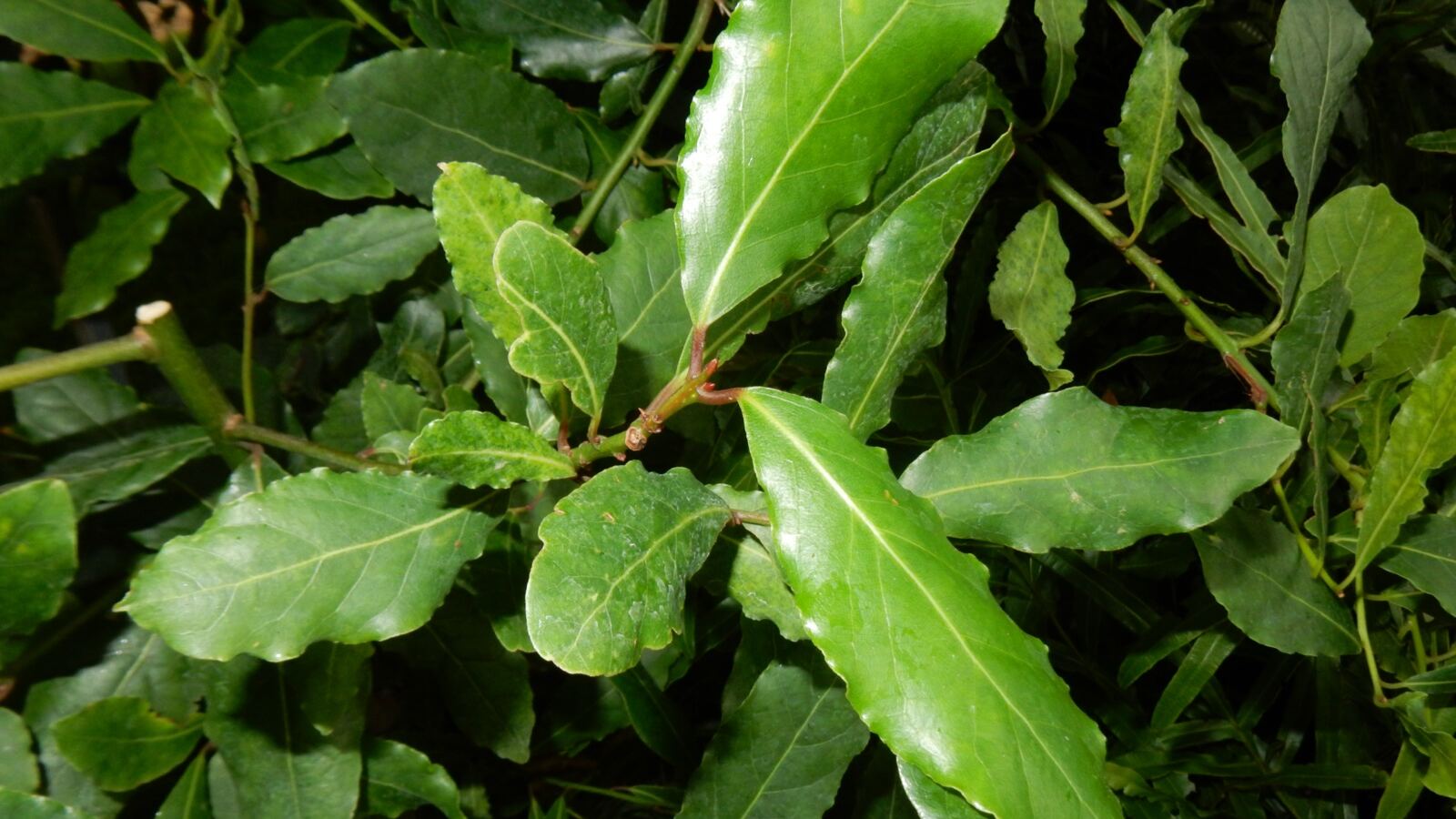
The tangle of "laurel"
Few plant names are as confusing as "laurel," because it is attached to several unrelated evergreens with glossy leaves. Two matter most, and they could hardly be more different — one a noble culinary tree, one a poisonous impostor.
Bay, or sweet bay, Laurus nobilis, is the true and original laurel, of the Mediterranean, in the laurel family Lauraceae — kin to the avocado, cinnamon, and camphor.
Cherry laurel, Prunus laurocerasus, and Portugal laurel, P. lusitanica, are not laurels at all but cherries — members of the rose family, in the same genus Prunus as the stone fruit — that merely resemble bay in their glossy evergreen leaves and borrowed the name.
Bay: the crown of victory
The true bay is one of the most storied plants of the classical world.
Its aromatic evergreen leaves were woven into the laurel wreath, the crown of victory and honour in ancient Greece and Rome — awarded to triumphant generals, poets, and athletes, and sacred to Apollo. The words survive everywhere: "laureate" (poet laureate, Nobel laureate) and "baccalaureate" both come from the laurel, and the Olympic and academic use of the wreath descends directly from it. To "rest on one's laurels" is the same image.
In the kitchen, bay leaves are a fundamental culinary herb — one of the aromatics of the bouquet garni, added whole to stocks, stews, sauces, and braises across European cooking and removed before serving, since the leathery leaf is not eaten. The flavour is warm, slightly bitter, and deepens slow-cooked dishes. See culinary herbs.
Bay is a handsome, dense evergreen that clips beautifully, and it is a classic tree for topiary and formal pots — the clipped bay standard (a mophead on a clear stem) is a staple of formal gardens, in the same tradition as clipped box and yew. It is slightly tender, so in cold areas it is grown in a pot and sheltered in winter.
Cherry laurel: the poisonous impostor
The cherry laurel is a very different plant with a darker character.
It is a vigorous, fast, dense evergreen shrub widely planted for hedging and screening, valued because it grows quickly into a tall, solid, glossy green wall. But it has serious drawbacks. Being a Prunus, its leaves and seeds contain cyanogenic compounds, and crushed cherry laurel foliage releases hydrogen cyanide — the leaves were once used by entomologists in "killing jars" to gas insects, and the plant is genuinely toxic to livestock and, in quantity, to people. The abundant black cherry-like fruit have poisonous kernels.
It is also, in mild oceanic climates, a serious invasive species. Cherry laurel seeds freely (birds spread the fruit), tolerates deep shade, and forms dense evergreen thickets in woodland that shade out the entire native ground flora — a major problem in British and Irish woods, where clearing invasive cherry laurel (rhododendron's frequent companion) is a large part of woodland management. It is the classic case of a tough, shade-tolerant, bird-sown evergreen hedge plant turning into a woodland menace, and it should be planted with real caution or avoided in favour of native hedgerow species.
Growing them
Bay wants a warm, sheltered, well-drained spot in sun or part shade; it is drought-tolerant once established and thrives in a pot. Hardy to around −5 to −10°C, so it needs winter protection in cold regions. Trouble-free apart from bay sucker and scale insects. Propagated by cuttings, which are slow to root, and by seed. See propagation and pruning basics.
Cherry and Portugal laurel grow almost anywhere, fast, in sun or deep shade, and stand hard pruning — cut them with a saw or loppers, not a hedge trimmer, which shreds the big leaves unsightly. Their very toughness is the problem; site them where the seedlings and suckers will not escape into woodland.
See also
- Avocado the edible member of the true laurel family
- Cinnamon and Camphor the aromatic laurel-family spice trees
- Culinary Herbs bay in the kitchen
- Box and Privet the other classic clipped evergreens
- Stone Fruit the Prunus relatives of cherry laurel
- Invasive Species cherry laurel in native woodland
- Rose Apple and Jambolan
- Curry Tree