The organisms that recycle wood
Wood is mostly cellulose, hemicellulose, and lignin. Lignin in particular is extremely resistant to breakdown, and for a long stretch of the Carboniferous almost nothing could digest it — which is a substantial part of why coal exists.
Fungi are now the principal organisms that can, and wood decay fungi are the main route by which a tree returns to soil. Bacteria and invertebrates contribute; fungi do the structural work.
The visible bracket or mushroom is only the fruiting body. The organism is the mycelium, already distributed through the wood, often for years or decades before anything appears outside.
That lag matters practically: a bracket appearing on a tree means decay is already well established, not that it has just begun.
Three rots, three consequences
The type of decay determines what happens to the wood mechanically, which is why it matters for tree safety.
White rot. The fungus breaks down lignin as well as cellulose, leaving pale, fibrous, stringy wood. Decayed wood stays relatively flexible and fails gradually, bending and tearing rather than snapping. White rot fungi are the only organisms that degrade lignin efficiently.
Examples: honey fungus, Ganoderma, turkey tail, Pleurotus.
Brown rot. The fungus takes the cellulose and leaves the lignin, producing wood that is brown, dry, crumbly, and cracked into cubes — the characteristic cubical brown rot. The residue is brittle and fails suddenly and catastrophically under load.
Examples: chicken of the woods, Laetiporus; sulphur tuft; dry rot in buildings, Serpula lacrymans.
The practical upshot: brown rot is the more dangerous in a standing tree, because there is little warning before failure. Two trees with the same volume of decay can present very different risks depending on which fungus is responsible.
Soft rot. Slower, caused by ascomycetes, degrading cell walls in very wet or otherwise hostile conditions where the others cannot operate.
Reading the brackets
Identifying the fungus tells an arborist a great deal about what is happening inside a tree, and it is one of the more useful field skills.
Honey fungus, Armillaria. White mycelial sheets under the bark at the base smelling strongly of mushroom, black bootlace rhizomorphs in the soil, and honey-coloured clumps of mushrooms in autumn. A root and butt rot, and a genuine killer of weakened trees. See tree diseases.
Ganoderma. Large perennial brackets at the base with a white pore surface that bruises brown. White rot of the butt and roots, and a common reason for major-limb and stem failure in mature broadleaves.
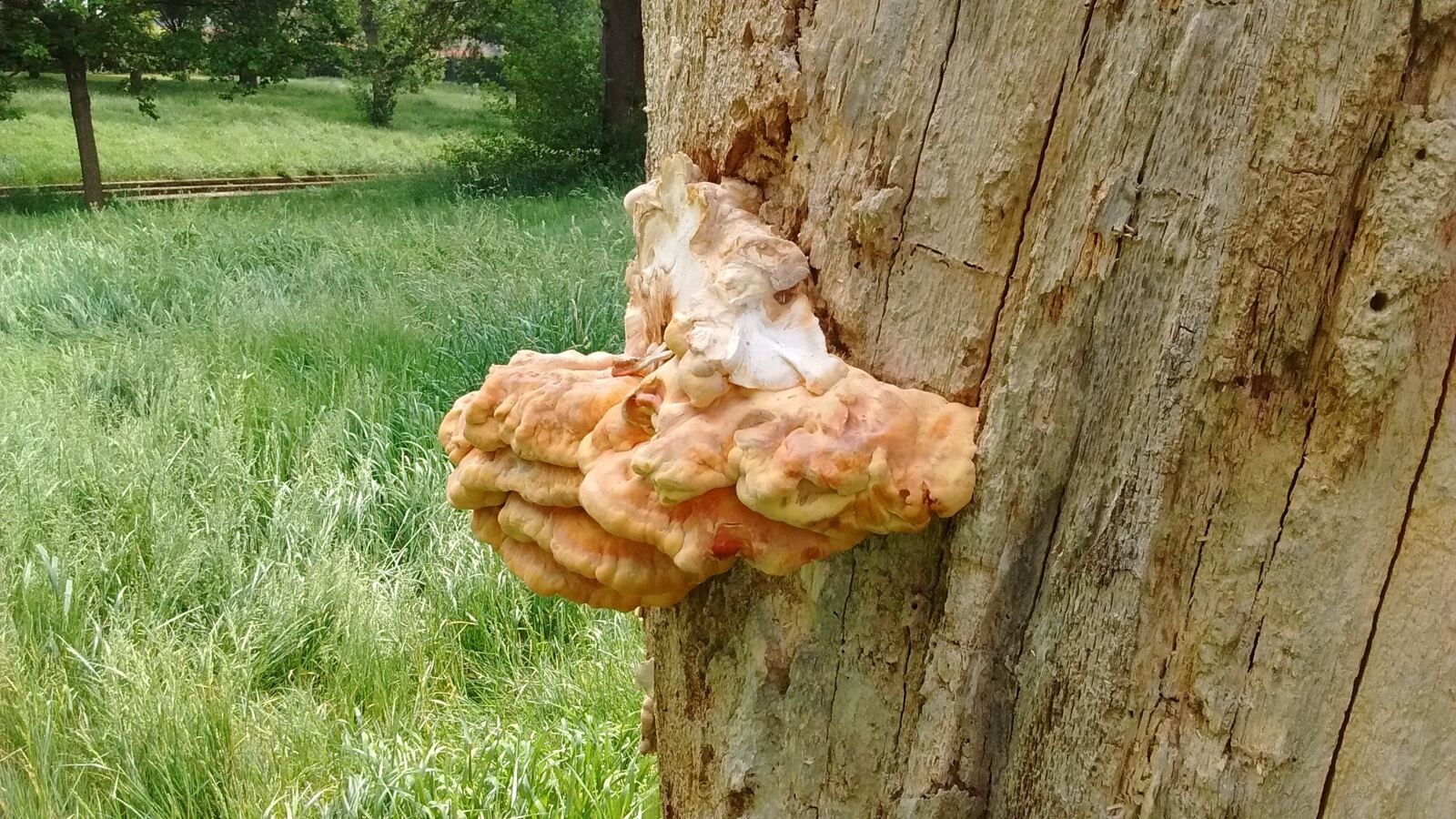
Chicken of the woods, Laetiporus sulphureus. Bright orange-yellow tiered brackets, usually on oak. Brown rot of the heartwood — so a tree carrying it has brittle heartwood and should be assessed. Also a good edible when young, from oak rather than from yew or conifers.
Beefsteak fungus, Fistulina hepatica. Looks like raw liver, on oak and sweet chestnut. Causes brown oak, a rich colouring prized by furniture makers, and decays slowly — comparatively benign.
Birch polypore, Fomitopsis betulina. On birch almost exclusively, and generally the sign that the tree is finished. Historically used as a strop for razors and as tinder, and it was among the items carried by Ötzi the Iceman.
Turkey tail, Trametes versicolor. Thin banded concentric brackets, extremely common on dead broadleaf wood, white rot, and largely a saprophyte rather than a pathogen.
Dryad's saddle, Cerioporus squamosus. Large scaly brackets, smells of watermelon, white rot on elm, sycamore, and beech.
Not all of them are killing the tree
An important distinction, and one that leads to a lot of unnecessary felling.
Saprophytes decay dead wood only. Their presence on a dead limb or a stump says nothing about the living tree.
Pathogens attack living tissue and kill.
Facultative species do both, typically taking hold in dead heartwood or through a wound while the living sapwood continues functioning.
That last category is the important one, because heart rot is normal in old trees and is not necessarily a problem. A hollow tree is not a dying tree. The living tissue is the outer sapwood ring, and a hollow cylinder is mechanically efficient — engineers use tubes for the same reason.
Ancient oaks, yews, and hornbeam pollards are routinely hollow and structurally sound, and the hollowing is part of how they achieve great age: it reduces weight, recycles nutrients back into the root zone, and is arguably an adaptation rather than a disease.
Why hollow trees matter
Decay is what creates the habitat features that take centuries to form.
Rot holes, cavities, loose bark, hollow trunks, and decaying heartwood support saproxylic invertebrates — species dependent on decaying wood — of which there are thousands, many of them rare and many found in nothing else.
Plus bats, owls, woodpeckers, and hole-nesting birds. See dead wood habitat, bats, and insectivorous birds.
Removing every dead limb and felling every hollow tree removes an entire guild. The correct response to decay in a tree away from targets is usually to leave it, monitor it, and let it become the habitat that a young tree cannot be for two hundred years.
Where there are targets — paths, roads, buildings — decay is a safety matter and needs assessment by someone competent, with the rot type as a central input.
Decay in use
Mushroom cultivation is the deliberate application of white rot fungi to logs and waste, and it is covered in mushroom cultivation.
Spalting — the black zone lines drawn where competing fungal colonies meet in decaying wood — is prized by woodturners and is fungal territorial boundary marking made visible.
Mycoremediation exploits the enzymes white rot fungi use on lignin, which also degrade a range of persistent pollutants. See bioremediation.
Mycelium materials grown into packaging and insulation use the same organisms binding agricultural waste.
Dry rot, Serpula lacrymans, is the same biology in a building, and it is destructive precisely because it can transport water through its mycelium and decay timber that is not otherwise wet enough to rot.
See also
- Dead Wood Habitat what decay creates
- Tree Diseases the pathogenic species in context
- Mushroom Cultivation putting white rot to work
- Decomposers the wider recycling community
- Woodland Management retaining decaying trees
- Bioremediation lignin enzymes against pollutants