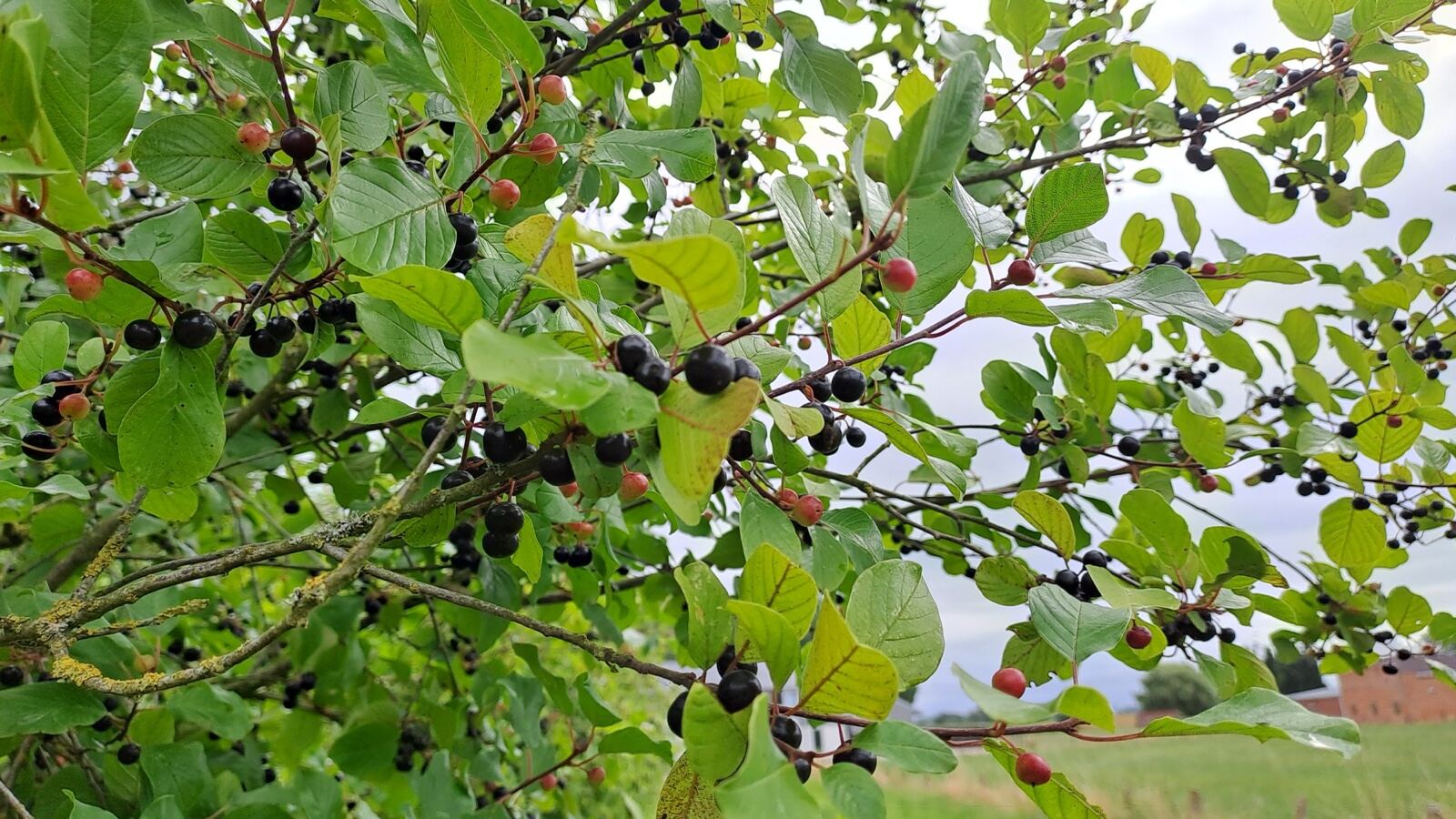
What they are
Two related shrubs of European hedge and woodland, easily overlooked and easily confused.
Purging buckthorn, Rhamnus cathartica: thorny, with opposite leaves, found on chalk and limestone.
Alder buckthorn, Frangula alnus: thornless, with alternate glossy leaves, found on wet acid ground and peat.
Both are small, unshowy, and important out of all proportion to their looks — one for a butterfly, the other for gunpowder.
The brimstone butterfly
Buckthorn's chief claim on the affections of naturalists is that the two shrubs are the sole larval foodplants of the brimstone butterfly (Gonepteryx rhamni).
The brimstone is one of the first butterflies of the year, the sulphur-yellow male often the very first seen on a warm late-winter day, and it is thought the word "butterfly" itself derives from its butter-yellow colour. Its caterpillars eat nothing but buckthorn, so the distribution of the butterfly follows the distribution of the shrubs, and planting buckthorn is one of the most reliable ways to bring brimstones to a garden or hedge. It is a clean example of a specialist insect wholly dependent on a single, obscure host — the same tight relationship as the pawpaw and its swallowtail. See butterflies and moths and caterpillars.
The best gunpowder charcoal
Alder buckthorn has a second, entirely unrelated distinction: its wood makes the finest charcoal for gunpowder.
Charcoal is one of the three ingredients of black powder, and not all charcoal is equal — the wood's density, evenness, and low ash matter. Alder buckthorn charcoal was recognised for centuries as the premier gunpowder charcoal, prized above all others by powder mills, and it was grown and coppiced specifically for the purpose. The fine, even, slow-burning quality that made it valued for powder also made it good artists' charcoal, in the manner of spindle and willow charcoal. The wood was coppiced on short rotation for this trade.
The purge
The "buckthorn" and "purging" names are a warning: the berries are a violent laxative — the source of the old cathartic "syrup of buckthorn" — and are mildly poisonous, causing severe purging if eaten in quantity. The bark of alder buckthorn (frangula bark) was likewise a traditional, gentler laxative drug, and is still recognised medicinally. The berries are safe for birds, which eat and disperse them, but not a hedgerow fruit for foraging. See seed-dispersing birds.
The North American invasion
In its native Europe buckthorn is a valued, well-behaved component of a mixed hedgerow and woodland edge. Introduced to North America, common (European) buckthorn became one of the worst invasive shrubs of the northern United States and Canada.
It leafs out early and drops leaves late, casting dense shade that suppresses everything beneath; it forms impenetrable thickets in woodland understorey; its berries (dispersed by birds and acting as that laxative, which speeds their passage) spread it far and wide; and it is an alternate host of soybean aphid and of oat crown rust, so it is an agricultural problem as well as an ecological one. Vast sums are spent removing it, and it is the classic case, alongside other introduced hedge shrubs, of a modest European plant becoming a menace abroad — the recurring invasive species story. Glossy (alder) buckthorn is invasive in wetlands there in the same way.
Growing them
Both are easy, cheap bare-root hedge plants in Europe.
Purging buckthorn wants sun and lime-rich soil — chalk and limestone. Alder buckthorn wants damp, acid ground and does well in wet riparian and boggy sites where few shrubs thrive, which makes it a useful component of a wet mixed hedge. Both are modest 3 to 6 m shrubs, easily kept in a hedge, and both are excellent for wildlife shrubs plantings — for the brimstone above all. Do not plant either where it is invasive.
See also
- Butterflies and Moths the brimstone that depends on buckthorn
- Spindle and Dogwood the hedge shrubs it grows with, and other charcoal woods
- Hedgerow Care buckthorn in a mixed native hedge
- Invasive Species common buckthorn in North America
- Coppice Rotation growing alder buckthorn for charcoal
- Wildlife Shrubs planting for butterflies and birds