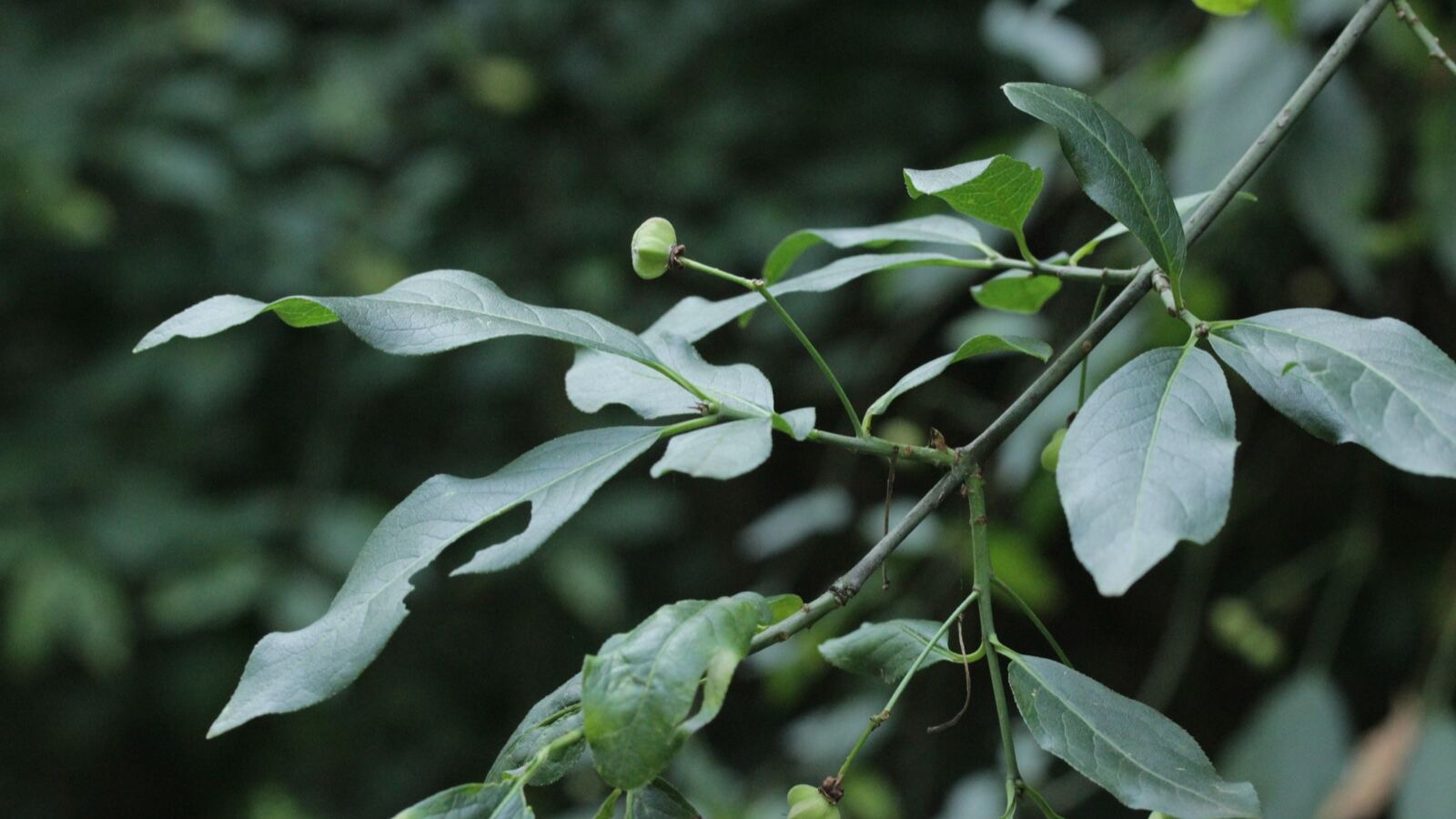
Two hedgerow regulars
Both are small deciduous shrubs of woodland edge and hedgerow across Europe, both are routinely overlooked, and both are worth knowing.
Spindle, Euonymus europaeus. Slender green four-angled twigs, inconspicuous greenish flowers, and then extraordinary fruit — vivid pink four-lobed capsules that split to reveal orange-coated seeds. Nothing else in a British hedge looks remotely like it.
Dogwood, Cornus sanguinea. Oval leaves with distinctive curving parallel veins, flat heads of small white flowers, black berries, and blood-red winter stems.
The dogwood leaf trick
A field-identification detail worth carrying.
Tear a dogwood leaf gently in half and pull the two pieces slowly apart. Fine white threads stretch between them, like a spider's silk, and hold the halves together.
Those are latex strands in the vascular tissue, and they are diagnostic — nothing else in a European hedge does it. Once you know it you can identify dogwood by touch at any time of year the leaves are on.
Spindle: beautiful and poisonous
The fruit is one of the most striking things in an autumn hedgerow, and every part of the plant is toxic — the seeds especially, containing alkaloids and cardiac glycosides. Children have been poisoned by the attractive fruit.
The seeds are nonetheless eaten and dispersed by robins and other birds, which are unaffected. See seed-dispersing birds.
Spindle has one further liability worth knowing on a farm: it is the winter host of the black bean aphid, which overwinters on spindle and moves to broad beans in spring. Removing spindle from near a vegetable plot is a genuine, if minor, consideration. See aphids and peas and beans.
What they were used for
Spindle wood is hard, dense, fine-grained, and pale, and it sharpens to a very fine point without splintering. It was the standard timber for the spindles of spinning wheels — hence the name — and for skewers, toothpicks, knitting needles, and pegs.
It also produces high-quality artists' charcoal, still sold as such, because it burns to a fine even black.
Dogwood is likewise very hard and dense — the name may derive from dags, meaning skewers, rather than from dogs. Used for skewers, arrows, tool handles, and mill cogs. The related American flowering dogwood was used for textile shuttles, where extreme wear resistance mattered.
Winter stems
Dogwood's real modern use is ornamental. The young stems are bright red, and cultivars extend that to orange, yellow, and near-black.
The colour is only on young wood, so the stems must be cut back hard — stooled to near ground level — every year or two in early spring. An uncut dogwood loses its colour entirely and becomes a dull green shrub, which is why so many planted ones disappoint.
This is coppice rotation at garden scale, and the cut material is useful for pea sticks and small woven work.
Dogwood also suckers and spreads, which makes it useful for stabilising banks and unhelpful in a small border. See erosion control.
In hedgerows and woodland
Both are proper components of species-rich hedgerows and woodland edge, and both matter for the same reasons.
Structure. They occupy the shrub layer beneath hawthorn, blackthorn, and hazel, and it is the presence of that layer — rather than the canopy above it — that determines much of a hedge's wildlife value. See structural diversity.
Nectar. Dogwood's flat white flower heads are excellent for hoverflies, beetles, and short-tongued insects. Spindle's inconspicuous flowers are more heavily worked by insects than they look.
Fruit for birds in autumn.
Age indication. The number of woody species in a length of hedge is a rough guide to its age, and spindle and dogwood are among the species that tend to appear in older hedges. They are also associated with ancient woodland and with lime-rich soils. See indicator species and historical ecology.
Growing them
Both are easy, cheap as bare-root whips, and undemanding.
Spindle prefers lime-rich soil and does best on chalk and limestone, in sun or part shade. 3 to 6 m.
Dogwood tolerates almost anything including heavy wet clay, and thrives in damp ground — which makes it useful in riparian buffers and on wet margins. 2 to 4 m.
Include both in mixed hedge planting at a low proportion — a hedge of 60 to 70 percent hawthorn and blackthorn with 30 to 40 percent mixed hazel, field maple, spindle, dogwood, guelder rose, and dog rose is far better for wildlife than a single-species one and costs no more. See hedgerow care and nursery stock.
Cut on a rotation rather than annually, leaving sections uncut each year so that flowering and fruiting continue somewhere in the hedge every season.
The wider genus
Cornus is a large and useful genus. C. mas, cornelian cherry, flowers on bare stems in late winter — one of the earliest nectar sources of the year — and produces edible red fruit. C. florida and C. kousa are the showy flowering dogwoods with large white or pink bracts. C. alba and C. sericea are the brightest-stemmed of the winter forms.
Euonymus includes the evergreen E. fortunei and E. japonicus used as ground cover and hedging, and E. alatus, burning bush, with spectacular autumn colour and an invasive habit in eastern North America. See invasive species.
See also
- Hedgerow Care rotational cutting and mixed planting
- Wildlife Shrubs the shrub layer and what it feeds
- Structural Diversity why the middle layer matters
- Indicator Species dating a hedge by its species
- Coppice Rotation stooling dogwood for stem colour
- Hawthorn the hedge they grow alongside
- Cornelian Cherry
- Buckthorn
- Guelder Rose and Viburnum
- Dove Tree