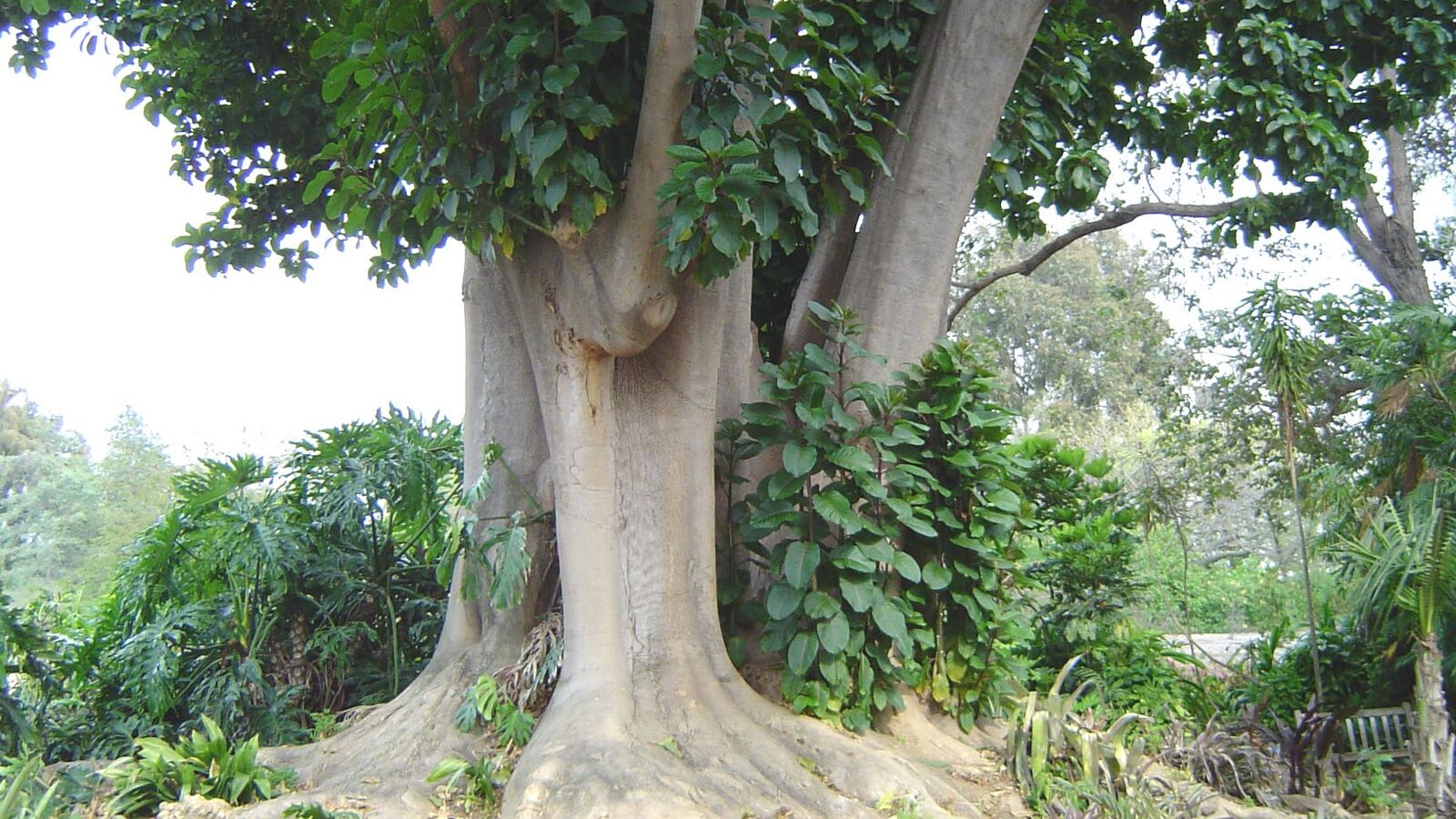
What it is
Phytolacca dioica, the ombú — the iconic solitary "tree" of the Argentine and Uruguayan pampas, standing alone on the vast flat grassland as a great dome of shade, a landmark visible for miles, and a beloved symbol of the region.
But the ombú, famously, is not really a tree at all. It is a giant herb — a tree-sized relative of the pokeweed — and it has none of the machinery of a real tree: its swollen trunk contains no true wood, no growth rings, and no proper bark, being instead a soft, spongy, water-storing mass of herbaceous tissue. It is one of the most striking examples of a non-woody plant growing to the size and stature of a great tree, in the way the banana and palms do among the monocots — but the ombú is a dicot, and its way of getting big is all its own.
A trunk of water and sponge
The ombú's trunk and its huge, buttressed, above-ground base are built of a soft, wet, spongy tissue that stores water — you can cut it with a knife, and it holds so much water and so little solid matter that the wood is useless for timber or even for firewood (it will barely burn). This watery, non-woody construction has several consequences that shape the plant's character:
- It grows very fast (unhampered by having to build dense wood);
- It is fire-resistant — the water-filled trunk does not readily burn, so the ombú survives the grass fires of the pampas that would kill an ordinary tree, one reason it stands alone as the surviving "tree" of the fire-swept grassland. See fire management.
- It is drought-resistant, drawing on its stored water, like the baobab and bottle trees in their different ways. See drought-tolerant species.
- But it is also weak and brittle, its huge limbs prone to splitting under their own weight, so old ombús often sprawl and rest their branches on the ground.
The whole plant is poisonous — all parts contain toxic saponins and other compounds — which means livestock and insects leave it alone, and it casts a dense shade in which little grows; the gauchos of the pampas prized it precisely as the one source of shade and shelter on the open grassland, a landmark and a resting-place, and it is woven through the folklore, poetry, and identity of Argentina and Uruguay. See historical ecology.
Growing it
Subtropical to warm-temperate, the ombú is tough, fast, and drought- and fire-resistant, wanting full sun and tolerating a wide range of soils, heat, drought, and wind; it is frost-sensitive when young but hardens with age, and it is grown as a shade and specimen "tree" in warm parks and large gardens, where its huge swollen base and broad dome make a dramatic feature.
It grows very fast from seed (and is dioecious, with separate male and female plants), and needs space — a great deal of space — for its spreading, splitting, ground-resting limbs and its massive base. As a fast-growing, fire-proof, drought-proof, poisonous giant herb that plays the part of a great tree on the treeless plain, the ombú is one of the most remarkable "trees" that is not a tree. See propagation.
See also
- Banana and Plantain and Palms other giant, non-woody, tree-sized plants
- Baobab and Kurrajong and Bottle Trees other water-storing trunks
- Fire Management the fire-resistance that lets the ombú survive the pampas
- Drought-Tolerant Species the ombú's stored-water survival
- Grass Tree another odd, non-standard "tree"
- Historical Ecology the ombú in the culture of the pampas