What it is
Coccoloba uvifera, the sea grape, a sprawling evergreen tree or large shrub of the tropical American coast — the beaches of Florida, the Caribbean, and Central and South America — and, surprisingly, a member of the buckwheat and rhubarb family, Polygonaceae, not related to the true grape at all.
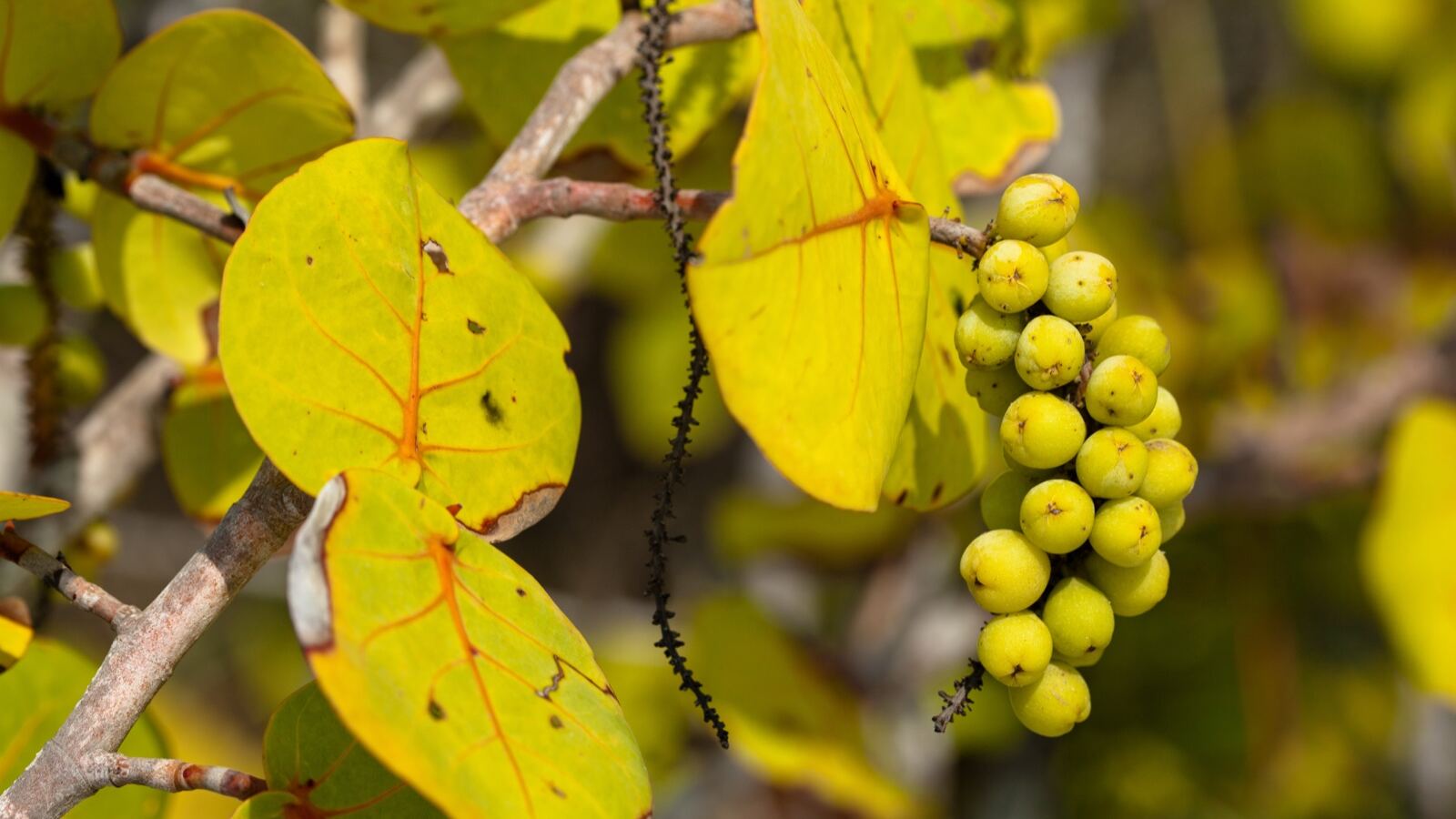
It is unmistakable on a tropical shore: large, round, leathery, dinner-plate leaves with red veins, a wind-sculpted spreading form, smooth mottled bark, and — on the female trees — long hanging clusters of round fruit that ripen from green to purple and really do look like bunches of grapes, which gives the tree its name.
The beach's front line
The sea grape's chief importance is as a coastal stabiliser — one of the toughest and most valuable of all shoreline trees.
It grows right on the beach, in pure sand, at the very front of the vegetation, where it endures conditions that kill almost everything else: salt spray, salt-laden wind, blazing sun, drought, poor sterile sand, and shifting dunes. Its spreading roots bind the sand, its dense low canopy breaks the wind and shades the ground, and it catches and holds blowing sand to build and hold coastal dunes — the same front-line dune-fixing role that casuarina and beach grasses play, but performed by a native tree that supports rather than displaces the shore ecosystem. For this reason sea grape is widely planted for beach stabilisation, erosion control, and windbreak along tropical coasts, and in many places it is protected precisely because it defends the shoreline. Its dense growth also shades sea-turtle nesting beaches appropriately and provides coastal habitat. See erosion control and windbreaks.
The fruit
The fruit is genuinely useful, if fiddly. Ripe sea grapes are sweet-tart, with a thin layer of pulp around a large stone, and are eaten fresh straight off the tree — a classic beach nibble — and, above all, made into a fine jelly and jam, and fermented into wine. Because the tree is dioecious (separate male and female plants), only the females bear fruit, and the crop ripens unevenly over a long season, so gathering enough for jelly takes patience. The fruit also feeds birds and other coastal wildlife, which disperse the seed along the shore. See seed-dispersing birds.
Growing it
Strictly tropical to warm-subtropical and frost-tender — sea grape is damaged by even light frost, which confines it to frost-free coasts — but within that range it is one of the toughest trees available.
Soil and site. Full sun and sharp-draining, sandy, even pure-sand soil; it thrives on salt, wind, drought, and infertility, and resents only cold, shade, and wet, heavy ground. It can be grown as a spreading tree, a clipped hedge or screen (it tolerates hard pruning well), or a sculptural specimen, and it is a superb, low-maintenance choice for a seaside garden where little else survives the salt.
Propagation. From seed (cleaned of pulp) and from cuttings and air-layering; plant females, or a mix, if fruit is wanted. See propagation. Largely free of serious pests and diseases, part of its value as a reliable coastal tree.
The sea grape is the quintessential tropical beach tree — holding the sand, breaking the wind, feeding birds and people, and asking nothing but sun and salt.
See also
- Coastal Dunes sea grape as a front-line dune stabiliser
- Casuarina the other great — but often invasive — coastal tree
- Erosion Control holding shifting beach sand
- Mangroves the coastal trees just offshore of the sea grape
- Windbreaks sea grape as a salt-proof coastal shelter
- Grapes the unrelated true grape it only resembles
- Tropical Almond
- Screw-Pine