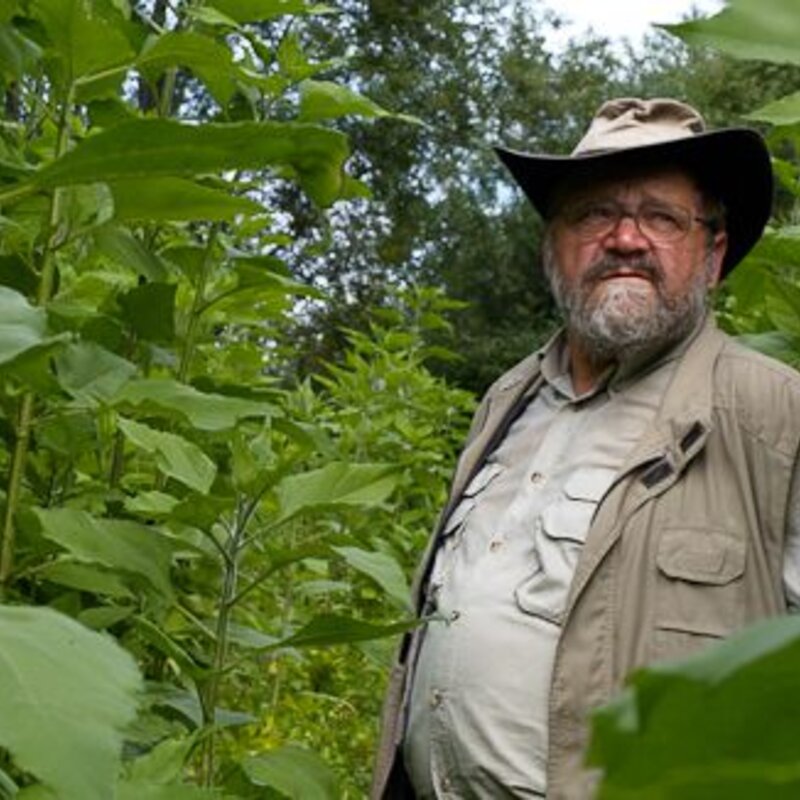
The Krameterhof
Sepp Holzer was born in 1942 in Ramingstein, in the Lungau region of Austria. He took over his family's mountain farm, the Krameterhof, in 1962 at the age of 19.
The farm is not promising ground. It sits between roughly 1,100 and 1,500 metres in the Austrian Alps, on steep slopes, with average annual temperatures around 4 C, a short growing season, and hard winters.
The conventional prescription for such a farm was conifer plantation and a few cattle. Holzer was told this repeatedly by agricultural advisers.
Instead he built something that agricultural science said was impossible: a 45-hectare system of terraces, ponds, and raised beds producing cherries, kiwis, grapes, and even lemons at an altitude where the official advice was spruce.
Working the Microclimate
Holzer's central insight is that a mountainside is not one climate. It is thousands of them, and the differences between a south-facing rock face and a shaded hollow ten metres away are larger than the difference between countries.
His practice is the systematic manufacture and exploitation of those differences.
Terraces cut into slopes create level ground, stop erosion, and produce a warm face and a cool one.
Stones, placed deliberately, absorb sun during the day and radiate heat at night. Holzer positions large rocks beside tender plants as thermal batteries, which is how the citrus survives. The same principle as a walled garden, described in frost protection and espalier and training, applied with boulders instead of brick.
Ponds, and he built over seventy of them, do several jobs at once. They store water, moderate temperature, reflect light onto adjacent slopes to extend the growing season, produce fish, and create wet habitat. Water as a thermal and optical instrument, not just a supply. See ponds and dams and self-sufficient ponds.
Raised beds, built high and long across the slope, increase surface area, improve drainage on wet ground, create sheltered and exposed faces, and warm faster in spring. Holzer's are large earth structures rather than garden boxes, and they function as hugelkultur, with wood buried inside to hold water and decompose slowly into fertility.
Hugelkultur
Holzer is the person most responsible for hugelkultur reaching an international audience, though the practice is older and traditional in parts of central and eastern Europe.
The method buries woody material under a mound of soil. The wood acts as a sponge, absorbing water in wet periods and releasing it during drought, and it decomposes over years into a steady supply of nutrients and organic matter. The mound's shape adds surface area and creates varied aspects.
For a cold, steep site with poor soil and no irrigation, it addresses several constraints simultaneously, which is why it suited the Krameterhof so well. The details are in hugelkultur.
Animals as Labour
Holzer keeps pigs, and he uses them as machinery.
Rather than ploughing, he scatters feed on ground he wants cultivated and lets the pigs root it up. They turn the soil, incorporate manure, remove weeds and roots, and prepare a seedbed. Then they are moved on.
The same logic applies to his poultry and his fish. Animals are placed where the work they naturally do is the work that needs doing, and moved before the work becomes damage.
This is the principle set out in poultry in systems and rotational grazing: the animal is not the problem, the duration is.
Fighting the Authorities
A substantial part of Holzer's story is his conflict with regulators, and it is not incidental.
He was fined repeatedly, and at one point faced criminal proceedings, for offences including failing to prune his fruit trees in the prescribed manner and building ponds without the correct authorisations. Austrian agricultural regulation assumed a model of farming that his system did not fit.
He became known as the Agrarian Rebel, which is the title of one of his books.
The episode is a useful corrective to the idea that regenerative systems fail only for ecological or economic reasons. Regulation, subsidy structures, and professional orthodoxy are frequently the binding constraint, as restoration economics and stakeholder mapping both note in other contexts.
Consulting and Influence
From the 1990s Holzer began consulting internationally, working on projects in Spain, Portugal, Russia, Colombia, Scotland, and elsewhere, frequently on degraded or desertified land.
His work in Portugal and Spain focused on rehydrating dry landscapes with earthworks and water retention, the same fundamental approach as keyline design and swales but developed independently on a mountain.
He is a divisive teacher. His methods are heavily site-specific and rely on an intuitive reading of terrain that is difficult to codify or transfer, and he is dismissive of scientific validation in a way that frustrates researchers. Some of his claims about yields and species are not well documented.
What is documented is the farm. The Krameterhof exists, it has been visited by many thousands of people, and it grows things at 1,500 metres in the Alps that the textbooks said could not be grown there.
The Lesson
Holzer's contribution is a demonstration that site limitations are usually less fixed than they appear.
Cold, steep, wet, and poor were all treated as constraints defining what the Krameterhof could produce. He treated them as raw material and rearranged them: heat where he wanted heat, drainage where he wanted drainage, shelter where he wanted shelter.
The general principle is the one in permaculture design: shape the patterns first, in water, earth, and access, and the detail becomes possible afterwards.
See also
- Hugelkultur the technique he popularised
- Ponds and Dams water as a thermal instrument
- Frost Protection manufacturing microclimate
- Permaculture Design patterns before details
- David Holmgren the parallel long-term demonstration site