What it is
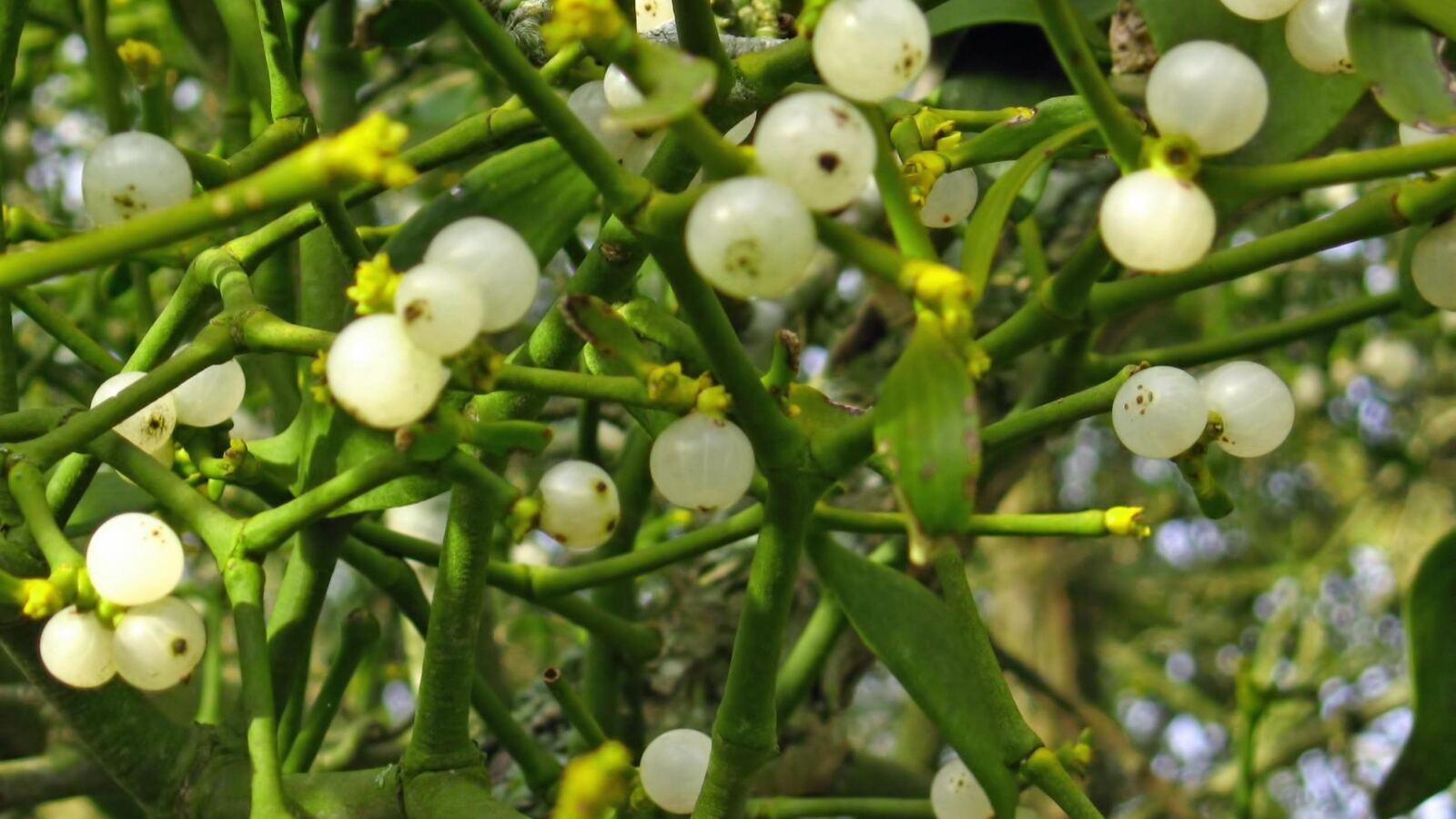
Mistletoe is a plant that lives not in the ground but in the branches of trees — the familiar evergreen ball of forking green stems and white berries hanging in a bare winter oak, apple, or poplar, and the sprig hung up at Christmas. It is one of the most ecologically important and culturally storied plants in the temperate world, and it makes its living in a peculiar way.
Mistletoe is a hemiparasite: it has green leaves and photosynthesises like any plant, but it cannot root in soil — instead it sinks a special root-like structure (a haustorium) into the branch of a host tree and taps the host's sap for water and minerals, half-feeding off the tree while making its own sugars. It is a partial parasite, drawing on its host but not wholly dependent on it, in the manner of the sandalwood and quandong that tap their neighbours' roots. A little mistletoe does a tree no great harm; a heavy infestation can weaken it.
A keystone for wildlife
Ecologically, mistletoe punches far above its weight, and in many woodlands it is a genuine keystone resource — a plant whose removal would impoverish the whole community out of all proportion to its size.
Its value is above all in winter, when little else is available. Its sticky white berries ripen in midwinter and are an important food for birds — the mistle thrush is named for them, and blackcaps, waxwings, and others depend on them in the hungry season. Its dense evergreen clumps give nesting sites and shelter high in otherwise bare winter trees, and its flowers, opening early, feed some of the first insects of the year. Studies that removed mistletoe from woodland found bird and animal diversity fell markedly — direct evidence of its keystone role. Mistletoe, in short, is a small plant that keeps a disproportionate share of the winter wood alive.
Planted by birds, on a twig
Mistletoe's spread is one of the neat stories of seed dispersal. Its berries are filled with an intensely sticky pulp, and when a bird eats the berry, the seed either passes through or is wiped off the bird's beak — either way ending up glued to a branch, exactly where a new mistletoe needs to germinate. (The old name is unflattering: "mistletoe" derives from words meaning "dung on a twig," from the belief that it sprang from bird droppings on branches.) The seed then germinates on the bark, sends its haustorium into the wood, and a new plant begins. It is a plant that depends utterly on birds to plant it in the treetops, a tight bird-and-plant mutualism.
(A related group, the dwarf mistletoes of conifer forests, are more damaging forest parasites and even disperse their seeds explosively — a quite different, and less welcome, side of the family.)
Ancient midwinter magic
Few plants carry such a weight of folklore. An evergreen bearing white berries in the dead of winter, high in a leafless, apparently dead tree, mistletoe was seen across northern Europe as a plant of life-in-death and of magic. The druids revered mistletoe growing on oak as especially sacred, cutting it with a golden sickle in ritual; in Norse myth it is the plant that kills the god Baldr; and it has been a plant of protection, fertility, and peace. The tradition of kissing under the mistletoe at Christmas descends from these midwinter fertility and goodwill customs — a direct thread from ancient ritual to the sprig over the modern doorway. See historical ecology.
In the garden and orchard
For the grower, mistletoe is mostly a plant to welcome in moderation — a wildlife asset and a charm — while keeping an eye on heavily-laden trees. It grows readily on apple, poplar, lime, and hawthorn among others, and can be established by pressing a fresh ripe berry into a crevice in the bark of a suitable host in late winter (patience is needed; it is slow). A traditional orchard with a little mistletoe in its trees is richer for it — for the winter birds, for the ancient magic, and for the sprig to cut at Christmas. See keystone species.
See also
- Keystone Species mistletoe's outsized role in the winter wood
- Seed Dispersal and Seed-Dispersing Birds the birds that plant it on a twig
- Mutualism and Symbiosis hemiparasitism on the symbiosis spectrum
- Rosewood and Sandalwood and Quandong other hemiparasites that tap their hosts
- Apples and Pears a favourite mistletoe host in the orchard
- Historical Ecology the druids, Baldr, and the Christmas kiss