What it is
Pinus palustris, the longleaf pine — a tall, straight pine of the southeastern United States, named for its very long needles, and the defining tree of one of North America's great lost ecosystems: the longleaf pine savanna.
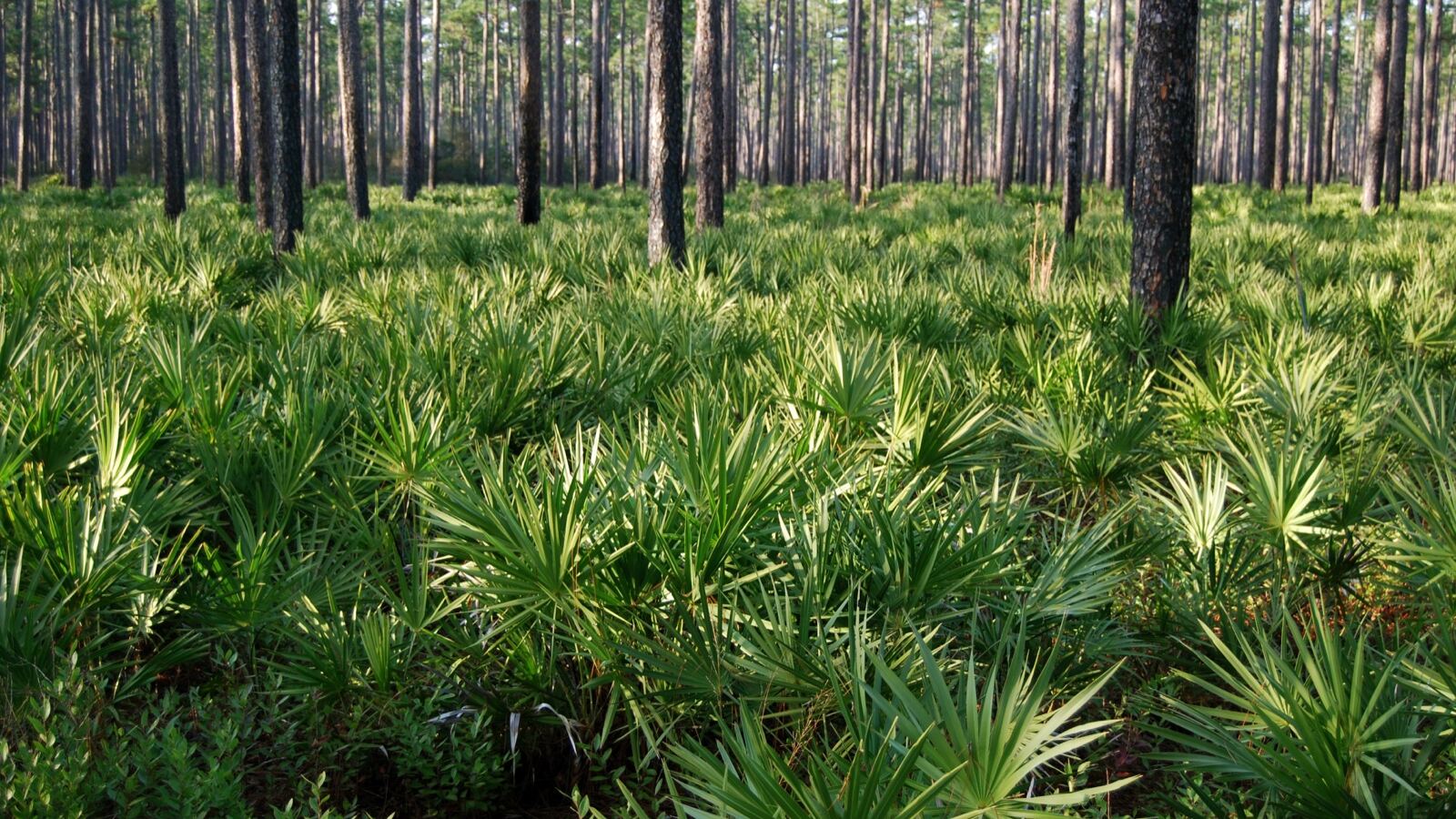
Once, longleaf pine forest stretched across some 90 million acres of the coastal plain from Virginia to Texas — open, park-like, sunlit woodland of widely-spaced tall pines over a knee-deep carpet of grasses and wildflowers, and one of the most biologically diverse ecosystems on the continent, richer in plant species per square metre than almost anywhere in North America. Today, after centuries of logging, clearance, and — crucially — fire suppression, about 97% of it is gone, making longleaf restoration one of the great conservation causes of the American South. See structural diversity.
The grass stage
The longleaf pine has one of the most remarkable early lives of any tree, an adaptation to its fiery home. A longleaf seedling does not shoot up like other pines. Instead it spends its first years — often five to fifteen of them — as a squat, stemless tuft that looks exactly like a clump of grass, all its energy going downward into a deep root and a fire-proof bud at ground level.
This "grass stage" is a fire survival strategy. Hidden at ground level, protected by a dense tuft of moist needles and buried in the soil, the growing bud survives the frequent ground fires that sweep the savanna, killing competing hardwood seedlings that have no such defence. Then, once its root is established, the longleaf bolts — shooting up a metre or more in a single season to lift its bud above the reach of future fires, and only then developing a trunk. It is one of the clearest and most elegant examples of a tree's whole life history being shaped by fire. See fire management.
A forest that needs to burn
The longleaf savanna is a fire-dependent ecosystem: it needs frequent, low, ground fires — historically every one to three years, from lightning and from Native American burning — to survive. The fires kill invading hardwoods and shrubs, keep the woodland open and sunlit, recycle nutrients, and trigger the flowering and seeding of the grasses and wildflowers of the understorey. Remove fire, and the open savanna chokes with brush and hardwoods and the diverse ground flora vanishes.
This fire-kept openness supports a wealth of specialised wildlife found nowhere else, above all the endangered red-cockaded woodpecker, which excavates its nest holes only in living old longleaf pines and is a keystone (and legally protected) species of the ecosystem; the gopher tortoise, whose burrows shelter hundreds of other species; and a long list of rare plants and animals. The collapse of longleaf and its fire regime drove many of these to the brink, which is why restoring longleaf means restoring fire — prescribed burning is the central tool of longleaf conservation. See keystone species and woodland management.
Turpentine and timber
Longleaf was also central to the economy of the old South. Its resin was tapped on a vast scale for "naval stores" — turpentine, rosin, pitch, and tar — used to waterproof wooden ships, an industry that scarred millions of trees and gave the Carolinas their nickname, the "Tar Heel" state. The dense, strong, resinous "heart pine" timber built much of the region and was prized for flooring and heavy construction, and old-growth heart pine is now salvaged and prized. This heavy exploitation, on top of clearance for farming and the loss of fire, is what reduced the great forests. See restoration economics.
Growing it
Longleaf wants full sun, sandy well-drained acidic soil, and — for a healthy stand — fire; it is drought-hardy, tolerant of poor sandy ground, and long-lived (trees reach several centuries). It is slow to start (the grass stage), which long made it less popular with foresters than faster pines, but it is superbly adapted to its region and increasingly planted for restoration, timber, and wildlife.
It is grown from seed, and its establishment — patience through the grass stage, and the reintroduction of regular prescribed fire — is the heart of the huge, ongoing effort to bring back the longleaf savanna. See reforestation techniques and propagation.
See also
- Pines the wider genus and its fire ecology
- Fire Management the prescribed burning longleaf depends on
- Keystone Species the red-cockaded woodpecker and gopher tortoise
- Structural Diversity the richness of the open savanna
- Reforestation Techniques restoring the longleaf ecosystem
- Restoration Economics naval stores and heart pine