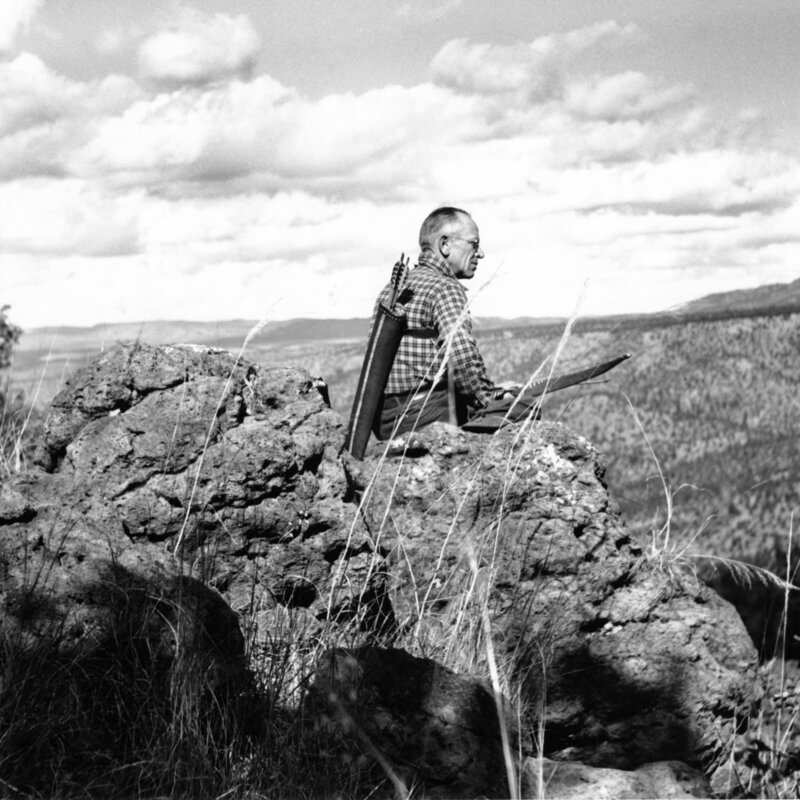
The Forester
Aldo Leopold was born in 1887 in Burlington, Iowa, on the bluffs above the Mississippi. He hunted and watched birds from boyhood, and he went to the Yale Forest School, founded with Pinchot money to supply the new United States Forest Service with professionals.
He joined the Forest Service in 1909 and was posted to the Arizona and New Mexico territories. He was 22, confident, and entirely conventional in his views.
Those views included the standard doctrine of the time: game was valuable, predators were vermin, and the job of a good manager was to remove wolves, bears, and mountain lions so that deer and elk could flourish.
He was good at it. He helped organise game protective associations and campaigned successfully for predator eradication across the southwest.
Thinking Like a Mountain
The essay that made him famous describes the moment the doctrine cracked.
Leopold and his companions shot a wolf and scrambled down to reach her. He wrote that he arrived in time to watch a fierce green fire dying in her eyes, and that he realised then that neither the wolf nor the mountain agreed with his view that fewer wolves meant more deer.
What followed over the succeeding decades was the evidence. Deer populations across the southwest, released from predation, irrupted. They ate the range down to bare soil, browsed every seedling within reach, and then starved in enormous numbers. The mountainsides he had helped clear of wolves were left with no regeneration, wrecked soil, and dead deer.
He called the resulting insight thinking like a mountain: the recognition that a system has requirements that operate on a timescale and a scale of causation longer than a manager's career or a hunter's season.
The lesson is now standard ecology and appears throughout practical work: unchecked herbivore populations prevent woodland regeneration, which is precisely the constraint described in deer and rabbits and the reason site protection determines whether planting succeeds. See also predator-prey balance.
The Shack
In 1935 Leopold bought an abandoned, worn-out farm on the Wisconsin River in Sauk County. The soil was sand, the land had been logged, farmed, burned, and abandoned, and the only building still standing was a chicken coop.
The family converted the coop into a cabin, called it the Shack, and spent weekends there for the rest of his life.
What they did on that land was ecological restoration before the term existed. They planted thousands of pines by hand, restored prairie species, and recorded what happened, year after year, in detail.
The record-keeping matters. Leopold and his children kept phenological notes: the dates of first bloom, arrival of migrating birds, ice-out. That dataset, continued by his daughter Nina, became one of the longest phenological records in North America, and it has since been used to document the advance of spring under a changing climate.
It is a reminder that monitoring done consistently over decades produces evidence that no single study can, and that the value is entirely in the persistence.
His restoration work at the University of Wisconsin Arboretum, begun in 1934, included the first deliberate attempt to reconstruct a tallgrass prairie, which makes him a founder of grassland restoration as a discipline.
The Land Ethic
Leopold assembled his essays into a book, A Sand County Almanac. It was accepted for publication in April 1948. He died a week later, at 61, of a heart attack while helping neighbours fight a grass fire.
The book was published posthumously in 1949 and eventually sold in the millions.
Its final essay, The Land Ethic, is the piece that changed conservation. Its argument is that ethics have historically expanded: from relations between individuals, to relations between individuals and society, and that the next necessary extension is to the land itself, meaning soils, waters, plants, and animals collectively.
He put the operating rule in one sentence, and it remains the most quoted line in conservation:
A thing is right when it tends to preserve the integrity, stability, and beauty of the biotic community. It is wrong when it tends otherwise.
The point of the formulation is that it refuses to reduce land to economics. Leopold's complaint about the conservation of his era was that it only defended what could be shown to be profitable, which left most species and most processes undefended.
He also wrote that the first rule of intelligent tinkering is to keep every cog and wheel, which is the argument for minimum viable populations and seed banking stated fifty years early.
What He Left
Leopold's practical legacy is substantial. He wrote the first textbook of game management, held the first chair in the subject, helped found the Wilderness Society, and argued successfully for the first designated wilderness area in the United States, the Gila.
His deeper legacy is the framing. Almost every argument in this encyclopedia for retaining what looks untidy, keeping what has no obvious use, and managing for the whole system rather than a single output descends from the land ethic: dead wood habitat, rewilding edges, rock and log piles, structural diversity.
He also modelled something rarer than any of it. He spent his early career confidently doing damage, recognised it, documented it, changed his mind in public, and wrote about the error rather than quietly dropping it.
See also
- Predator-Prey Balance the lesson of the wolves
- Grassland Restoration the prairie work he began
- Monitoring the phenological record at the Shack
- Deer and Rabbits unchecked browsing
- Rewilding Edges keeping every cog and wheel