An unusually well-documented failure
Mangrove restoration is worth studying because the standard approach has been repeatedly measured and repeatedly found not to work.
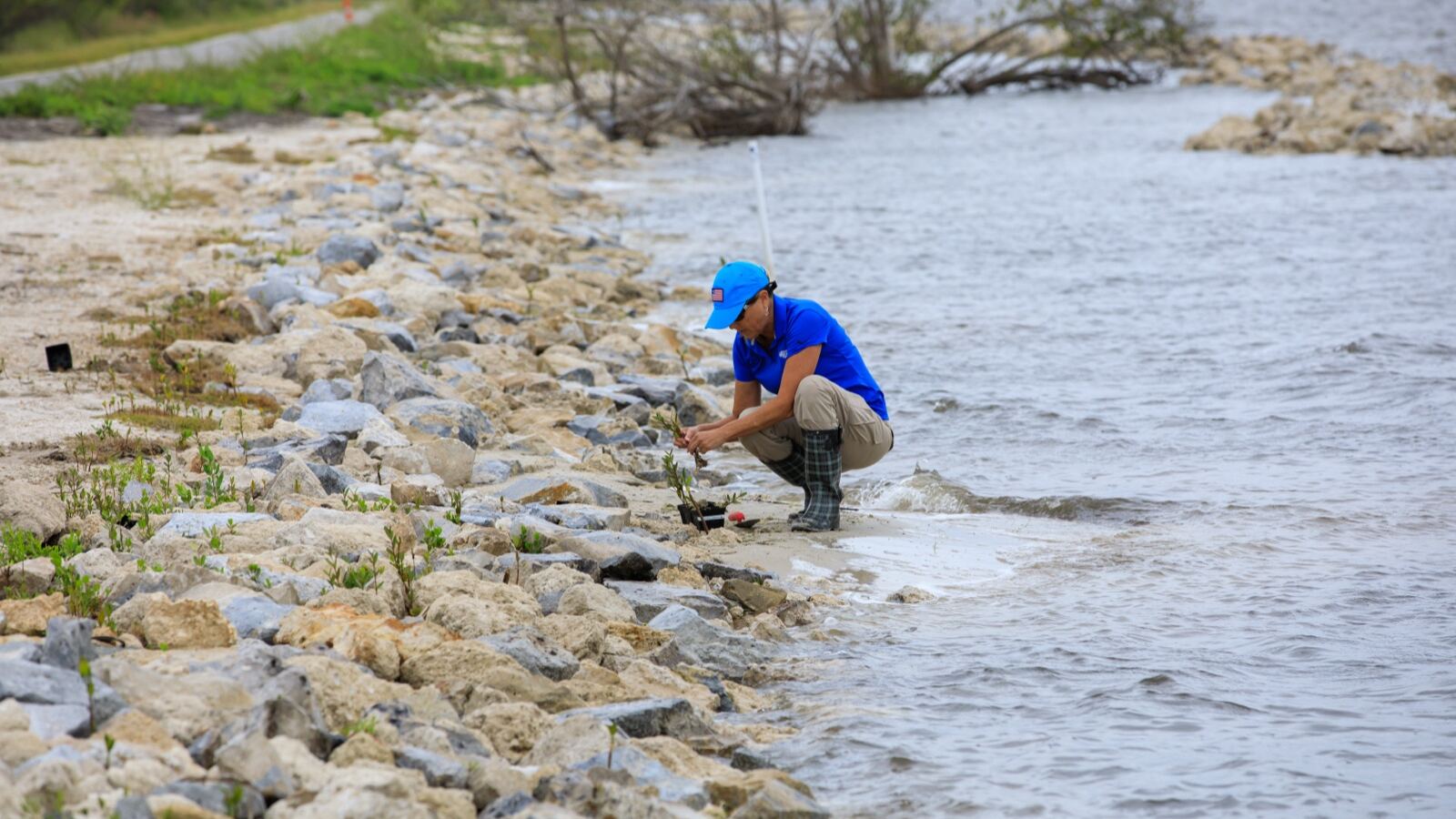
The familiar image is rows of volunteers pushing Rhizophora propagules into mud. Survival in such projects is frequently reported at under 20 percent, and often close to zero after a few years. Reviews of projects across South and Southeast Asia have found large-scale planting programmes with negligible surviving cover.
Meanwhile, sites where the hydrology was corrected and nothing was planted have regenerated densely and for a fraction of the cost.
The reason is a specific and instructive mistake.
Mangroves are zoned by tidal elevation
Mangrove species occupy narrow bands determined by how often and how long they are inundated.
Avicennia and Sonneratia occupy the lower, more frequently flooded zone. Rhizophora sits in the middle. Bruguiera, Ceriops, and Xylocarpus occupy higher ground flooded only on spring tides. See mangroves.
A species planted outside its band dies, and the tolerance is measured in centimetres of elevation, not metres.
The classic failure is planting Rhizophora on open tidal mudflats seaward of where mangroves grew — because that ground is available and looks like the right place. It is not mangrove habitat at all; it is mudflat, a distinct ecosystem with its own value and its own bird populations. The propagules are inundated too long, and they die.
So the projects are simultaneously killing the plantings and damaging an intact habitat.
Ecological Mangrove Restoration
The alternative method, developed largely by Robin Lewis, inverts the sequence. The core principle: do not plant first, and often do not plant at all.
The steps:
1. Understand the natural reference. Survey an intact mangrove nearby — species, zonation, elevations, and the tidal regime that supports it.
2. Understand the hydrology. Map tidal flooding frequency and duration across the site, and identify what has changed. Almost always the answer is a physical alteration: a bund, dyke, road, or aquaculture pond wall blocking tidal exchange.
3. Assess natural recruitment. Mangroves produce enormous quantities of buoyant propagules that disperse on tides. If there is a seed source within reach and the hydrology works, they will arrive on their own.
4. Fix the hydrology. Breach the bunds, restore the creeks, re-establish tidal flow and correct elevations. This is the actual work, and it is usually earthmoving rather than planting.
5. Plant only if recruitment fails, after establishing why.
This is the mangrove version of the argument in assisted regeneration: where a seed source survives, removing the obstruction beats planting, and it costs far less.
What blocks the hydrology
Abandoned aquaculture ponds. Millions of hectares of mangrove were converted to shrimp and fish ponds, many abandoned within a decade as they acidified and yields collapsed. The pond walls remain and exclude the tide. Breaching them is the single highest-return intervention available in much of Southeast Asia.
Roads and causeways built across tidal creeks without adequate culverts.
Salt pans and agricultural bunds.
Altered sediment supply, where dams upstream have cut the sediment that maintains mangrove elevation — a slow problem that plantings cannot solve.
Subsidence and sea level rise, which change the elevation relationship over time.
Why it matters
Coastal protection. Mangroves attenuate wave energy substantially, reducing wave height across a belt of forest, and they reduce storm surge and flooding damage. Post-tsunami and post-cyclone assessments have repeatedly found lower mortality and damage behind intact mangrove.
Carbon. Mangrove soils store carbon at very high densities — among the highest of any ecosystem per hectare, mostly below ground in waterlogged anoxic sediment that has accumulated for millennia. Converting mangrove to ponds releases it, and the accounting parallels peatland restoration closely: the soil store dwarfs the biomass, and once oxidised it is not recoverable on a project timescale. See carbon accounting.
Fisheries. Mangroves are nursery habitat for a large share of tropical coastal fish and crustacean species, so the fishery value accrues offshore and to different people from those who clear the forest — the classic beneficiary mismatch described in restoration economics.
Sediment trapping and water quality, filtering land runoff before it reaches reefs and seagrass.
Doing it well
Fix hydrology before anything else.
Match species to elevation if planting is genuinely needed, and use a mixture rather than a monoculture of Rhizophora, which is chosen mainly because its propagules are easy to handle.
Do not plant on mudflats or seagrass, which are separate habitats being destroyed by the intervention.
Work with the people using the site. Mangrove clearance is driven by aquaculture, fuelwood, and land pressure, and restoration that ignores those drivers is undone. Community-managed mangrove with defined harvesting rights has a far better record than fenced exclusion. See community engagement and stakeholder mapping.
Measure survival, not planting. The tree-count problem described in restoration economics is nowhere more visible than here: propagules planted is the metric that produced decades of failed projects.
Monitor over years. See monitoring.
The transferable lesson
The mangrove case generalises, and it is why it is worth reading even for someone working in a temperate woodland.
Diagnose the reason regeneration stopped, and remove it. In mangroves it is tidal exchange; in dryland restoration it is grazing and infiltration; in scots pine it is deer and ground disturbance; in juniper it is browsing and bare seedbed.
Planting into an unfixed cause produces dead plants and good photographs.
See also
- Mangroves the trees themselves and their zonation
- Assisted Regeneration the same principle in forests
- Carbon Accounting blue carbon and soil stores
- Peatland Restoration the closest parallel
- Restoration Economics why counting plantings misleads
- Wetland Restoration hydrology-first restoration generally