What it is
Zelkova, a small genus of the elm family — Japanese zelkova (Z. serrata), Caucasian zelkova (Z. carpinifolia), and Chinese zelkova (Z. sinica) — closely related to the true elms and resembling them in leaf and habit, but differing in ways that turned out to matter enormously.
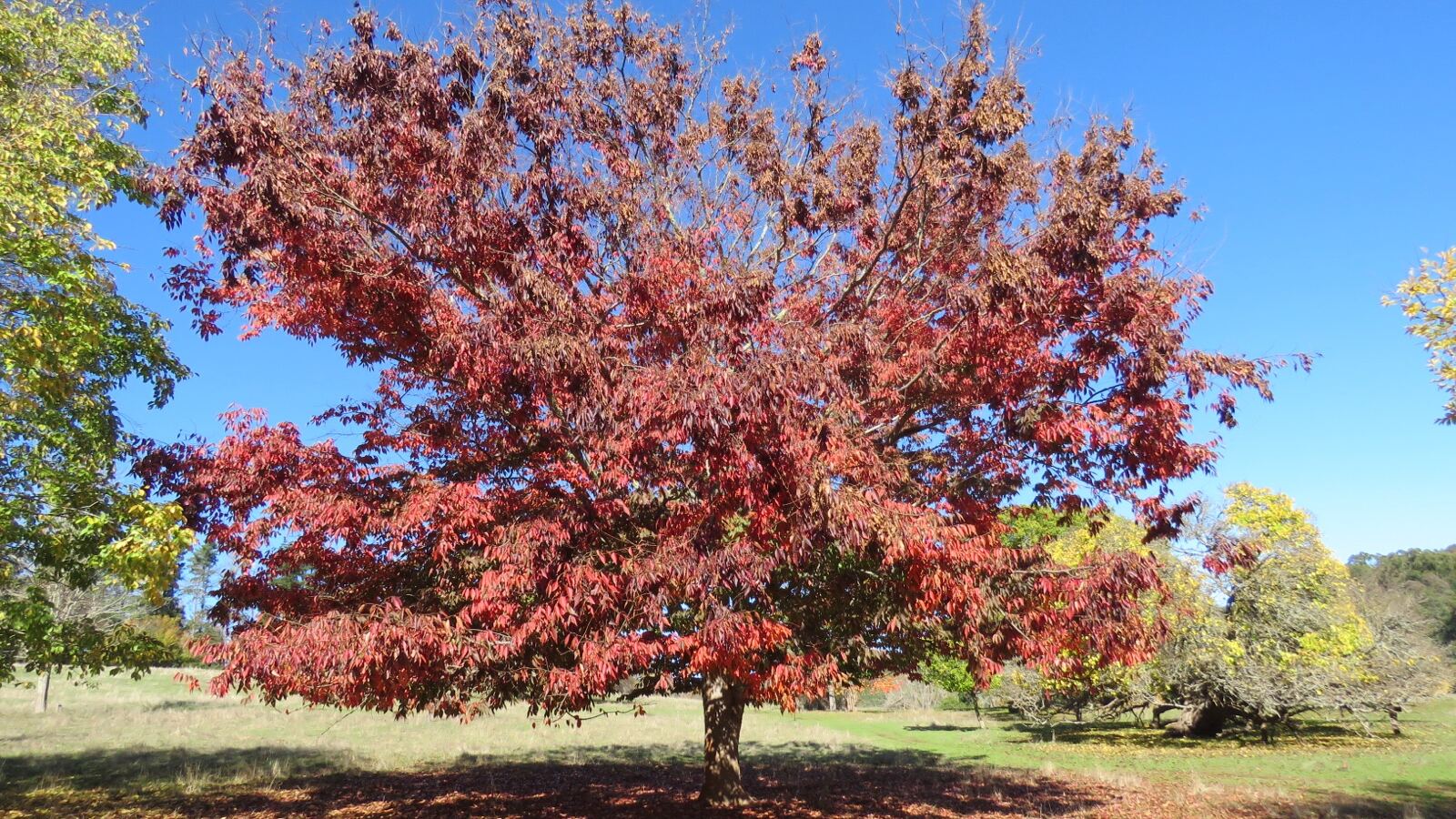
The leaves are smaller and more evenly toothed than an elm's, the bark is smooth and grey when young then flakes to reveal orange patches (a little like a plane), and the crown is a clean, symmetrical, upward-spreading vase — one of the most elegant natural forms of any tree.
The elm substitute
Zelkova's prominence today is a direct consequence of catastrophe. When Dutch elm disease swept through Europe and North America from the mid-twentieth century, killing tens of millions of the elms that had defined those landscapes, cities needed a replacement with the same graceful arching form.
Zelkova was the answer. It has the elm's vase shape and fine-textured canopy, but is substantially resistant to Dutch elm disease (and to elm leaf beetle), so it was planted in enormous numbers as an elm surrogate along streets and avenues from the 1970s onward. Cultivars such as Green Vase and Village Green were selected for exactly that arching elm-like habit. It is one of the clearest cases of a disease reshaping the urban forest and of a resistant relative stepping into the gap, the same story now playing out with ash and its dieback. See tree diseases and urban forestry.
It is not immune to everything — zelkova can suffer from the same elm yellows and, in some regions, from canker — and the usual structural diversity caution applies against planting it as a monoculture in its turn. But as a tough, elegant, disease-tolerant street tree it has been a genuine success.
Keyaki: the revered timber
In Japan, zelkova — keyaki — is far more than a street tree. It is one of the most valued of all Japanese timbers.
The wood is hard, strong, beautifully grained, and durable, and it was the premier wood for temple and shrine construction, for the great pillars and beams of traditional buildings, for temple drums (taiko), fine furniture, and joinery. Old keyaki timber is prized and expensive, and ancient keyaki are protected as sacred trees at shrines. The tree is also a classic subject for bonsai, where its natural fine twigging and vase form produce the idealised "broom style" miniature tree.
Wildlife and season
Zelkova gives good, reliable autumn colour — yellow, orange, bronze, and red, often several at once on the same tree — and the small nut-like fruit and dense twiggy canopy offer modest food and cover for birds. It is a decent, if not outstanding, wildlife tree, and its main ecological value now is as a resilient large canopy tree in places where the native elms have gone. See seed-dispersing birds.
Growing it
Full sun and deep, moist, well-drained soil for best growth, though it tolerates drought, heat, wind, pollution, and urban conditions once established — part of why it succeeded as a street tree.
Moderate to fast, reaching 20 to 30 m with that broad vase crown, and long-lived. It transplants well and stands hard pruning, and it is notably wind-firm.
Grows from seed (cold-stratified) and from cuttings; cultivars are grafted. Few serious problems, which was the whole point of adopting it. See propagation and grafting.
See also
- Elm the relative it replaced, and the disease that killed it
- Tree Diseases Dutch elm disease and resistant substitutes
- Urban Forestry zelkova as a street tree
- Hackberry another elm-family tree for tough sites
- Ash the tree now suffering the same disease fate
- Plane Trees another flaking-barked urban survivor