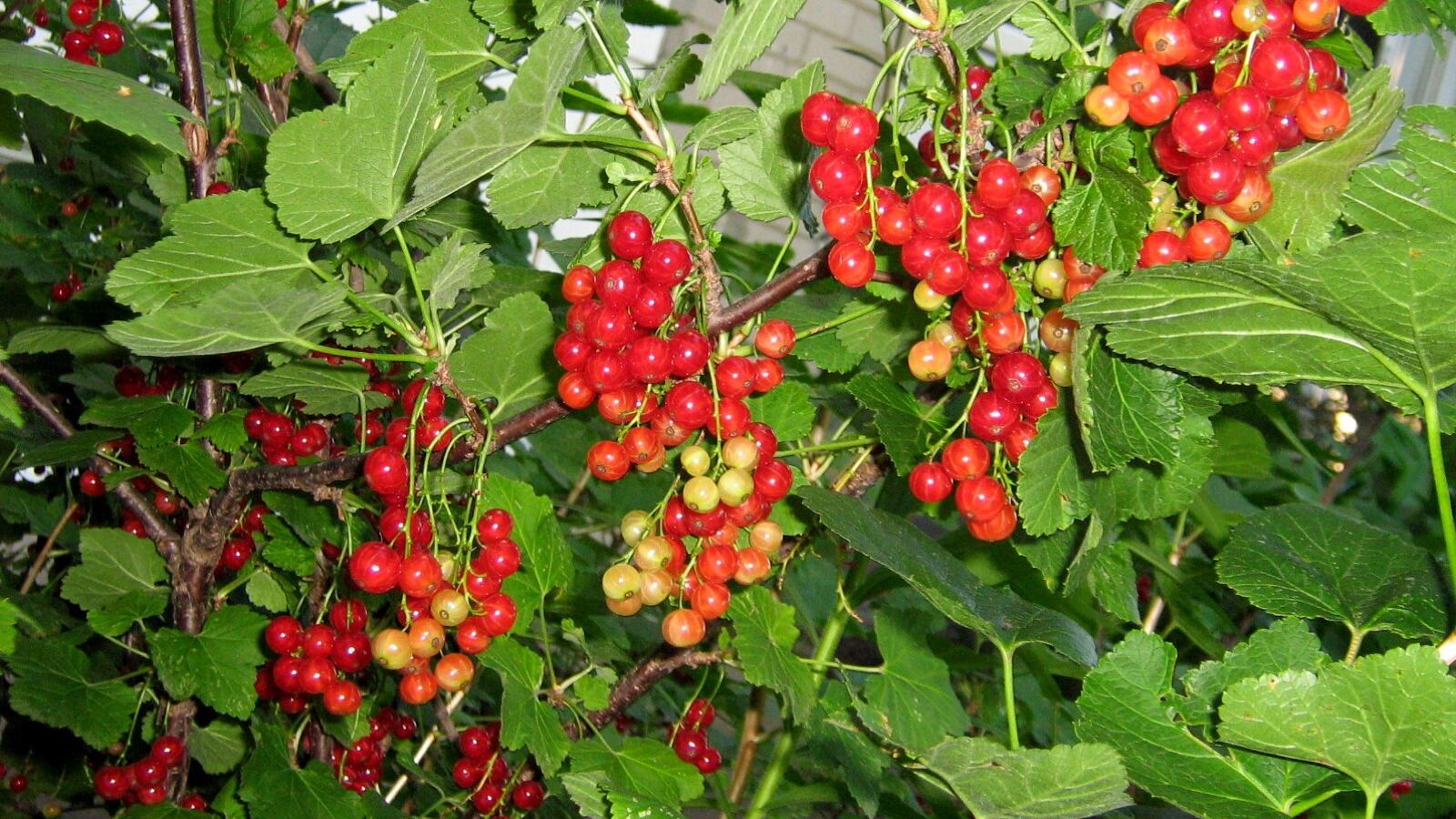
What they are
Ribes, a genus of around 150 species, including blackcurrant, redcurrant, whitecurrant, gooseberry, and jostaberry.
They are among the most productive soft fruit for a temperate garden, tolerate part shade better than almost any other fruit, are hardy, long-lived, and largely self-fertile.
They are also the crop where getting the pruning right doubles the yield, and where getting it wrong halves it — because the different species fruit on different wood.
The pruning split
The single most useful thing to know about Ribes.
Blackcurrants fruit on wood grown the previous season. One-year-old wood carries the best crop; older wood declines sharply.
So blackcurrants are pruned by renewal: cut out roughly one third of the oldest stems to ground level every winter. Old wood is darker and rougher; young wood is paler. Over three years the whole bush is replaced.
The stool system takes this further — cutting the entire bush to the ground every second year, giving no crop in one year and a heavy one the next, which suits commercial harvest.
Redcurrants, whitecurrants, and gooseberries fruit on spurs on old wood, and at the base of the previous season's growth.
So they are pruned as permanent framework plus spurs, exactly like an apple: establish an open goblet of 8 to 10 main branches, then each winter shorten leaders by about a third and cut side shoots back to 2 to 3 buds. A summer prune of new side shoots to about five leaves improves air flow and fruit size.
Prune a redcurrant like a blackcurrant and you remove the entire fruiting structure. It is the commonest mistake with these crops.
Gooseberries and redcurrants also train superbly as cordons and fans against a wall, which lifts the fruit clear of the ground, makes picking a thorny gooseberry bearable, and improves airflow against mildew. See espalier and training.
The white pine blister rust ban
A piece of history that still shapes what you can grow in parts of North America.
Cronartium ribicola, white pine blister rust, requires two hosts to complete its life cycle: a five-needled white pine, and a Ribes.
Introduced to North America around 1900, it devastated eastern white pine and western white pine — commercially and ecologically important trees. See nut pines and conifers.
The response was a federal eradication programme from the 1910s: Ribes were removed across enormous areas, and cultivation was banned nationally.
The federal ban was lifted in 1966, but several US states retained restrictions, and some still regulate or prohibit blackcurrants specifically, since blackcurrant is the most susceptible species. Immune and resistant cultivars now exist and are permitted in many places.
The practical consequence: blackcurrants are common in Europe and unfamiliar to many Americans, which is a direct legacy of a tree disease. Check local regulations before planting in North America.
It is also a clean example of the alternate-host problem in plant pathology, and of how disease management can reshape what a whole country eats.
The species
Blackcurrant, R. nigrum. Very high in vitamin C — several times that of oranges by weight. Distinctive aromatic flavour from the leaves and fruit. Cordial, jam, and cassis. Needs the renewal pruning above.
Redcurrant and whitecurrant, R. rubrum. Translucent, sharp, high in pectin, and the classic jelly fruit. Whitecurrants are a sweeter, less acidic form of the same species. Both fruit on spurs.
Gooseberry, R. uva-crispa. Thorny, hardy, and productive. Dessert varieties eaten ripe are genuinely good and quite unlike the hard green cooking fruit most people remember. Culinary varieties are picked hard and green in early summer, then the remainder left to ripen — two crops from one bush.
Jostaberry, a blackcurrant–gooseberry hybrid: thornless, vigorous, mildew-resistant, and productive, with a flavour between the two. Prune as a blackcurrant.
Growing them
Part shade is acceptable, which makes Ribes unusually useful. Blackcurrants and gooseberries crop reasonably on a north-facing wall or under light tree shade — one of the few fruit crops that will. That makes them a strong candidate for the shrub layer of a food forest or a difficult corner.
Moist, fertile, well-drained soil with plenty of organic matter. They are shallow-rooted and dislike drought.
Mulch annually, which suits the shallow roots and suppresses weeds. See mulching for moisture.
Feed with potassium; blackcurrants also appreciate nitrogen, being cut hard each year.
Plant blackcurrants deep — about 5 cm deeper than they grew in the pot — which encourages multiple stems from below ground, since the crop comes from a constant supply of new shoots. Plant gooseberries and redcurrants at the same depth they grew, on a short leg, so the framework stays clear of the soil.
Propagate from hardwood cuttings, which root very easily. A 20 to 25 cm cutting of the current year's wood pushed into the ground in autumn will root by spring — one of the easiest propagations there is, and it makes these crops effectively free once you have one bush. See propagation.
Problems
Birds, which take the entire crop with precision. Net, or grow in a fruit cage. This is not optional with redcurrants.
Gooseberry sawfly, whose larvae strip a bush to bare stems in days. Check leaf undersides in the centre of the bush from late spring, and pick off. They come in successive generations, so one inspection is not enough.
American gooseberry mildew, a white felt on shoots and fruit. Open pruning for airflow, resistant varieties, and cutting out affected tips.
Big bud mite on blackcurrants, producing swollen rounded buds — and, importantly, transmitting reversion virus, which destroys cropping. There is no cure for reversion; remove and replace affected bushes, and buy certified stock.
Currant blister aphid, causing red puckered leaves. Cosmetic, largely. See aphids.
Why they earn space
Soft fruit generally gives more food per square metre per hour of work than almost anything else in a garden, and Ribes in particular is hardy, shade-tolerant, long-lived, free to propagate, and productive for 15 years or more from one planting.
The fruit is also expensive and often unavailable to buy — blackcurrants and gooseberries barely appear in shops, for the same shelf-life reasons as mulberry.
See also
- Strawberries the other main soft fruit
- Berry Bushes the wider group including honeyberry and aronia
- Espalier and Training cordon gooseberries and redcurrants
- Propagation hardwood cuttings
- Food Forest Design Ribes in the shade-tolerant shrub layer
- Pruning Basics the underlying cuts