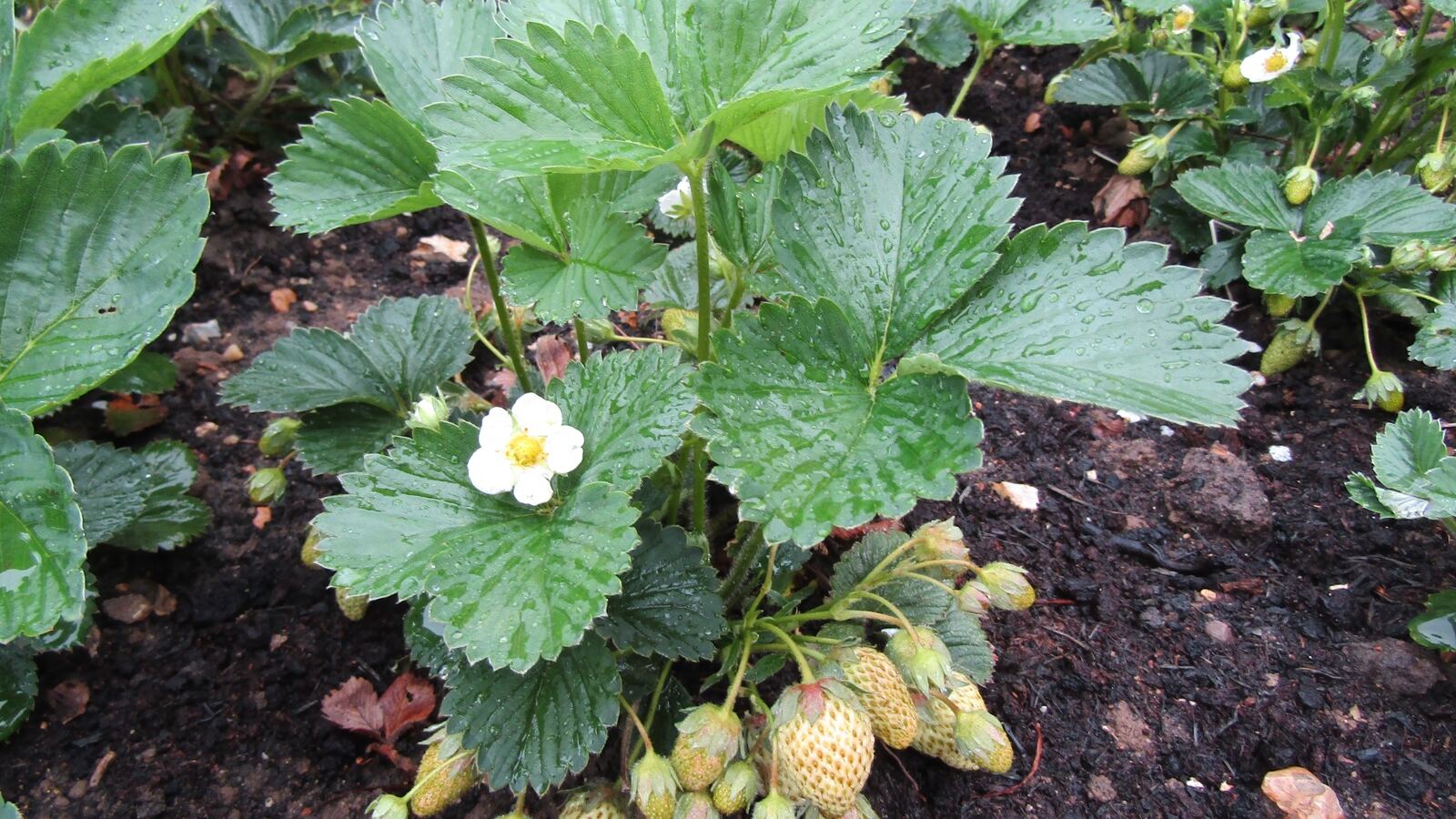
An accidental hybrid
The garden strawberry, Fragaria × ananassa, did not exist before the eighteenth century.
European wild strawberries, F. vesca, are tiny. The modern fruit came from crossing two American species in a French garden:
F. virginiana from eastern North America, brought to Europe in the seventeenth century — good flavour, small fruit.
F. chiloensis from Chile, brought back in 1714 by Amédée-François Frézier, a French engineer sent to spy on Spanish fortifications. He carried five plants home; two survived the voyage.
The Chilean plants were all female and set no fruit alone. Planted near F. virginiana, they crossed — and the hybrid combined the Chilean fruit size with the Virginian flavour and fertility.
Every strawberry in cultivation descends from that accident. It is a good illustration of the value of ex-situ collections and of moving genetic material, discussed in seed banking.
The fruit is not botanically a berry. The fleshy part is swollen receptacle tissue, and the true fruits are the pips on the outside, each containing a seed.
Junebearers, everbearers, day-neutrals
The distinction that determines when you get fruit and how you manage the plant.
Junebearers (short-day) initiate flower buds in autumn as days shorten, and crop in one heavy flush in early summer. Highest total yield, best for preserving, and the traditional type. They produce runners freely.
Everbearers produce two or three flushes — early summer and late summer into autumn. Lower total yield, longer season, fewer runners.
Day-neutrals are insensitive to daylength and crop continuously from summer until frost, given warmth and feeding. Fewer runners still, and generally treated as annuals or biennials in commercial systems.
A garden with a junebearer for the main crop and a day-neutral for a long tail gives fruit from June to October.
Note the parallel with onions: daylength sensitivity governs the crop, and choosing the wrong type for your latitude produces disappointment that no amount of feeding fixes.
Runners
Strawberries reproduce vegetatively by runners — stolons that root at the nodes and form new plants.
That is simultaneously the propagation method and the management problem.
Remove runners during the fruiting season on plants you want to crop. Every runner is energy diverted from fruit, and letting a bed run produces a mat of small plants and small berries.
Keep runners when you want new plants. Peg the strongest into pots or soil, let them root, then sever from the parent.
Take runners only from healthy plants, and preferably from plants you have not let fruit, since virus accumulates in old stock.
Why beds decline
Strawberry beds deteriorate predictably, and the reasons are worth knowing because the fix is scheduled rather than reactive.
Virus accumulation. Strawberries are vegetatively propagated, so viruses — spread by aphids and by propagation itself — build up generation on generation. Yields fall and fruit shrinks. This is the main reason for decline.
Soil-borne disease. Verticillium wilt, red core, and crown rot build in the soil.
Plant senescence. Individual crowns get woody and less productive after 3 to 4 years.
The management response:
Replace the bed every 3 to 4 years, using certified virus-free stock rather than your own runners at least periodically.
Move to fresh ground each time, on a rotation of 4 years or more. Do not follow potatoes or tomatoes, which share verticillium. See crop rotation.
Run a rolling system — one bed fruiting, one in its second year, one newly planted — so you are never without.
Growing them
Full sun, fertile, well-drained, slightly acid soil with plenty of organic matter. They dislike waterlogging and shallow chalk. See soil pH.
Plant with the crown at soil level — buried crowns rot, exposed crowns dry out. This is the commonest planting error.
Space 30 to 45 cm apart in rows 75 cm apart.
Plant in late summer for a full crop the following year, or in spring for a lighter one.
Mulch with straw once the fruit begins to swell — which is where the name may come from. It keeps fruit off the soil, reduces rot and mud splash, and suppresses weeds. Remove it after fruiting to reduce slug habitat. See mulching for moisture and slugs and snails.
Water consistently during fruit swelling, and water the soil rather than the fruit and foliage.
Feed with potassium rather than nitrogen once flowering starts. Excess nitrogen gives large leaves and soft, poorly flavoured fruit.
After fruiting, cut the old foliage off junebearers to about 10 cm, remove it along with the straw, and let fresh leaves grow. It removes disease inoculum and tidies the bed.
They grow well in containers, hanging baskets, and towers, which lifts the fruit away from slugs.
Problems
Birds, comprehensively. Net, or lose the crop. See insectivorous birds for the trade-off, and net the specific crop rather than removing bird habitat.
Slugs and snails, the other main fruit thief.
Grey mould, Botrytis, in wet weather. Space for airflow, mulch to keep fruit off soil, remove infected fruit promptly.
Powdery mildew and verticillium wilt.
Vine weevil, especially in containers, where the larvae destroy roots. See soil-dwelling pests.
Poorly shaped fruit is usually incomplete pollination — each achene must be pollinated for the receptacle beneath it to swell evenly, so a misshapen berry is a map of which pollinations failed. Cold or wet weather at flowering, or a shortage of pollinators, is the cause. It is one of the most legible demonstrations of pollination value in any crop. See native bees and pollinator habitat.
Alpine strawberries
F. vesca varieties are worth a separate mention: tiny, intensely flavoured, day-neutral, cropping continuously from summer to frost, and mostly runnerless, so they stay where you put them.
They come true from seed, tolerate part shade, and make an excellent edging or ground cover under fruit trees — a genuinely useful component in a fruit tree guild or a food forest understorey.
Yield is small per plant, and the flavour is better than any commercial strawberry.
See also
- Currants and Gooseberries the other main soft fruit
- Crop Rotation verticillium and the four-year gap
- Container Growing strawberries in pots and towers
- Pollinator Habitat why fruit comes out misshapen
- Fruit Tree Guilds alpine strawberry as ground cover
- Mulching for Moisture straw under the fruit