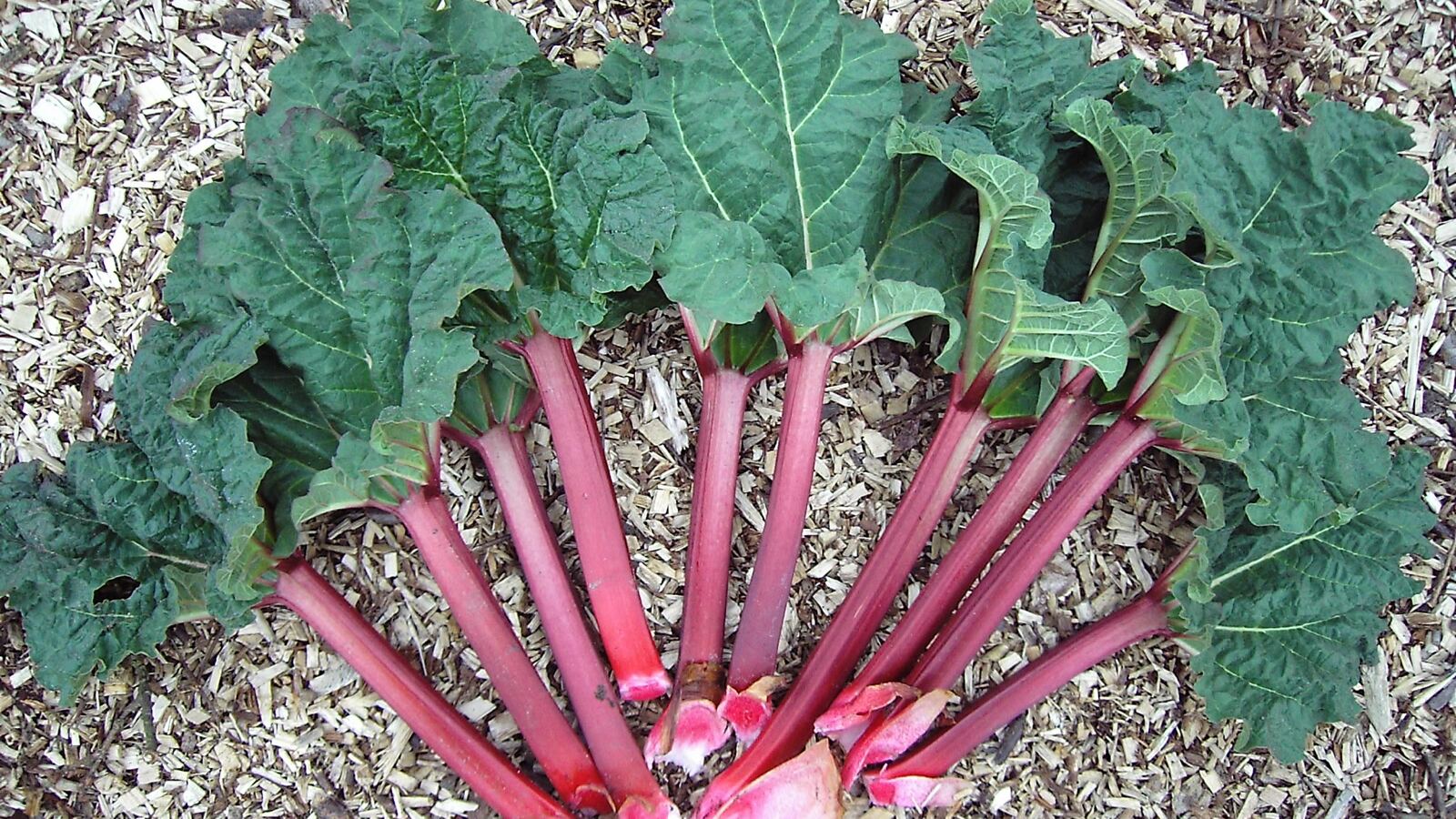
What it is
Rheum × hybridum, a hardy herbaceous perennial from the knotweed family — related to sorrel, dock, and buckwheat, which shows in the sharp oxalic tang.
Grown for its leaf stalks, which makes it a vegetable, though it is cooked and eaten as fruit and is legally classified as one in some jurisdictions for tariff purposes.
It arrived in Europe as a medicinal root long before anyone ate the stalks, and only became a culinary plant once sugar was cheap enough to make it palatable.
The leaves are poisonous
The blades contain high concentrations of oxalic acid and other compounds and should never be eaten. The stalks contain far less and are perfectly safe.
The practical rules: cut the leaf off and discard it as soon as you harvest, never feed leaves to livestock, and do not eat stalks from a plant that has been frosted hard after growth has started, since oxalic acid can migrate from the leaf into the stalk.
Leaves are fine on the compost heap — oxalic acid breaks down readily. See composting methods.
Plant it once
Like asparagus, rhubarb is a permanent planting rather than a rotation crop, and a good crown produces for 10 to 20 years or more.
Site: full sun to light shade, sheltered, and out of the way — a mature plant occupies a square metre or more and has enormous leaves.
Soil: deep, rich, moisture-retentive but not waterlogged. Rhubarb is a very hungry plant and repays heavy manuring more than almost anything else in the garden.
Clear perennial weeds first, since you will not dig the site again.
Plant crowns in autumn or early spring, with the buds just at or slightly above soil level. Burying the crown causes rot. Space 90 cm apart.
Do not harvest at all in year one. Take a light pull in year two, and crop properly from year three. As with asparagus, early over-picking is what produces a weak, short-lived plant.
Harvest by pulling, not cutting
Pull the stalk, twisting it sideways and out at the base, rather than cutting it.
Cutting leaves a stub that rots back into the crown. Pulling separates cleanly at the base and the plant seals it.
Never take more than about a third to a half of the stalks at once, and always leave several to keep the plant feeding itself.
Stop harvesting by around midsummer. After that the plant needs its remaining leaves to build reserves for next year, and late-season stalks are tougher and higher in oxalic acid anyway. The same six-week discipline that governs asparagus applies here in a gentler form.
Forcing
The technique that produces the pale pink, exceptionally tender stalks sold at a premium in late winter.
Cover a dormant crown in midwinter with a tall opaque container — a traditional terracotta forcer, a bin, or a bucket — excluding all light.
The plant, warmed slightly and searching for light, sends up long, slender, pale stalks weeks earlier than an uncovered crown, and they are markedly sweeter and more tender because they have produced fewer of the compounds that come with light.
Harvest the forced stalks over a few weeks, then remove the cover.
Forcing exhausts the crown. Never force the same plant two years running, and preferably work on a three-year cycle. Feed a forced plant well afterwards and let it grow unharvested for the rest of that season.
The Rhubarb Triangle in West Yorkshire built an industry on this, forcing in dark heated sheds and harvesting by candlelight.
Through the year
Late winter: mulch heavily with manure or compost, keeping it clear of the crown itself. Start forcing if you intend to.
Spring: the main harvest.
Summer: stop picking by around midsummer. Remove flower spikes as soon as they appear — a thick, pale, rapidly rising stem with a cauliflower-like head. Flowering diverts substantial energy from the crown and reduces next year's crop. Some varieties bolt more readily than others, and an old congested plant flowers more.
Autumn: let the leaves die back and collapse. They can be left as a mulch or cleared.
Every 5 to 10 years: lift and divide. An old crown becomes woody and congested in the centre and yields thin stalks. Dig it in autumn, split with a spade into pieces each carrying at least one strong bud, discard the worn centre, and replant the vigorous outer sections. This is also how you propagate it, and how you share it. See propagation.
Problems
Rhubarb is among the least troubled crops there is.
Crown rot on badly drained ground or from a buried crown — the main killer, and a siting problem.
Honey fungus occasionally.
Slugs on emerging spring growth. See slugs and snails.
Bolting, as above, aggravated by heat, drought, and age.
It has no significant pest problem, which is unusual and welcome. The leaves' oxalic acid content is sometimes made into a homemade insecticidal spray, though it is not selective and is best avoided — see organic sprays.
Harvest and keeping
Stalks keep for a week or two in the fridge and freeze extremely well, chopped and raw, with no blanching needed — which makes rhubarb one of the easiest gluts to deal with.
It also makes obvious jam, chutney, and cordial, and pairs traditionally with ginger and with strong-flavoured fruit.
See harvest and storage.
Why it earns its space
Rhubarb is the low-effort end of the perennial argument. It produces the first substantial harvest of the year, in the hungry gap when almost nothing else in a temperate garden is ready — earlier still if forced — and it does so from a plant that needs an annual mulch, a flower spike removed, and a division every decade.
Very few crops return that much for that little. See perennials first.
See also
- Perennials First planting once and harvesting for decades
- Asparagus the other long-lived perennial vegetable
- Propagation dividing crowns
- Composting Methods what to do with the leaves
- Harvest and Storage freezing without blanching
- Frost Protection forcing and early growth
- Buckwheat, Quinoa and Amaranth
- Globe Artichoke