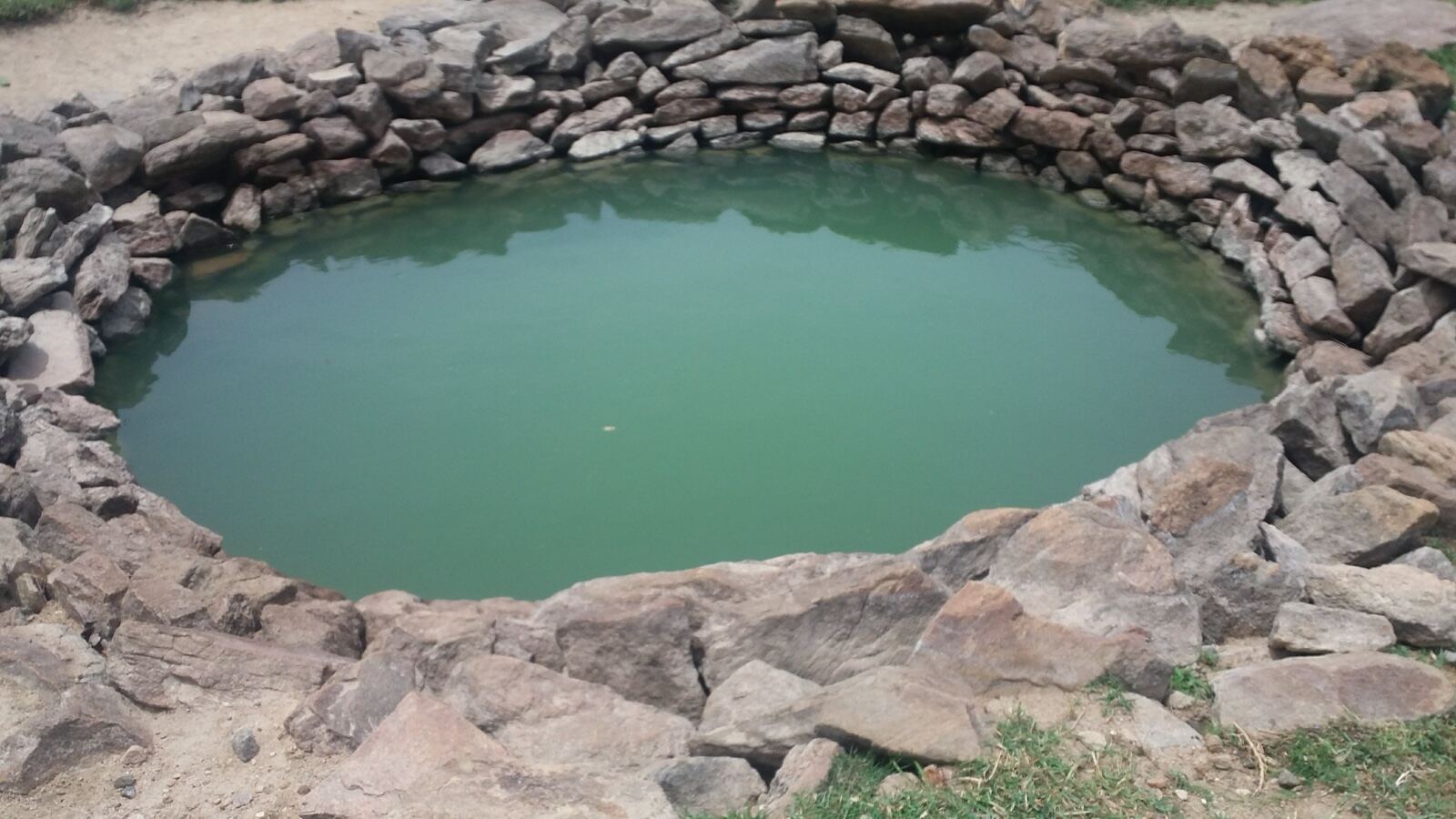
What a spring is
A spring is a point where the water table intersects the ground surface, or where an aquifer is forced to the surface by geology.
The common forms:
Contact spring, where a permeable layer sits on an impermeable one and water emerges along the junction — the most frequent type on hillsides, often appearing as a line of seeps at a consistent elevation.
Fracture spring, where water emerges from a joint or fault in rock.
Artesian spring, where a confined aquifer under pressure reaches the surface.
Depression spring, where the ground surface simply cuts below the water table.
Understanding which you have matters, because it tells you where the water is coming from and therefore what can contaminate it. See wells and boreholes.
Why springs are worth developing
A spring that flows reliably is among the best water sources available.
No pumping. If the spring is above the point of use, gravity delivers it indefinitely with no power and no moving parts. See gravity-fed systems.
Naturally filtered. Water that has passed through soil and rock is generally free of the pathogens and sediment that make surface water unsafe.
Steady. Spring flow varies far less than stream flow, because the aquifer buffers rainfall.
Cool and consistent in temperature.
The catch is that all of that depends on capturing it correctly, and a badly developed spring is frequently worse than an undeveloped one.
Capture at the source
The single principle that governs spring development.
Water must be collected at the point it emerges from the ground, before it flows across the surface. Once it runs over open ground for even a metre, it can pick up faecal contamination from livestock and wildlife, and the natural filtration is undone.
That means excavating back to the actual emergence point — often several metres into a hillside — until you reach the water-bearing layer, and capturing it there.
The standard arrangement:
Excavate back to firm water-bearing material, working upslope from where water appears.
A perforated collection pipe or gravel-filled gallery laid along the seepage line to gather flow.
A spring box — a sealed chamber of concrete, masonry, or plastic — receiving that flow. It needs a watertight lid, a screened overflow, a drain for cleaning, and a screened outlet to the supply pipe. It must be sealed on all sides except where water enters from the aquifer.
An impermeable cut-off — puddled clay or a concrete apron above and around the box — preventing surface water entering.
A diversion ditch upslope, carrying surface runoff around the site.
Fencing to keep livestock well clear.
The mistake to avoid is building a small dam across a surface flow and calling it a spring capture. That is a surface water intake, with all the contamination risk of one.
Protect the recharge area
A spring is the outlet of a catchment that may extend a considerable distance uphill, and whatever happens on that catchment reaches the spring eventually.
Identify it. Geology, topography, and where possible dye tracing. In fractured rock and limestone the recharge area may be surprising, and travel times can be days rather than years — karst springs behave almost like surface water and can turn turbid within hours of rainfall.
Exclude the obvious hazards: livestock, latrines and septic systems, fuel storage, manure heaps, silage, sprayed land, and vehicle access.
Maintain vegetation and tree cover, which sustains infiltration and reduces nutrient and sediment loading. This is the same relationship described in aquifer recharge — the recharge area's land use is the water quality.
Watch for changes upstream. A new development, a felled woodland, or a change in farming practice within the catchment can alter a spring that has been reliable for generations.
Testing and treatment
Test before use and periodically after, including bacteriology and whatever the local geology suggests. A spring is groundwater and carries the geology's chemistry — arsenic, fluoride, iron, and hardness are all possible. See water quality testing.
Test after heavy rain as well as in dry weather. A spring that is clean in settled conditions may turn contaminated after a storm, which reveals a rapid surface connection and a capture that is not sealed properly.
Turbidity following rainfall is the diagnostic warning sign, and it means the spring is not as protected as it appears.
Most well-developed springs on sound geology need little or no treatment. UV disinfection is a common precaution for potable supply, and it requires clear water to work. See the treatment order in water quality testing.
Flow, storage, and rights
Measure the yield across a full year, including the driest period, before designing anything around it. Spring flow in late summer may be a small fraction of spring flow in March, and the dry-season minimum is the number that matters.
Measure by timing the fill of a container of known volume at the outlet.
Add storage to bridge the gap between steady spring flow and peaky demand. A spring yielding a modest continuous trickle delivers a large daily volume into a tank, and the tank handles the peaks. This is the same arithmetic as ram pumps. See tank sizing and tank placement.
Never take the whole flow. A spring frequently feeds a stream, a wetland, or a downstream user, and drying it has ecological and legal consequences. Design the overflow to return surplus to the original channel.
Check the legal position. Rights to abstract spring water vary considerably, and downstream users often have established rights. Registration or a licence may be required above certain volumes.
Maintenance
Inspect and clean the box annually, and disinfect it after any work.
Keep screens clear on overflow and outlet — they exclude insects and animals, and a blocked overflow floods the box.
Check the fencing and the diversion ditch.
Watch for flow decline, which may indicate a blocked collection gallery, a fallen water table, or a change in the recharge area.
A well-built spring capture will run for generations with this much attention, which is a considerable return for a structure with no moving parts.
See also
- Gravity-Fed Systems distributing it without a pump
- Wells and Boreholes the same aquifer, reached differently
- Water Quality Testing what to test and when
- Aquifer Recharge protecting what feeds the spring
- Tank Sizing buffering steady flow against peaky demand
- Ram Pumps lifting spring water without power
- Qanats and Karez