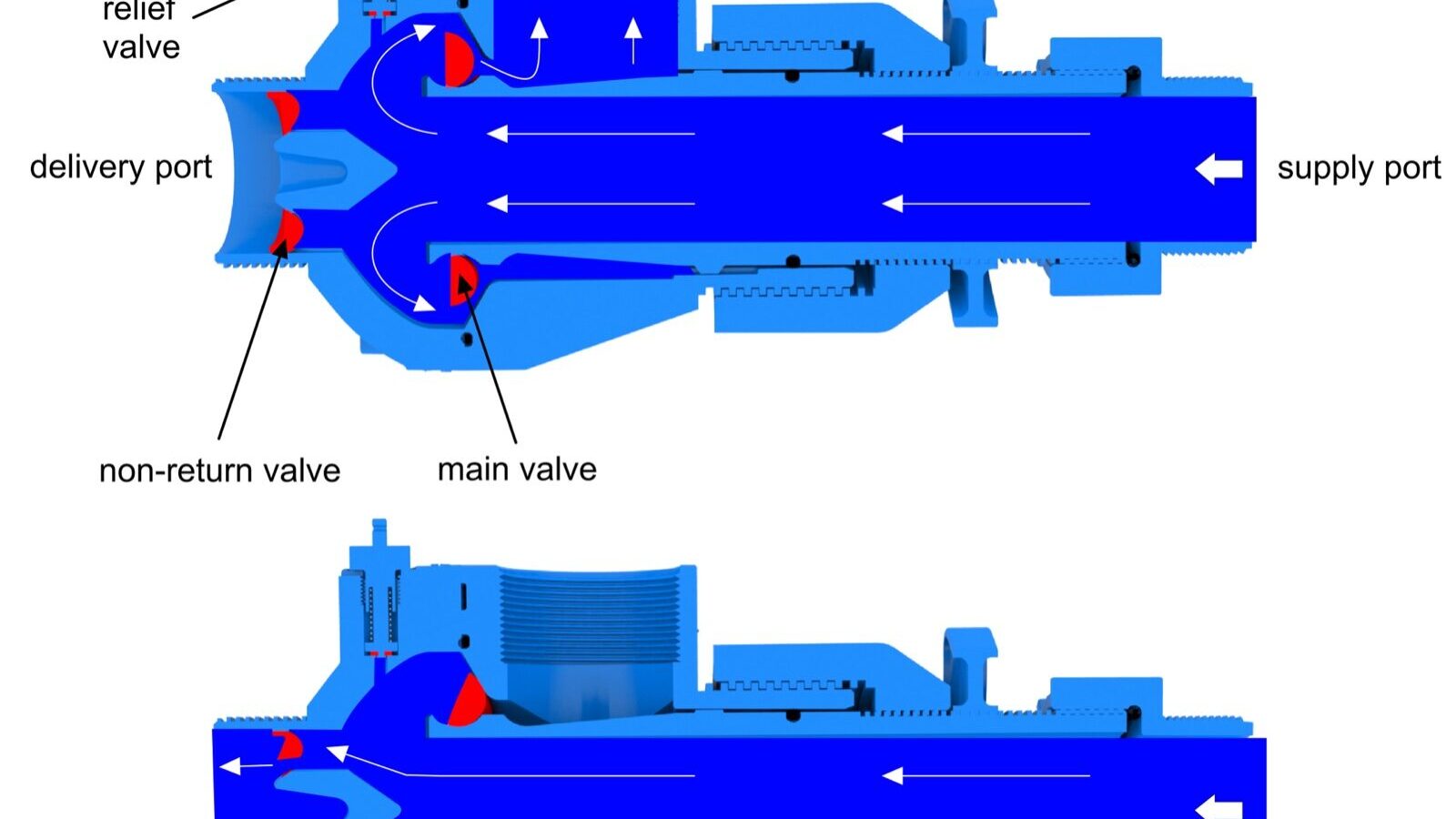
What it is
A pump with two moving parts, no power supply, and no fuel, that runs continuously for decades.
A hydraulic ram takes a flow of water falling a small distance and uses its momentum to push a small fraction of that water up a much larger distance. Everything else is discharged.
The technology is from the 1790s. Installations from the nineteenth century are still running. If you have a stream with a metre or two of fall and somewhere higher you want water, it is close to unbeatable.
How it works
The cycle is simple once you see it.
Water flows down a drive pipe from the source and out through the open waste valve. As it accelerates, drag on the waste valve increases until it slams shut.
The moving column of water in the drive pipe has momentum and nowhere to go. That produces a pressure spike, water hammer, the same effect that bangs your household pipes when a tap shuts fast.
That spike forces open the delivery valve and pushes a slug of water into the air chamber, compressing the air trapped there. The delivery valve closes, the compressed air pushes that water up the delivery pipe, pressure in the body drops, the waste valve falls open, and the cycle restarts.
It runs at roughly 40 to 120 beats a minute, audibly, forever. The characteristic sound is how you know it is working from a distance.
What you get out of it
The trade is volume for height. You lift a small amount high by discharging a large amount low.
A workable rule of thumb: you can lift roughly one tenth of the drive flow to about ten times the drive head, minus losses. So 60 litres a minute falling 2 m might deliver 6 litres a minute to 20 m.
Efficiency is typically 50 to 80 percent in energy terms, best when the lift ratio is modest. Push for a very high lift on a very small fall and delivery drops to a trickle.
The number that matters is daily volume, not flow rate. Six litres a minute sounds small. Run it 24 hours and it is 8,600 litres a day, which fills a substantial tank and irrigates a lot of ground. A ram pump's advantage is that it never stops.
Size the storage rather than the pump. Let it trickle into a tank around the clock and draw from the tank on demand. See tank sizing and tank placement.
What you need
Fall to the pump. A minimum of about 0.5 m, ideally 1.5 to 3 m or more. This is the drive head, and it sets everything.
Enough flow. Small rams need 7 to 20 litres a minute. Most of it leaves through the waste valve, which is not lost, just returned to the stream below the pump.
A drive pipe of the right proportions. Rigid, not flexible, because the whole mechanism depends on water hammer and a flexible pipe absorbs it. Straight, with a consistent fall, and typically 5 to 12 times its own diameter in length. Getting the drive pipe wrong is the commonest reason a home-built ram will not run.
Somewhere for the waste water to go. Back to the stream, into a pond, or onto irrigated ground.
Where it fits
Any site with a spring, stream, or gravity-fed supply that is below where the water is needed. Classic uses: spring in a valley, house or tank on the ridge, livestock troughs on high pasture.
It pairs naturally with a pond or a stream diversion, and with keyline design, where the point is often to move water from a valley up onto a ridge for gravity distribution across the whole property. A ram pump is one of the few ways to do that without power.
Compared with the alternatives: solar pumping is more flexible and works without any fall, but costs more, involves electronics, and has a finite life. A ram pump has two moving parts, both replaceable with basic tools, and no consumables. Where the site suits it, it is the more durable answer. See wells and boreholes for the solar comparison.
Running one
Starting it. A ram often needs help to begin. Open the waste valve by hand a few times until the cycle catches.
Tuning. The waste valve adjusts: heavier or longer travel gives slower beats and more volume per stroke, better for higher lift. Lighter and shorter gives faster beats and more total flow at lower lift. Adjust for the actual delivery, not the sound.
Air chamber. The trapped air gradually dissolves into the water and the chamber waterlogs, at which point delivery falls off and the pump gets noticeably harsher. A snifter valve, a small hole that draws a bubble of air in each cycle, solves this. Waterlogging is the second commonest fault.
Intake screening. Leaves and grit jam the valves. A settling box and screen at the intake prevents nearly all service calls.
Freezing. Water in the body will split it. In cold climates, drain or insulate.
Maintenance is realistically an annual check of the valve rubbers. They are the only wearing parts.
Building versus buying
Home-built rams from standard fittings are a well-documented project and they work. The design is not sensitive to fine tolerances, and the parts are ordinary check valves and pipe.
The two things that determine success are the drive pipe proportions and a properly sized air chamber. Get those right and almost any reasonable build runs.
Commercial cast rams last longer under continuous duty and are worth it where the installation is remote or critical.
The wider point
A ram pump is a good illustration of catching and storing energy that is already moving through the site rather than importing it. Water is already falling. The pump takes a cut.
That is the same logic as gravity-fed distribution, wicking beds, and ollas: find the energy gradient the landscape already provides and arrange things so it does the work. See permaculture design.
See also
- Gravity-Fed Systems distribution once the water is high
- Wells and Boreholes the powered alternatives
- Keyline Design moving water from valleys to ridges
- Tank Placement where the delivered water should go
- Ponds and Dams a common source for the drive flow
- Overflow Management handling the waste discharge
- Spring Development