What they are
Viburnum, a large and useful genus of shrubs and small trees, with several native to European and North American hedge and woodland and many more grown as garden ornamentals. Two natives lead:
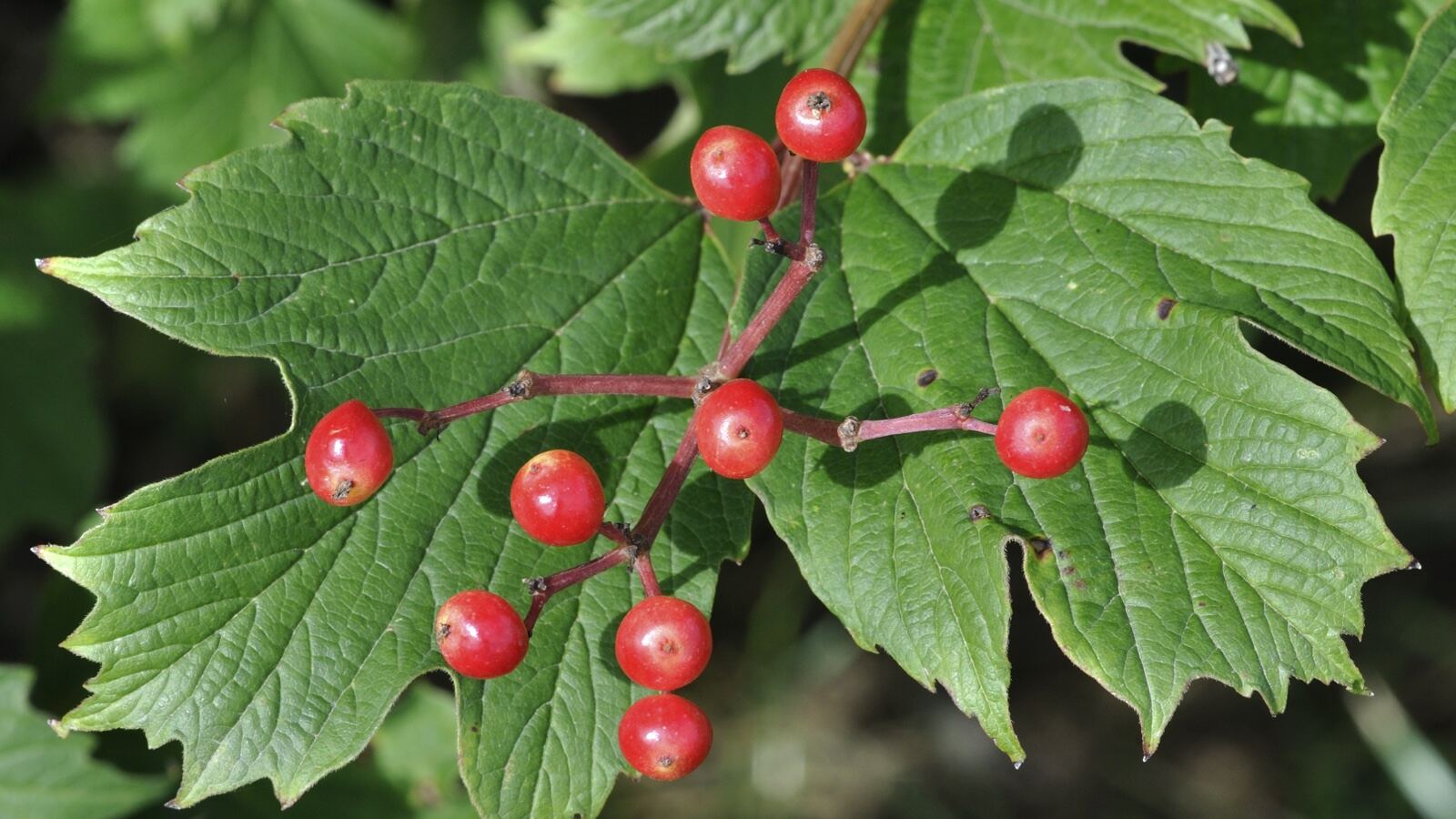
Guelder rose, Viburnum opulus: a shrub of damp hedgerow and wet woodland with maple-like lobed leaves, flat white lacecap flower heads, and spectacular glossy, translucent red berries.
Wayfaring tree, Viburnum lantana: its dry-ground counterpart on chalk and limestone, with rounded felted leaves and berries that ripen through green, red, and black together in the same cluster.
Neither is a rose, despite the name — guelder rose is named for the Dutch province of Gelderland, where the cultivated snowball form arose.
The lacecap and the snowball
The wild guelder rose has one of the prettiest flower arrangements in the hedgerow: a flat "lacecap" head in which a ring of large, showy, sterile flowers surrounds a centre of small fertile ones. The big outer flowers are pure advertisement — they produce no seed, existing only to draw pollinating insects in to the fertile centre, a neat piece of floral economy also seen in the lacecap hydrangeas.
Gardeners took the guelder rose and selected a form — the snowball tree (V. opulus 'Roseum') — in which all the flowers became large and sterile, turning the flat lacecap into a round ball of white bloom. It is beautiful but, being wholly sterile, produces no berries and is useless to wildlife: a good illustration of how selecting for showier flowers can breed the ecological value straight out of a plant. For wildlife, the wild single form is the one to plant.
Berries and wildlife
The wild viburnums are valuable wildlife shrubs.
Guelder rose's translucent red berries hang in heavy clusters well into winter — they are bitter and not a first choice, so birds take them later in the season when better fruit is gone, which makes them a useful late-winter reserve in the manner of hackberry and rowan. Bullfinches, waxwings, and thrushes eat them. The wayfaring tree's berries feed birds through autumn. The lacecap flowers are excellent for hoverflies, bees, and other insects, and the shrubs give nesting cover, so both earn their place in a mixed native hedgerow alongside hawthorn, spindle, and dogwood. See seed-dispersing birds and pollinator habitat.
The main pest is the viburnum beetle, whose larvae can strip the leaves; it is the one real drawback of growing viburnums, and lacewings and birds help control it.
The wider genus in gardens
Viburnum is one of the most useful of all garden genera because between its species it offers something in almost every season:
- Winter flower and scent — V. × bodnantense, V. farreri, and V. tinus (laurustinus) flower in the depths of winter, powerfully fragrant, among the best of all winter-scented shrubs;
- Spring flower — the snowball and the fragrant V. carlesii and V. × burkwoodii;
- Autumn colour and berries — guelder rose and many others.
Laurustinus (V. tinus), an evergreen Mediterranean species, is a particularly common and tough garden and hedge shrub, flowering all winter and feeding early bees. It is worth noting that some ornamental viburnums have become mildly invasive outside their range, the usual caution for a berry-bearing, bird-sown shrub.
Growing them
Easy and undemanding.
Guelder rose wants moist to wet soil and tolerates heavy, damp ground and part shade, which makes it useful in riparian and wet hedge situations where many shrubs sulk. Wayfaring tree wants the opposite — dry, chalky, alkaline soil in sun. Between them they cover wet and dry, acid and lime. Both are cheap as bare-root whips, 3 to 5 m, and easy from seed (slow, doubly dormant) and cuttings. See propagation and nursery stock.
See also
- Wildlife Shrubs viburnums in a wildlife planting
- Hedgerow Care guelder rose and wayfaring tree in a mixed hedge
- Spindle and Dogwood their companions in the shrub layer
- Elderberry another native flat-flowered, berrying hedgerow shrub
- Hoverflies the insects the lacecap flowers feed
- Seed-Dispersing Birds the birds that take the winter berries