What it is
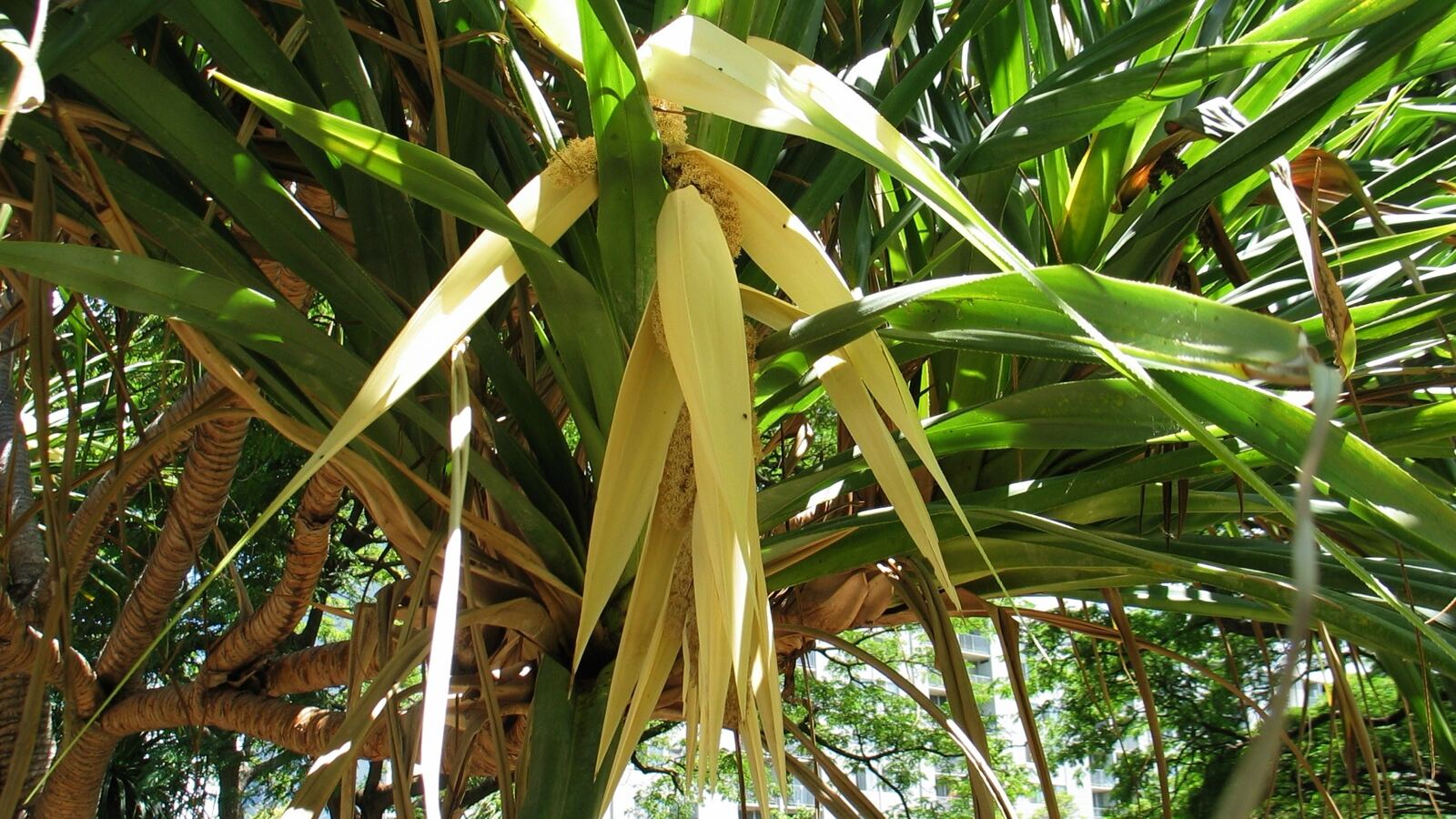
Pandanus, the screw-pines or pandans — a large group of tree-like plants of tropical coasts, islands, and wetlands from Africa across Asia to the Pacific, and one of the most useful and distinctive of all shore plants.
Despite the name, the screw-pine is not a pine (and not related to the true pines at all). The "screw" comes from the way its long, strap-shaped, spiny-edged leaves are arranged in spirals up the stems, twisting round like the thread of a screw; the "pine" from a fancied resemblance of the pineapple-like fruit to a pine cone. It is a monocot, more akin to the palms and grasses than to any conifer, and it stands, unforgettably, on a cone of stilt roots.
Standing on stilts
The screw-pine's signature feature is its prop or stilt roots — thick, aerial roots that grow down from the trunk and lower branches to the ground, propping the plant up on a tripod or cone of roots, so that an old screw-pine appears to stand on stilts above the sand or mud, sometimes with the original base of the trunk rotted away entirely.
These stilt roots are an adaptation to the plant's unstable, wet, wind-blown home: they anchor it in loose sand and soft mud, brace it against wind and waves and shifting ground, and let it stand in tidal and flooded conditions — the same bracing-and-breathing strategy as the mangrove and the banyan's prop roots. This makes the screw-pine a superb coastal stabiliser, binding shorelines, dunes, and riverbanks and buffering the coast against storms, in the front-line role of the sea grape, casuarina, and tropical almond; its buoyant, water-dispersed fruit floats to colonise new shores, as the coconut does. See coastal dunes and erosion control.
A tree that clothes and feeds cultures
The screw-pine is one of the most useful plants of the Pacific and Indian Ocean world, and for many island peoples it is a plant of everyday necessity — food, material, and flavour all in one:
- Leaves for weaving and thatch. The long, tough leaves (stripped of their spines) are the classic material for mats, baskets, hats, sails, thatch, and cordage across the Pacific and Southeast Asia — whole crafts and economies rest on pandan weaving.
- Fruit as food. The large, segmented, pineapple-like fruit is a staple food on many low coral islands (Kiribati, the Marshall Islands, the Maldives), where little else grows — the segments chewed or processed into a stored paste — one of the few starchy foods of the atolls, alongside the coconut.
- Pandan leaf as flavour. The leaves of certain fragrant screw-pines (Pandanus amaryllifolius) are the beloved "pandan" of Southeast Asian cooking — added to rice, curries, cakes, and desserts for their sweet, grassy, vanilla-like aroma and green colour, one of the signature flavours of the region.
Little of the plant is wasted, and it is planted and protected across the tropics for all of these. See food forest design.
Growing it
Tropical to warm-subtropical and frost-tender, the screw-pines are tough plants of the coast and wetland, wanting heat and tolerating salt, wind, drought, poor sandy soil, and flooding — the harsh shore conditions few plants endure — though most are intolerant of frost. They range from small shrubby kinds to large trees, and most are dioecious (separate male and female plants).
They are grown from seed (the floating fruit) and from suckers and cuttings, and are planted for coastal protection, weaving material, fruit, and (the fragrant pandan) for the kitchen; pandan is easily grown in a pot for a supply of the aromatic leaves. As a stilt-rooted, spiral-leaved, endlessly useful tree of the tropical shore, the screw-pine is one of the defining plants of the coasts and islands of the warm world. See propagation.
See also
- Mangroves and Banyan and Strangler Figs other stilt- and prop-rooted trees
- Sea Grape, Casuarina, and Tropical Almond fellow coastal-stabilising trees
- Coconut and Nipa Palm other useful coastal and island plants
- Coastal Dunes and Erosion Control the screw-pine's shoreline role
- Travellers Palm another dramatic palm-like non-palm
- Food Forest Design the screw-pine as food, material, and flavour