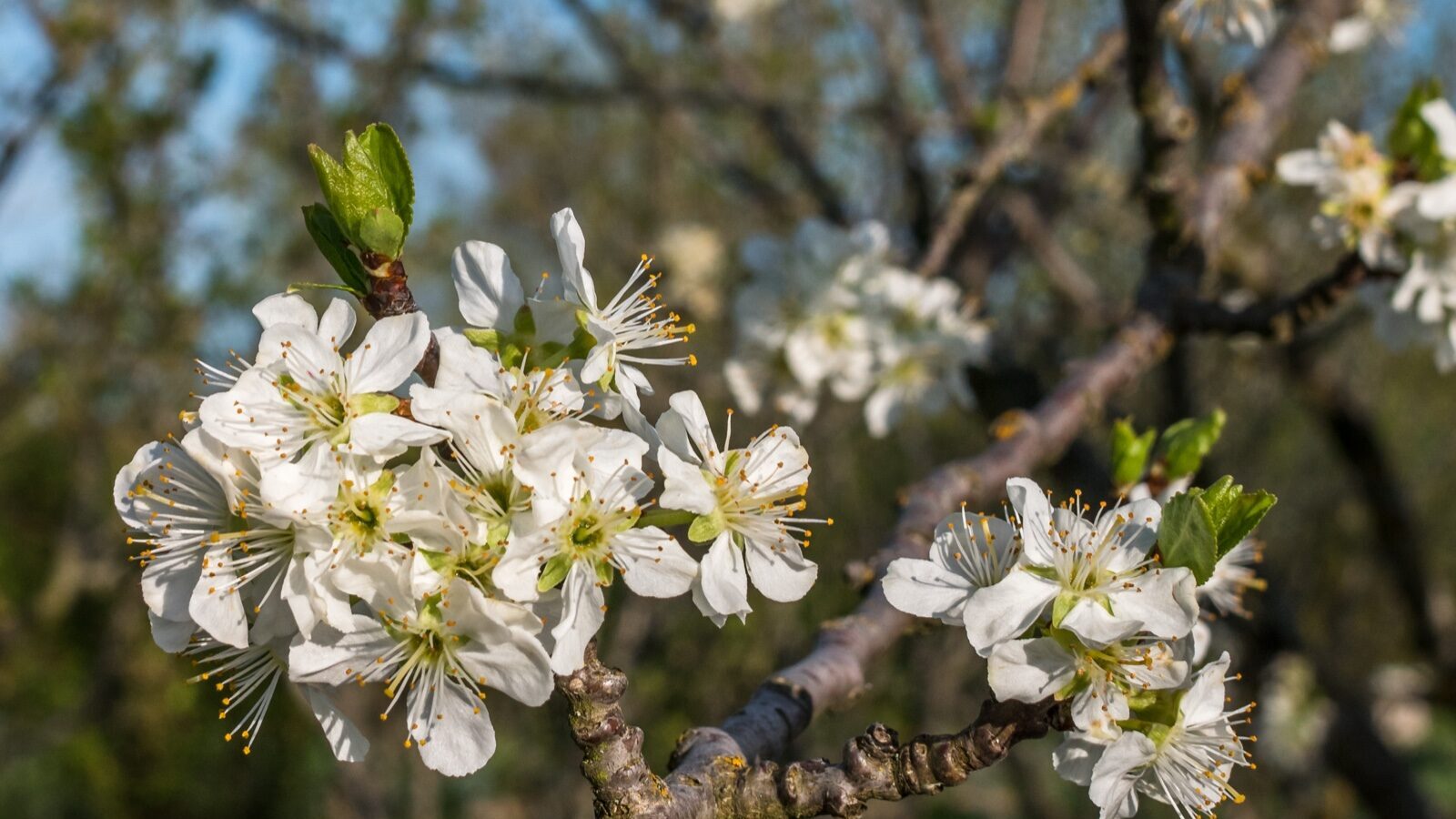
What they are
Prunus, the stone fruits or drupes: a fleshy fruit around a single hard stone containing the seed. Plums, damsons, gages, cherries, peaches, nectarines, apricots, and almonds are all the same genus.
They differ from the pome fruits, apples and pears, in ways that matter practically: they flower earlier, they are pruned at a different season, and most fruit on younger wood.
Prune in summer, never winter
The single most important rule, and the one that kills the most trees when ignored.
Silver leaf, Chondrostereum purpureum, is a fungal disease that enters through wounds. Its spores are abundant in autumn and winter and scarce in summer, and wounds close far faster during active growth.
So all stone fruit is pruned between late spring and late summer. Never in the dormant season. A plum pruned in January is an invitation, and bacterial canker follows the same logic.
The symptom is a silvery sheen on leaves as the fungus separates leaf tissue layers, followed by branch dieback and a purple bracket fungus on dead wood. Cut out affected branches well beyond the staining, and disinfect tools between cuts. See tree diseases and tool care and safety.
Prune lightly in general. Stone fruit does not need or want the structural winter pruning that apples get.
They fruit on young wood
This shapes the whole management approach.
Plums and damsons fruit on both one-year shoots and older spurs, so they are forgiving.
Sweet cherries fruit mostly on spurs on older wood.
Acid cherries, such as Morello, fruit almost entirely on the previous season's growth, so management is about constantly renewing young wood, cutting out what has fruited and tying in replacements.
Peaches and nectarines fruit exclusively on the previous year's shoots. A shoot that fruits will never fruit again. So peach pruning is a replacement system: as a shoot flowers, you identify a replacement shoot at its base, and after harvest you cut out the fruited wood and tie in the replacement. Neglect it and the fruiting zone marches outward, leaving bare wood behind and fruit only at the tips.
This is the same logic used for grapevines and it is very different from apple pruning. See pruning basics and espalier and training, where fans rather than espaliers are the correct trained form for exactly this reason.
Early flowering is the constraint
Stone fruit flowers early, sometimes very early. Apricots and peaches can be in bloom in late winter, plums well before apples.
That means frost is the dominant risk to the crop, and in many temperate regions it is the reason apricot and peach crops are erratic rather than any problem with the tree itself.
Site accordingly. Avoid frost pockets and valley bottoms. Use a warm wall where possible, since the stored heat lifts the local temperature. Be prepared to throw fleece over a wall-trained tree on frosty nights during blossom, which is entirely practical on a fan and impossible on a standard.
Early flowering also means few pollinators are flying. Cold still weather at blossom time means little insect activity, and hand pollination with a soft brush is a genuinely worthwhile job on a wall-trained apricot or peach.
See frost protection and native bees, noting that early-flying solitary bees and bumblebees matter far more than honeybees at this season.
Pollination
Varies considerably by species, and getting it wrong means no fruit.
Plums. Some are self-fertile, including Victoria, and some need a partner in a compatible group. Damsons are generally self-fertile.
Sweet cherries. Traditionally self-incompatible with a complicated group system, which is why old cherry orchards were mixed. Modern self-fertile varieties such as Stella have made single-tree cherry growing possible.
Acid cherries. Self-fertile.
Peaches, nectarines, apricots. Generally self-fertile, which is fortunate given how few insects are flying when they flower.
Rootstocks
As with pome fruit, the rootstock decides the size of the tree and much of its behaviour. See grafting and rootstocks.
For plums: Pixy for dwarf, St Julien A for the general-purpose middle, Brompton for vigorous standards.
For cherries: Colt is semi-vigorous, and the Gisela series is the reason home cherry growing became practical. A traditional cherry on wild rootstock reaches 12 m, and no netting exists that will cover it, which means the birds get everything.
That is not a small point. Cherries need netting, and netting requires a tree small enough to net.
The problems
Silver leaf and bacterial canker, both entering through wounds, both managed by summer pruning and clean cuts.
Peach leaf curl, a fungal disease producing red blistered distorted leaves in spring. Spores are spread by winter and early spring rain, so the effective control is keeping rain off the tree from midwinter until late spring with a simple lean-to shelter over a wall-trained tree. Remarkably effective and much better than spraying.
Brown rot, which mummifies fruit on the branch. Remove and destroy every mummified fruit, since they carry the infection to next season.
Plum moth and cherry fruit fly for the maggots, managed with pheromone traps and hygiene.
Birds, which take entire cherry crops with precision timing. Netting or nothing.
Wasps on ripening plums late in the season.
See integrated pest management for the general approach.
Almonds, and the odd one out
Almond is a Prunus grown for its seed rather than its flesh, with the fruit hull discarded. It flowers extremely early, which restricts it to regions with reliable warm springs, and it is closely related enough to peach that the two hybridise and share rootstocks.
Almond is also the crop most dependent on managed pollination anywhere in the world, with the Californian orchards requiring the movement of a very large share of all managed honeybee colonies in the United States each spring. It is the clearest possible illustration of what monoculture does to pollination, and why resident wild pollinator habitat matters. See pollinator habitat.
In a mixed planting
Stone fruit fits well into fruit tree guilds and mixed orchards, and the early blossom is valuable to pollinators precisely because so little else is open.
Damsons and bullaces are worth particular attention for difficult sites: hardy, tolerant of exposure and wet, resistant to neglect, and traditionally grown as hedgerow and windbreak trees in northern England. They produce heavily with almost no management. See hedgerow care.
Wild cherry, Prunus avium, doubles as a serious timber tree and a wildlife resource, and belongs in woodland mixtures as much as orchards.
See also
- Apples and Pears the contrasting pome fruits
- Grafting and Rootstocks choosing tree size
- Frost Protection the main threat to the crop
- Espalier and Training fans for stone fruit
- Tree Diseases silver leaf and canker
- Pruning Basics the seasonal rules