What they are
Malus domestica and Pyrus communis, both in the rose family, both producing a pome: a fruit where the flesh is swollen floral tissue and the true fruit is the core.
The apple came out of the Tian Shan mountains of Kazakhstan, where wild Malus sieversii still grows in forests of fruiting trees. It moved west along the trade routes, hybridised with European crab apples on the way, and became the most widely planted temperate fruit on earth. Something like 7,500 named varieties exist.
Pears took a parallel route out of the Caucasus and western Asia. Fewer varieties, longer-lived trees, and a reputation for being planted by people who will not live to eat from them.
Every one is a clone
An apple pip does not produce the apple it came from. Apples are obligate outbreeders with enormous genetic variability, and a seedling is a genuine lottery: usually small, usually sour, occasionally extraordinary.
So every named variety is a single original seedling, propagated vegetatively ever since. Every Bramley on earth is a cutting of a cutting of one tree grown from a pip in a Nottinghamshire garden around 1809. Every Golden Delicious descends from one chance seedling on a West Virginia farm.
This is why fruit trees are grafted, and why the rootstock beneath matters as much as the variety above. The full mechanics are in grafting and rootstocks.
Practically: choose the rootstock for the space and soil, choose the variety for the fruit, and know that a tree on M25 and the same variety on M9 are different propositions entirely, one a 7 m standard you will need a ladder for, the other a 2.5 m bush you can pick from the ground.
Pollination is the thing beginners miss
Almost all apples and pears are self-incompatible. One tree on its own, however healthy, gives you blossom and no fruit.
You need a second variety that flowers at the same time. Varieties are grouped into pollination groups, roughly 1 to 7 from earliest to latest flowering, and a partner in the same group or one either side will work.
Two complications:
Triploids. Some varieties, Bramley, Blenheim Orange, Jonagold among them, have three chromosome sets and produce sterile pollen. They need a pollinator but cannot return the favour. Plant a triploid and you need two other compatible varieties, not one.
Family trees and crabs. A single tree with three varieties grafted onto it solves the problem in a small garden. So does a crab apple: most flower over a long period and pollinate almost everything. One crab in a garden or hedge does more pollination work than a carefully matched pair.
Then you need something to actually move the pollen. Blossom in a cold wet spring gets little insect activity, and hive bees stay in. This is where native bees earn their reputation, since mason bees and bumblebees fly at lower temperatures and in worse weather. Hoverflies contribute as well, and both need habitat nearby rather than a monoculture of mown grass. See pollinator habitat.
Choosing varieties
Supermarket varieties are bred for shipping and shelf life, not for growing in your garden or tasting of anything. Ignore them.
Choose for three things:
Disease resistance, above all. Scab and canker are the two that ruin apple growing in wet climates, and variety choice determines whether you spend every year fighting them. Resistant varieties exist and are worth more than any spray. In wet western climates this decision is the whole game.
Local provenance. Regional varieties exist because they worked in that region for a century. A variety selected in your rainfall and your frost dates will outperform a famous one from elsewhere.
Season and use. Early apples do not keep, some barely keep a week. Late-keeping varieties store into spring. A garden with three trees is better with an early eater, a late keeper, and a cooker than with three of anything.
Pears additionally need warmth. They flower earlier than apples, so they lose blossom to late frost more often, and they need a warm site to ripen properly. On a cold site plant apples.
Spacing and form
Spacing follows rootstock, not variety. Dwarf bush at 2.5 to 3 m, semi-dwarf at 4 to 5 m, standards at 8 to 12 m.
Trained forms are worth more attention than they get. An espalier, cordon, or fan against a wall fruits heavily in almost no ground space, ripens earlier against stored heat, and is far easier to net, prune, and pick. Historic walled gardens grew pears this way for good reason.
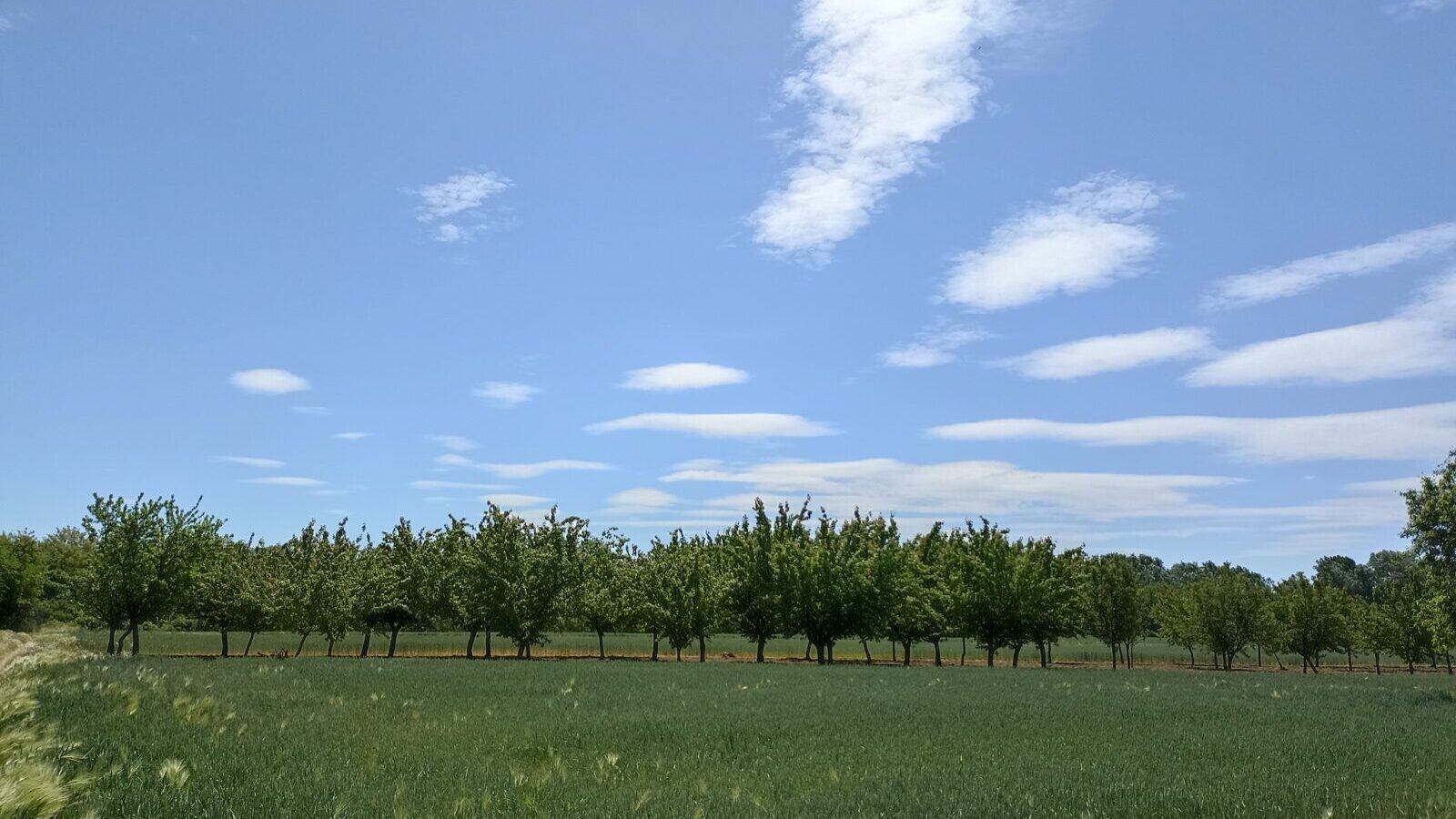
Traditional standard orchards, big trees on vigorous rootstock at wide spacing with grazing beneath, are a different system again: low yield per hectare, very high biodiversity, and productive for a century or more. Old orchards are among the richest habitats in lowland farmland, largely because of the deadwood in ageing trees. See dead wood habitat.
The year
Winter. Prune apples and pears while dormant. This is also grafting season.
Spring. Blossom, and the frost risk that goes with it. A late frost at full bloom removes the crop. Site accordingly, avoiding frost pockets at the bottom of slopes.
Early summer. The June drop, where the tree sheds fruit it cannot carry. Then thin what remains, to one or two fruits per cluster. Thinning feels wasteful and is the single biggest improvement to fruit size, and it prevents biennial bearing, the exhausting boom-and-bust cycle where a huge crop is followed by nothing.
Autumn. Pick apples when the fruit parts from the spur with a slight lift and twist. Pears are picked hard and ripened off the tree, which is the only way to avoid the gritty collapse of a pear ripened on the branch.
Storage. Cool, dark, humid, with air movement, fruit not touching. Late varieties keep for months. Never store apples with potatoes, which taint them.
The problems
Scab. Fungal, olive-black blotches on leaf and fruit, worst in wet springs. Managed by resistant varieties, open pruning for airflow, and clearing fallen leaves that carry the overwintering stage.
Canker. Sunken lesions that girdle branches, worse on heavy wet soils. Cut out into clean wood, improve drainage, choose resistant varieties.
Fireblight. Bacterial, blackened shoots with a shepherd's crook tip, and it kills pears fast. Cut well below the visible damage, sterilise between cuts.
Codling moth. The maggot in the apple. Pheromone traps for monitoring and mating disruption, plus greased bands and encouraging the predators that take the larvae.
Woolly aphid. White waxy colonies on bark, controlled largely by the natural enemies covered in aphids and predator-prey balance.
The general approach is in integrated pest management, and the pathogen background in tree diseases. Reaching for organic sprays is the last resort, not the first.
Underneath the tree
An orchard floor mown to a lawn is a wasted resource. Underplanting with a guild of nitrogen fixers, nectar plants, and pest-confusing aromatics does real work: comfrey mining potassium, alliums deterring, umbellifers feeding hoverflies, clover fixing nitrogen.
This is set out fully in fruit tree guilds and companion planting. Keep the mulch circle clear of grass in the early years, as in weed management, then let the guild fill in.
Old trees
An abandoned orchard is not a lost cause. Apples and pears tolerate hard renovation better than almost any other fruit, and a neglected tree brought back over three or four winters will crop again.
Do it gradually, no more than a quarter of the canopy in a season, or the tree responds with a thicket of watershoots. The method is in aged orchard rejuvenation.
Unnamed local varieties in old orchards are genuinely worth preserving, and the way to preserve one is scion wood next winter. See seed banking for the wider argument about genetic loss.
See also
- Grafting and Rootstocks why the tree is two plants
- Fruit Tree Guilds what to plant underneath
- Aged Orchard Rejuvenation bringing old trees back
- Native Bees the pollinators that fly in bad weather
- Tree Diseases scab, canker, and fireblight in context
- Pruning Basics the annual cuts