What it was
Ulmus, around 30 species across the northern hemisphere. In Britain and much of Europe, elm was a defining landscape tree: English elm lining hedgerows, wych elm in northern and western woods, and elm avenues in every town.
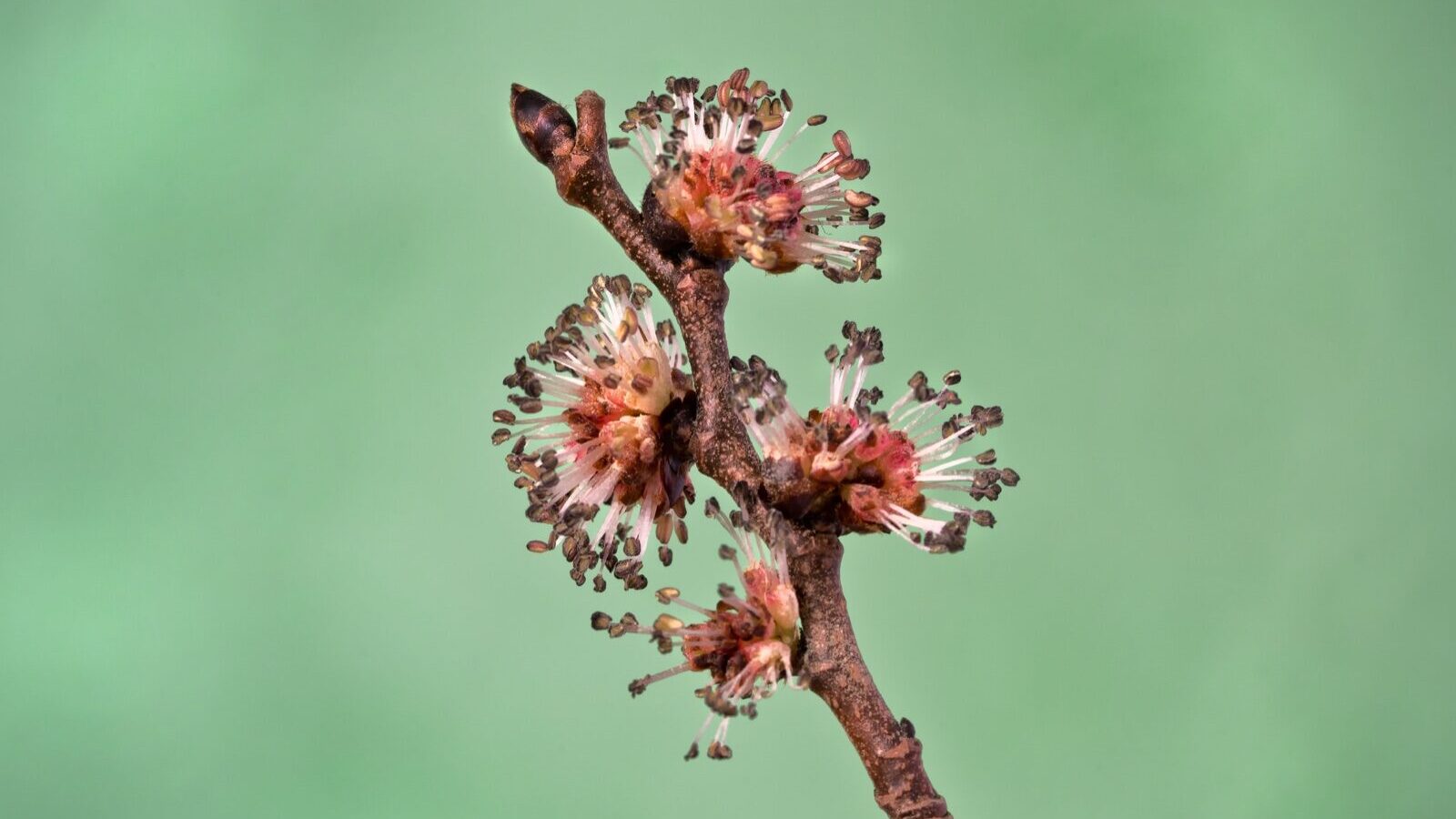
Asymmetric leaf bases, rough-textured leaves, and papery disc-shaped seeds produced very early in spring, often before the leaves.
Then, within about fifteen years, most of them died.
Dutch elm disease
Caused by the fungi Ophiostoma ulmi and the far more aggressive O. novo-ulmi, and spread by elm bark beetles that breed under the bark of dying trees and carry spores to healthy ones as they feed.
The fungus grows in the vascular system. The tree responds by plugging its own vessels to contain the spread, and in doing so cuts off its water supply. Wilting, yellowing, and death follow, often within a single season for a mature tree.
The name is misleading: the disease is not Dutch in origin, but Dutch pathologists identified it. The first milder epidemic ran in the 1920s. The second, from a far more virulent strain, arrived in Britain in the late 1960s in imported logs and killed an estimated 25 to 30 million elms by the mid-1980s. Similar losses occurred across Europe and North America.
The loss changed the look of whole countrysides. Elm was the dominant hedgerow tree across large parts of lowland England, and its removal is one of the largest landscape changes of the twentieth century.
Why it is not extinct
Elm survives, and the reason is that the fungus and its beetle vector both need mature bark.
Elm suckers vigorously from surviving root systems. Those suckers grow into young trees, thicken, and once the trunk reaches roughly 10 to 15 cm diameter, the bark becomes suitable for the beetles to breed in. The tree is then infected and dies back. The roots survive and sucker again.
So elm persists across much of its former range as a permanent cycle of regrowth and dieback in hedgerows: never absent, never reaching maturity. Genetically the same individuals, in many cases, that were there before the epidemic.
This is why elm is a common hedgerow shrub in England and a rare tree. Look along old hedges and the suckers are everywhere.
Wych elm, which reproduces by seed rather than suckering, has fared differently and survives better in the north and west, particularly in Scotland where isolation and cooler conditions slowed the spread.
The butterfly that needs it
The white-letter hairstreak lays exclusively on elm, and its larvae feed on elm flowers and leaves. The butterfly declined catastrophically alongside the tree, with British populations falling by an estimated 96 percent.
It survives on exactly those hedgerow suckers, which is the practical argument for keeping them rather than removing elm regrowth as scrub.
If you manage hedges, elm suckers are not a nuisance to be cleared. They are the entire remaining habitat of a specialist species. Cut hedges on a rotation that leaves some elm to flower, and avoid cutting everything in the same year. See hedgerow care and caterpillars.
Resistance
Several routes are being pursued, with genuine but partial success.
Asian species including U. pumila and U. parvifolia coevolved with the pathogen and are substantially resistant. They are also different trees, smaller and with a different form.
Hybrid cultivars bred from Asian and European parents are now available and perform well, with a number of well-tested selections widely planted in Europe and North America. They are not immune but they survive.
Surviving mature natives. A scattering of large elms survived the epidemic, some through isolation, some apparently through genuine tolerance. These are being identified and propagated, and they matter for the same reason tolerant ash matters. See ash and seed banking.
Management. Prompt removal and destruction of infected material breaks the beetle breeding cycle, and injection treatments protect individual high-value trees at cost. Isolated populations, such as those in Brighton and on the Isle of Man, have been protected for decades by rigorous sanitation.
The timber
Elm has properties nothing else quite matches.
The interlocked grain makes it extremely resistant to splitting, which is why it was the timber for chair seats, wheel hubs, and mallet heads. It is also exceptionally durable when permanently waterlogged, so it was used for water pipes, harbour piles, lock gates, and the keels of boats. Elm water mains from the eighteenth century are still dug up intact.
It is not durable in alternating wet and dry conditions.
The grain figure is handsome, and elm boards have become scarce and valuable since the epidemic removed the supply.
Planting it now
Worth doing, with realistic expectations.
For landscape and street planting, use tested resistant cultivars, and follow the diversity limits in urban forestry rather than repeating the monoculture that made the epidemic so devastating.
For conservation, the priority is retaining and managing existing sucker populations rather than planting. They carry local genetics and they support the specialist species.
For woodland, wych elm is worth including in mixtures in cooler regions, and it regenerates from seed where mature trees survive.
Do not import elm material. The second epidemic arrived in imported timber, and the plant trade remains the main route for tree pathogens. See tree diseases and nursery stock.
See also
- Tree Diseases how the epidemic worked
- Ash the same story, happening now
- Hedgerow Care managing the surviving suckers
- Caterpillars the white-letter hairstreak
- Structural Diversity why monocultures fell
- Urban Forestry planting resistant cultivars