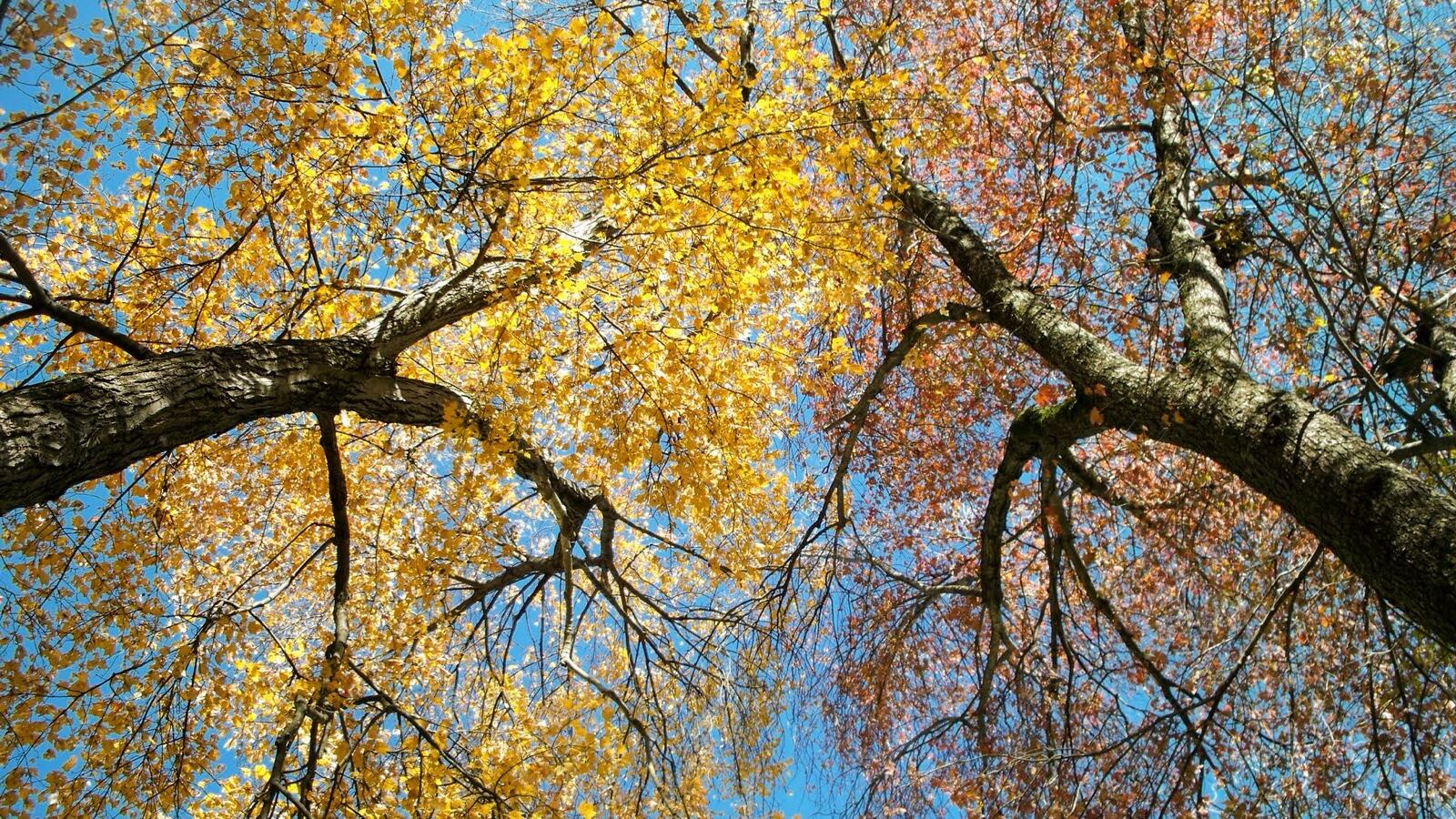
What they are
Acer, around 130 species, overwhelmingly northern hemisphere, with the greatest diversity in East Asia.
Opposite leaves, usually palmate with the familiar lobed outline, and paired winged seeds that spin as they fall. That helicopter seed, a samara, is the genus signature and an efficient dispersal mechanism that puts seedlings well clear of the parent.
Maples span everything from 40 m forest dominants to shrubs, which makes the genus useful across almost any planting scale.
The ones worth knowing
Sugar maple, A. saccharum. The syrup tree and the backbone of northeastern North American hardwood forest. Shade-tolerant, slow, long-lived, and responsible for the most spectacular autumn colour of any temperate forest. Sensitive to soil compaction and road salt, which is why it does poorly as a street tree.
Norway maple, A. platanoides. European, tough, tolerant of pollution and poor soil, widely planted in cities. Also seriously invasive in eastern North America, where it casts dense shade, leafs out early, and suppresses native regeneration. A good example of a species that is unremarkable at home and destructive elsewhere. See invasive species.
Sycamore, A. pseudoplatanus. Central European, naturalised widely and treated as invasive in Britain by some and as a valuable naturalised tree by others. Extremely wind-firm and salt-tolerant, which makes it one of the best shelter trees for exposed and coastal sites. Supports large aphid populations, which in turn feed a great many birds and predatory insects. See aphids and predator-prey balance.
Field maple, A. campestre. Small, native across much of Europe, and an excellent hedgerow component. Tolerates hard cutting, turns clear butter yellow in autumn, and supports a good invertebrate fauna. Under-used. See hedgerow care.
Red and silver maple, A. rubrum and A. saccharinum. North American, fast, tolerant of wet ground. Red maple has expanded dramatically across eastern North America under fire suppression, since it is fire-sensitive but shade-tolerant, and it is now displacing oak on many sites. See fire management.
Japanese maples, A. palmatum and relatives. Small, slow, grown for form and colour. Understorey plants that want shelter from wind and scorching sun.
Tapping for sap
Maple syrup is a genuinely sustainable forest product, and a tapped tree lives a normal lifespan.
The mechanism depends on a specific weather pattern: freezing nights followed by days above freezing. That cycle creates pressure changes in the stem that drive sap flow. Only a handful of regions in the world get a reliable enough spring freeze-thaw sequence, which is why the industry is concentrated in northeastern North America.
Sugar maple sap runs at around 2 percent sugar, so roughly 40 litres of sap boils down to 1 litre of syrup. Other maples can be tapped, including sycamore, field maple, and birch, with lower sugar content and correspondingly more boiling.
Tapping rules that keep the tree healthy: minimum trunk diameter around 25 to 30 cm for one tap, more taps only on larger trees, a shallow hole drilled at a slight upward angle, a new hole each year well away from previous ones, and removal of the spile at the end of the season. Done properly the wound compartmentalises and closes.
The economics are interesting because they give standing hardwood forest an annual income without cutting it, which is exactly the kind of arrangement that keeps forests standing. See restoration economics and woodland management.
Autumn colour, and what causes it
Maple colour is the best in the temperate world, and the chemistry is worth knowing because it explains the variation between years.
As chlorophyll breaks down in autumn, the yellow carotenoids that were always present become visible. The reds and scarlets are different: anthocyanins, manufactured fresh in autumn, not merely revealed.
That synthesis needs sunny days and cool but not freezing nights. Bright cold autumns produce spectacular colour; warm, dull, wet ones produce a muted year. Drought-stressed trees often colour early and drop early.
Why a tree spends energy making pigment in a leaf it is about to discard is still debated, with the main hypotheses being sunscreen protection during nutrient withdrawal and signalling to insects.
The wood
Hard maple, principally sugar maple, is dense, pale, fine-grained, and extremely wear-resistant. It is the standard for bowling alleys, basketball courts, butchers' blocks, and workbenches.
Figured maple, with wavy or quilted grain, is among the most valuable decorative timber in the world, used for violin backs and guitar tops. The figure cannot be predicted from the outside of the log, which makes buying it a gamble.
Soft maples, including silver and red, are lighter and used for furniture parts and pallets.
Sycamore timber in Europe is pale, hard, and prized for kitchenware precisely because it does not taint food.
Planting them
Maples are broadly easy: most tolerate a range of soils, most transplant well, and most establish quickly.
Watch three things. Norway maple should not be planted where it is invasive, which includes most of eastern North America. Sugar maple will not thrive in compacted or salted urban soil, so it is a park tree rather than a street tree. And the shallow dense root systems of some maples, particularly Norway and silver, make it hard to grow anything beneath them.
For street planting, follow the diversity limits in urban forestry. Maple has been over-planted in North American cities to the point of real vulnerability.
In mixed woodland, maples slot in as canopy or sub-canopy depending on species, and field maple is one of the more useful small trees for structure. See structural diversity.
See also
- Native Oaks the usual forest partner
- Beech the competing shade-caster
- Hedgerow Care field maple in hedges
- Invasive Species Norway maple outside its range
- Urban Forestry maple over-planting in cities
- Woodland Management tapping as forest income