What it is
Fraxinus excelsior across Europe, with F. americana and F. nigra in North America and around 60 species worldwide, all in the olive family.
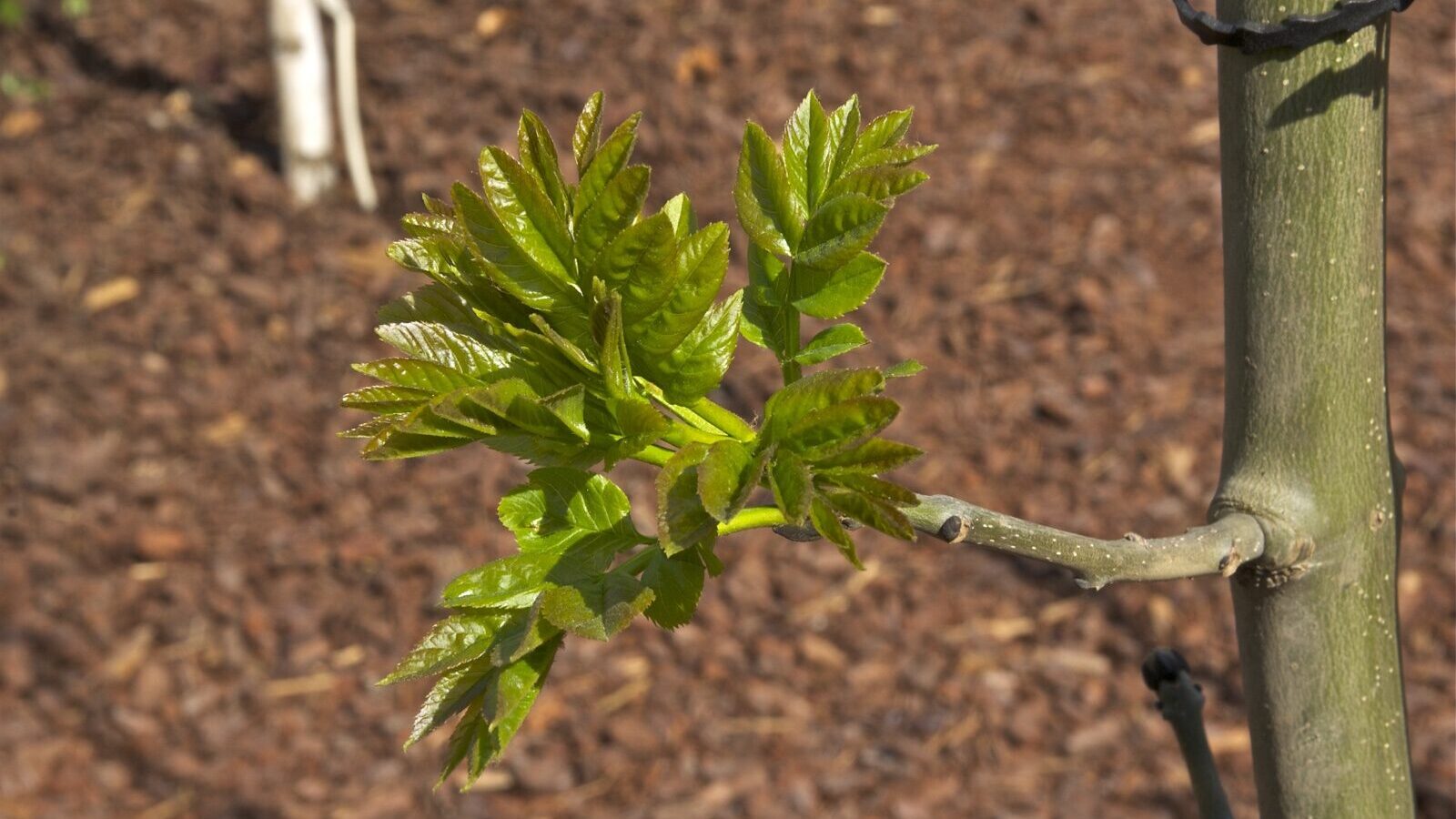
Pinnate leaves with 7 to 13 leaflets, distinctive matt black buds in winter that identify it at a glance, and winged seeds hanging in bunches through winter. Fast growing, up to 35 m, and typically living 200 to 400 years.
Ash is the light-canopy counterpart to beech. Its leaves come late, fall early, and are held in an open pinnate arrangement, so a great deal of light reaches the floor.
The light it lets through
The ecological consequence is significant: ash woodland has a rich ground flora precisely because the canopy is thin and the season under it is long.
Dog's mercury, bluebells, wild garlic, and a wide range of woodland herbs thrive under ash in a way they cannot under beech. Ash leaf litter is also base-rich and breaks down quickly, so it improves rather than acidifies the soil, feeding earthworms and supporting a fast nutrient cycle. See decomposers and soil food web.
That combination, high light and good litter, makes ash disproportionately important to woodland biodiversity relative to its share of the canopy. Over 900 species in Britain are associated with ash, and around 45 of them are found on nothing else.
Which is what makes its loss so serious.
Ash dieback
Hymenoscyphus fraxineus, a fungus from East Asia where the local ash species coevolved with it and tolerate it. European ash has no such history.
It arrived in Europe in the early 1990s and spread across the continent within two decades, largely through the nursery trade. Spores are windborne over tens of kilometres, so containment was never realistic once it was established.
The fungus blocks the vascular system. Symptoms are crown thinning from the top, dark diamond-shaped lesions where branches meet the stem, blackened wilting leaves in summer, and epicormic shoots as the tree tries to compensate. Death follows over several years, faster in young trees.
Expected losses are commonly put at 70 to 95 percent of European ash. Secondary attack by honey fungus and ash bark beetles kills many weakened trees before the dieback alone would.
In North America the equivalent catastrophe is the emerald ash borer, an introduced beetle that has killed hundreds of millions of ash and is functionally eliminating the genus across large regions. See tree diseases.
The survivors are the point
A small proportion of European ash, somewhere in the low single digits, shows genuine heritable tolerance. Not immunity, but enough resistance to survive and reproduce.
That fraction is the entire basis for the species' future, and it is the reason the standard advice is now: do not fell ash simply because it has dieback.
Trees that remain healthy while neighbours die are the most valuable genetic material in the landscape. Breeding programmes across Europe are built on identifying and propagating them, and natural selection through the epidemic is doing the same work at scale, provided enough trees are left standing for it to act on.
Fell for safety near roads, paths, and buildings, since dieback makes ash brittle and unpredictable, and it fails suddenly. Leave everything else, particularly anything looking healthy. See seed banking and minimum viable populations.
Standing dead ash is also exceptional habitat, and the gap created is a chance to diversify rather than a hole to fill with a single replacement. See dead wood habitat and storm damage recovery for the same triage logic.
The timber
Ash is one of the great utility hardwoods: pale, straight-grained, tough, and exceptionally shock-resistant.
It is the traditional timber for anything that takes impact or needs to flex — tool handles, hurleys, oars, hockey sticks, ladder rungs, wheel felloes, and early aircraft frames. It steam-bends well and finishes cleanly.
It is also among the best firewood in Europe, and unusually will burn reasonably even when green, which is the origin of the old rhyme about ash wood wet or ash wood dry.
Not durable in ground contact, so it is not an outdoor timber without treatment.
The dieback epidemic has produced a glut of ash timber followed by an expected long-term shortage, and much of what has been felled has gone for firewood rather than into the uses that would justify it.
Coppice and management
Ash coppices vigorously and was one of the mainstays of the traditional coppice rotation alongside hazel, cut on roughly 10 to 25 year cycles for poles, handles, and firewood. See coppice rotation.
It also seeds itself extremely freely, to the point of being a nuisance in gardens, and it colonises abandoned ground readily. In its pioneer role it behaves much like the species in pioneer species.
Where dieback has taken the canopy, the management question is what replaces it. Natural regeneration from tolerant survivors is preferred where it is happening, supplemented with a diverse mixture rather than a single substitute. Planting a monoculture of the next fashionable species repeats the mistake that made the epidemic so costly.
Do not plant ash from imported nursery stock. Local seed, local propagation, and biosecurity discipline are the minimum. See nursery stock.
See also
- Tree Diseases the epidemic in context
- Beech the deep-shade counterpart
- Dead Wood Habitat what standing dead ash supports
- Coppice Rotation the traditional management
- Seed Banking preserving the tolerant fraction
- Nursery Stock biosecurity in the plant trade