What it is
Tilia, called lime in Britain, linden in Germany and North America, basswood in the American timber trade. Nothing to do with the citrus fruit.
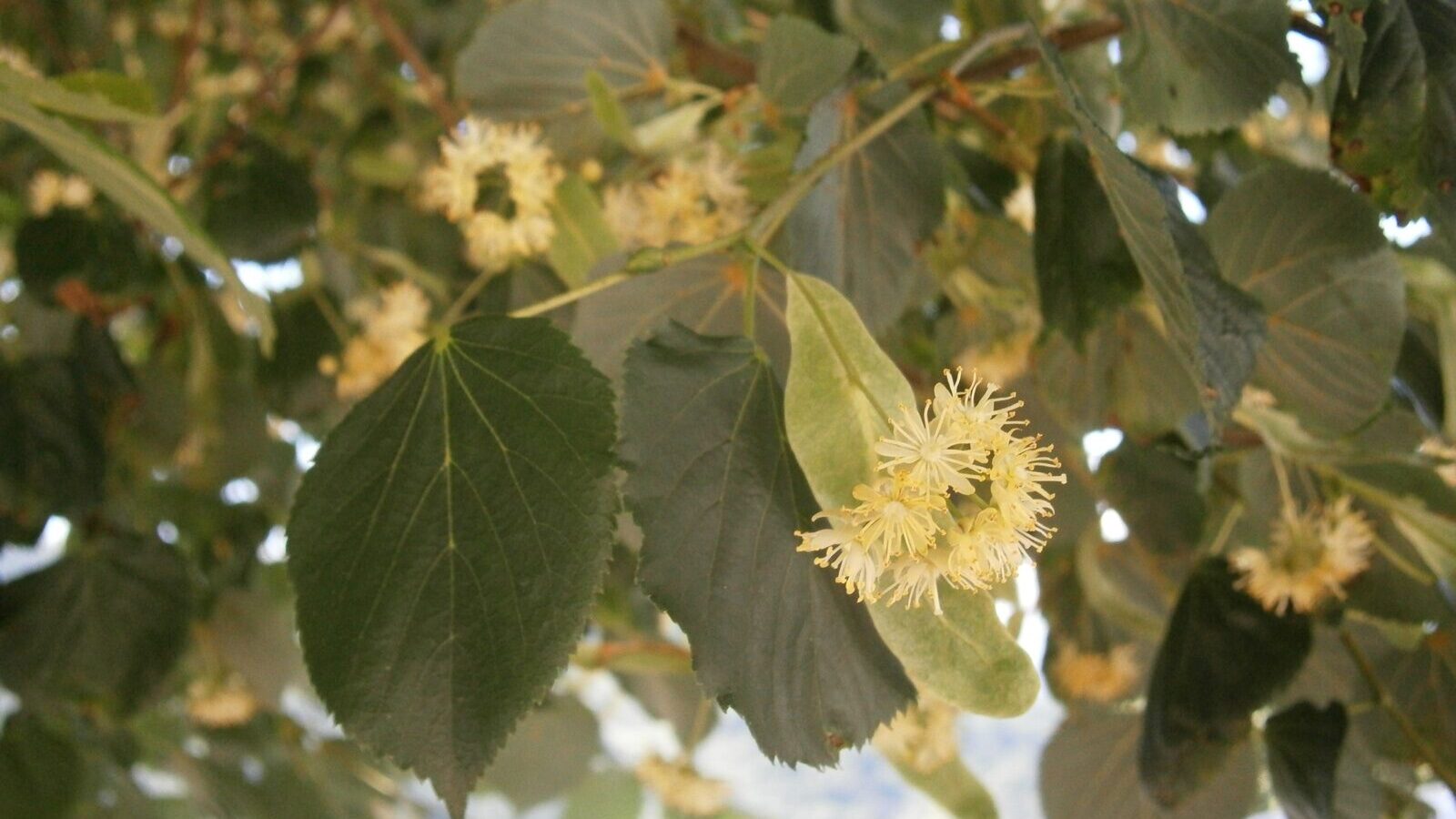
Around 30 species across the northern temperate zone. Heart-shaped leaves with an asymmetric base, and a distinctive flower structure: clusters of small pale yellow flowers hanging from a long papery bract that acts as a wing when the seeds fall.
Large, long-lived, and capable of 40 m. Small-leaved lime, T. cordata, and large-leaved lime, T. platyphyllos, are the European natives; common lime is their hybrid and the one planted in every avenue.
The nectar
Lime is the most productive nectar source of any temperate forest tree, by a wide margin.
A mature lime in full flower in midsummer is audible from a distance. Honeybees, bumblebees, hoverflies, and a great many other insects work it heavily, and lime honey is distinctive, pale, and strongly flavoured enough to be sold as a single-source honey across Europe.
The timing matters as much as the quantity. Lime flowers in midsummer, in the gap after the spring blossom of fruit trees and hawthorn and before the late-summer flow. That gap is a genuine dearth in many landscapes, and lime fills it.
For anyone planting for pollinators, this is the highest-value tree available in temperate conditions. See pollinator habitat and native bees.
One caveat worth knowing: bumblebees are sometimes found dead beneath limes, particularly silver lime, T. tomentosa. The long-held explanation was toxic nectar, but the current evidence points instead to starvation, with bees exhausting themselves on a tree whose nectar has run out late in the flowering period.
The stool that outlives the tree
Small-leaved lime coppices exceptionally well and produces some of the oldest living structures in European woodland.
Coppice stools of lime have been dated at well over a thousand years, and in some cases estimated at two thousand or more. The stems are cut and regrow repeatedly; the root system and stool continue. A ring of lime stems several metres across is a single organism that was already ancient when the woodland around it was young.
Lime was one of the dominant trees of European post-glacial forest, far more abundant then than now. Pollen records show it as a major component of the mid-Holocene canopy across Britain and northern Europe. Its decline is largely attributable to human clearance, since it grows on the fertile lowland soils people wanted for agriculture, and its regeneration from seed is poor in cool climates.
Ancient lime stools in woodland are therefore direct evidence of woodland continuity, and they are a useful marker in historical ecology. See coppice rotation.
Bast
The inner bark of lime is fibrous and strong, and it was one of the principal cordage materials of prehistoric and medieval Europe.
Strips of inner bark were retted in water, separated into fibres, and twisted into rope, matting, and netting. The word bast survives in basswood and in bast fibre generally. Neolithic rope and net finds are frequently lime bast.
Coppice cycles supplied it, since the young smooth-barked poles are what you want.
The timber
Pale, fine, even-grained, soft, and almost without figure, which is exactly what a carver wants.
Lime is the premier carving wood in Europe. Grinling Gibbons worked in it, and it remains the standard for fine woodcarving, musical instrument parts, and pattern-making because it cuts cleanly in any direction and holds fine detail.
Not durable outdoors, not structural, and poor firewood.
American basswood has the same properties and the same uses.
The problems with it
Aphids and honeydew. Lime carries very large aphid populations, and the honeydew they excrete rains down and coats everything below in a sticky film that then grows sooty mould. This is the single reason people regret planting lime over a car park or a pavement.
Ecologically the aphids are a feature rather than a fault, feeding hoverflies, ladybirds, and a great many birds. See aphids and predator-prey balance. It is still a poor choice directly over parking.
Epicormic growth. Common lime in particular produces dense masses of shoots around the base and on the trunk. Attractive to some, untidy to others, and requiring regular removal in formal settings. Small-leaved lime does it far less.
Suckering from the base on some clones.
Planting and management
Lime tolerates a wide range of soils, prefers fertile moist ground, and handles both shade and exposure better than most large broadleaves.
It responds extremely well to hard pruning, which is why it is the classic pleaching species: trained into a hedge on stilts along avenues and formal walks. It also stands repeated pollarding.
For street and park planting, prefer small-leaved lime over common lime, since it produces far less epicormic growth and less honeydew. See urban forestry.
In woodland planting, small-leaved lime is a valuable and much under-used component: it casts moderate shade, produces good litter, coppices indefinitely, and supplies the midsummer nectar gap. It is a strong candidate wherever the aim is structural diversity with productive function.
Seed regeneration is unreliable in cool climates, so plant or layer rather than relying on natural spread. See propagation.
See also
- Pollinator Habitat filling the midsummer gap
- Coppice Rotation the thousand-year stools
- Historical Ecology lime as a continuity marker
- Native Bees the main beneficiaries
- Hedgerow Care pleaching and laying
- Urban Forestry choosing the right lime for streets