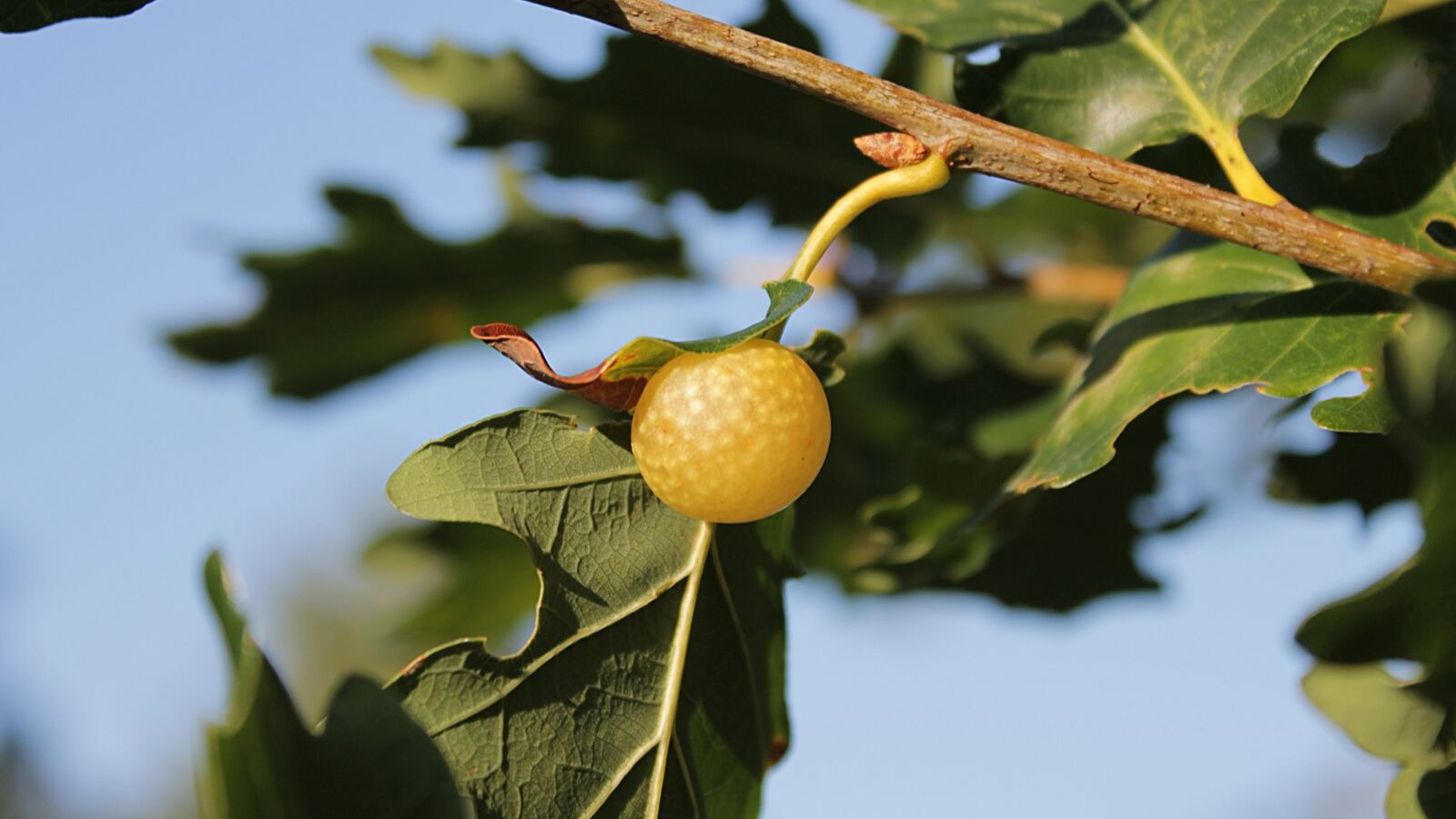
What a gall is
A gall is an abnormal growth on a plant — a swelling, ball, spike, or fuzzy tuft on a leaf, twig, bud, or root — produced by the plant, but built at the command of another organism living inside it. A tiny insect or mite lays its egg in the plant tissue, and chemical signals from the developing larva hijack the plant's growth, causing it to build a custom structure of exactly the right shape around the intruder: a home and a larder, its walls the larva's food, its shape and even its internal chemistry controlled by the insect.
It is one of the most extraordinary relationships in nature — a case of one organism's genes reaching out to reshape another's body, what biologists call an "extended phenotype." The gall-maker does not build the gall; it makes the plant build it.
Who makes them
A whole range of small creatures induce galls, each producing its own characteristic, often beautiful and species-specific shape:
- Gall wasps (cynipids) — the masters of the art, especially on oaks: the round oak marble gall, the oak apple, the flat spangle galls dotting the underside of oak leaves in autumn, and the knopper gall on acorns are all made by tiny wasps, each species its own gall;
- Gall midges (tiny flies) — such as the pear midge and countless leaf-and-bud galls;
- Gall mites — microscopic mites that make the felty "nail galls," "nipple galls," and fuzzy patches on the leaves of limes, maples, and the hackberry;
- Aphids and psyllids — some aphids induce galls, such as the pouch and purse galls on poplar and spruce.
The famous "robin's pincushion," the fuzzy red-and-green moss-like ball on wild rose stems, is the gall of a tiny wasp — one of the most conspicuous and charming galls of the hedgerow.
Mostly harmless — and once, essential
The reassuring news for the gardener is that the great majority of galls are cosmetic and harmless to the plant. The oak that is covered in spangle galls, the hackberry with its nipple galls, the rose with its pincushion — all are essentially unharmed, carrying their lodgers with no real cost. Galls are best enjoyed as one of the small wonders of the garden rather than feared, and they are food and habitat for a surprising web of other creatures (the "inquilines" and parasitoids that live in and on them), part of the biodiversity a mature tree supports. A few galls do matter economically (the pear midge that ruins young pears, some galls on crops), but they are the exception.
One gall changed history. The oak marble gall and its relatives are extraordinarily rich in tannin, and for well over a thousand years these "oak galls" were the raw material of iron-gall ink — the standard black writing ink of the Western world, used to write the vast majority of manuscripts, letters, and documents from the Roman era to the twentieth century. The Magna Carta, the works of Bach and Leonardo, and most of the written record of civilisation were set down in ink made from a wasp's gall on an oak — the same tannin chemistry that the myrobalan also supplied. See historical ecology.
In the garden
Galls need no management in almost every case — the plant is unharmed, and the galls are a sign of a rich food web, not a disease. They are a good subject for curiosity: learning to read which insect made which gall is a satisfying piece of natural history, and a window onto the intricate coevolution between plants and the creatures that exploit them. Simply leave them be, and enjoy them. See tree diseases for the genuine (and quite different) threats to trees.
See also
- Native Oaks the great gall-bearing trees, and the ink their galls made
- Wild Roses home of the robin's pincushion gall
- Hackberry and its near-universal nipple galls
- Aphids among the gall-forming insects
- Coevolution the intricate insect-and-plant relationship galls represent
- Historical Ecology oak-gall ink and the written record